Solving Building Writing Equations with a Balance Scale: Algebra Balance
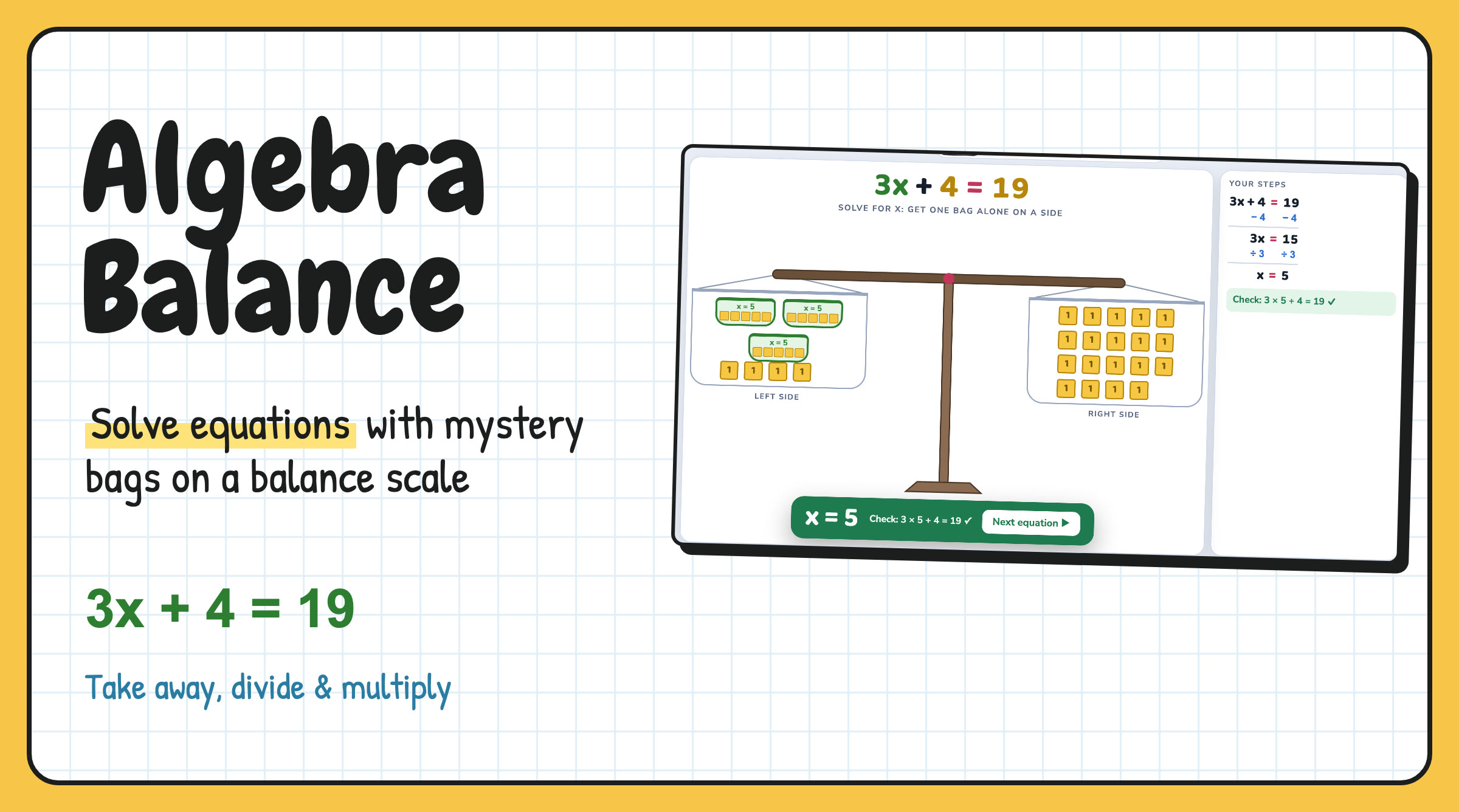
Algebra Balance is a digital tool that makes the rule something students can see: every equation sits on a balance scale, and the scale only stays level when both sides are equal.
Green mystery bags stand for x and yellow tiles are worth 1. Students take away, divide or multiply both sides until one bag is alone, then type what is inside it, and every bag opens to check. It covers one-step and two-step equations, x on both sides and story problems.
Watch it in action
The tool runs in any web browser. There's nothing to print, cut or laminate, and students don't need logins.
Bags, tiles and a scale
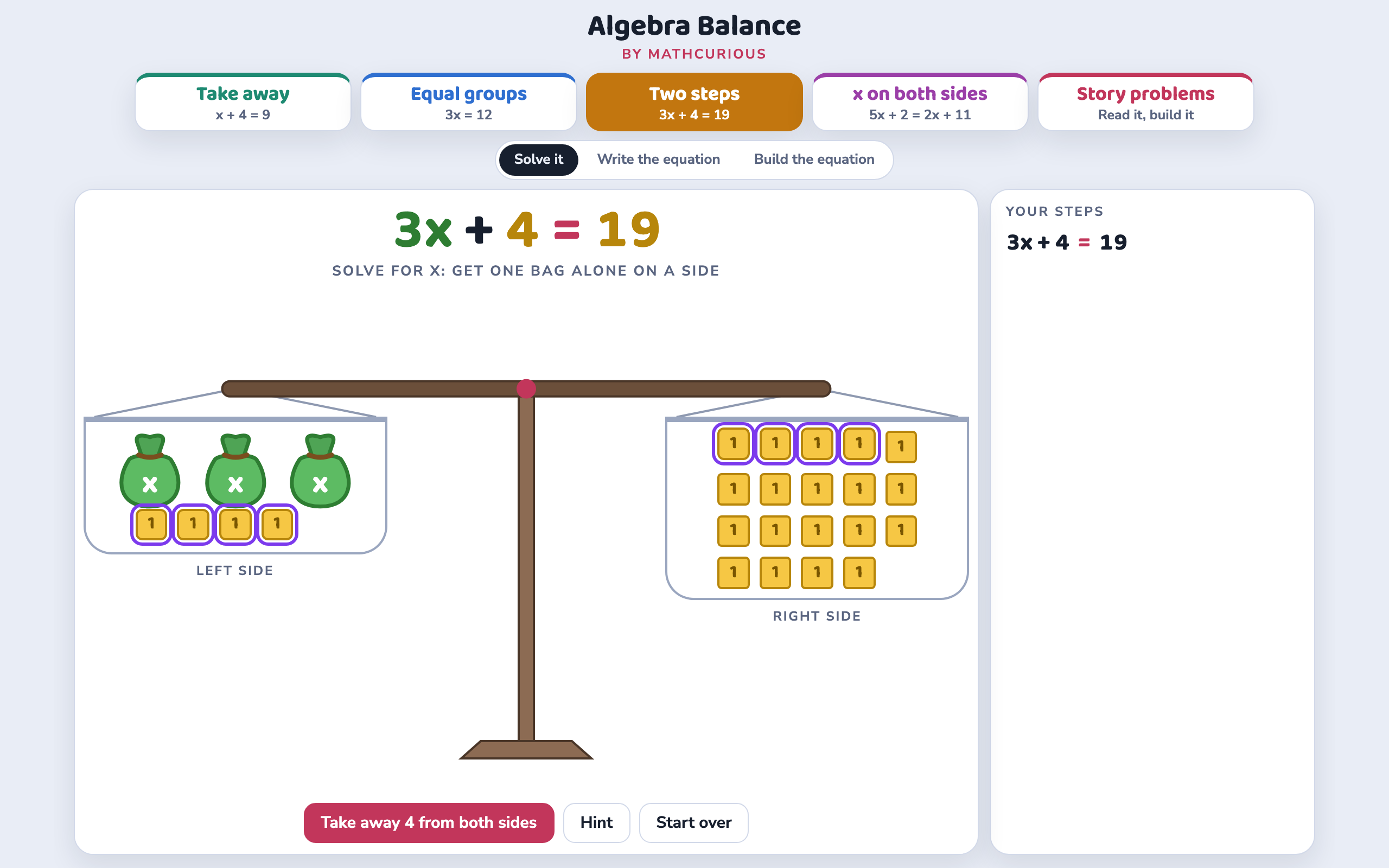
3x + 4 = 19 is three bags and 4 tiles on the left, balancing 19 tiles on the right. Every bag holds the same number, and that number is x.
- Pick pieces by tapping them or drawing a loop around them.
- The scale shows what would happen before the move is made. Pick the same on both sides and it stays level.
- The button names the move: pick 4 tiles on each side and it reads "Take away 4 from both sides".
The scale tips when the sides don't match
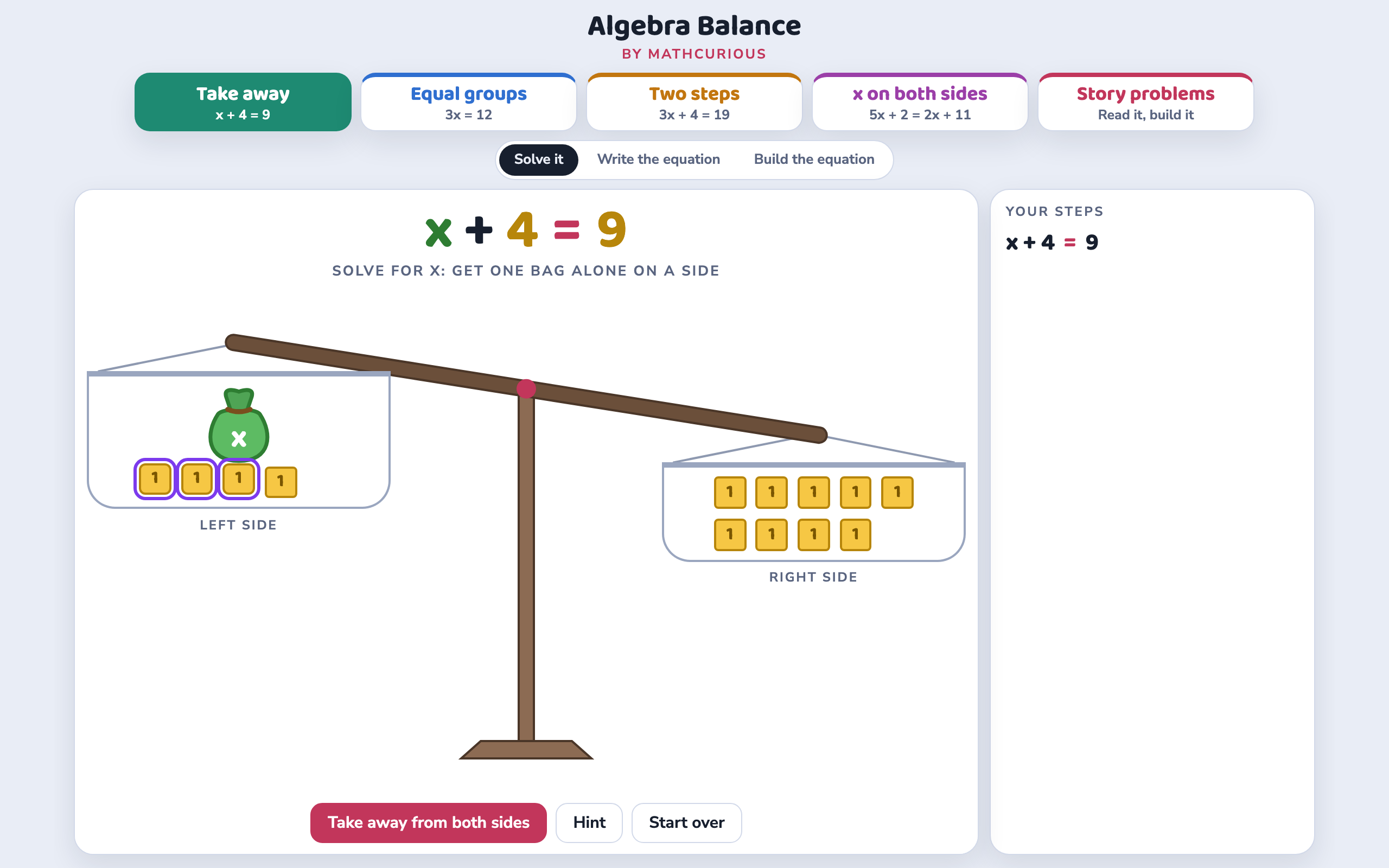
Pick tiles on one side only and the scale tips. Students don't have to be told the rule; they watch what breaks it. This is the moment to ask: "What do we need to do to the other side to keep it balanced?"
Take away, divide or multiply
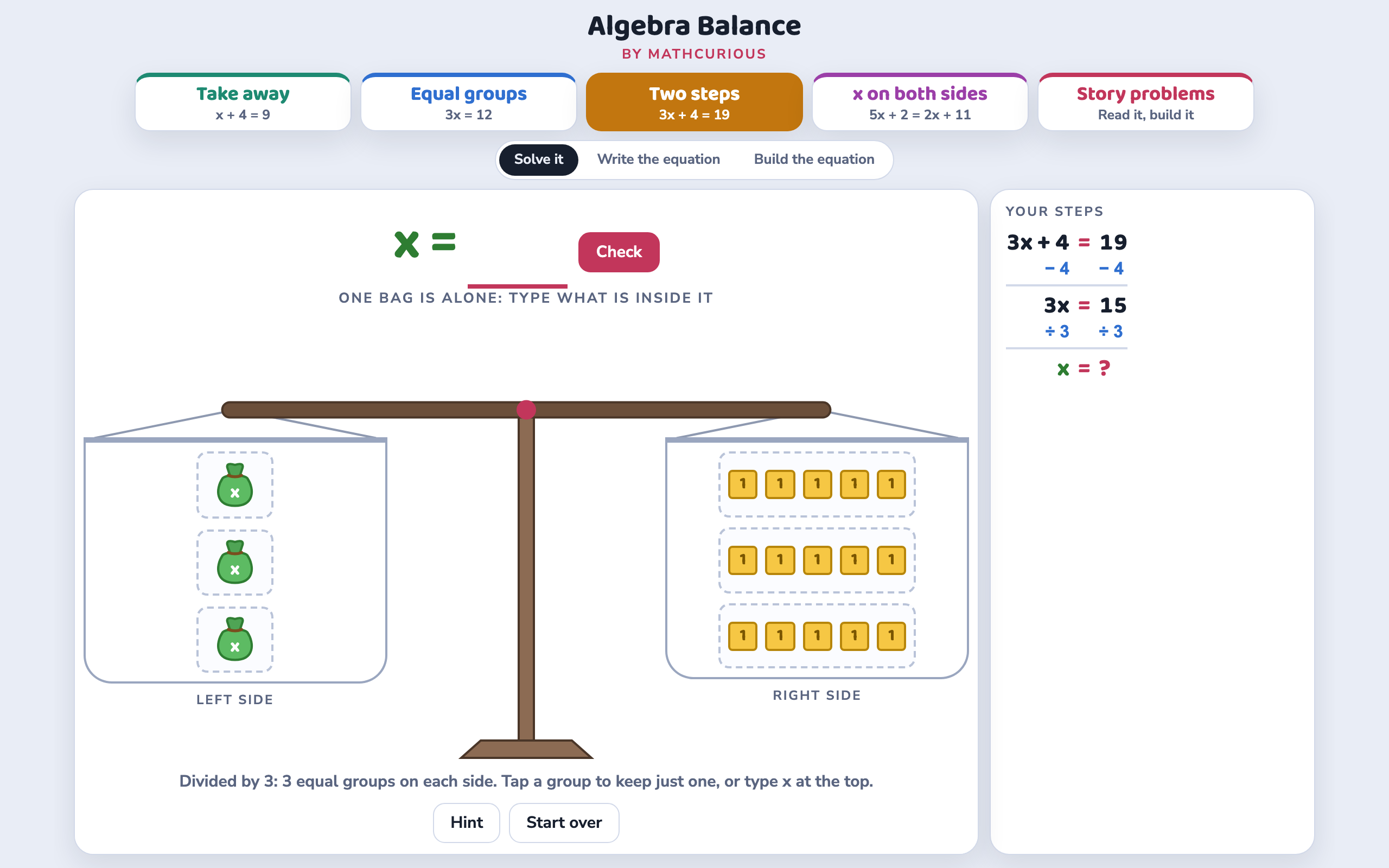
Students choose every move and every number themselves:
- Take away the same bags or tiles from both sides.
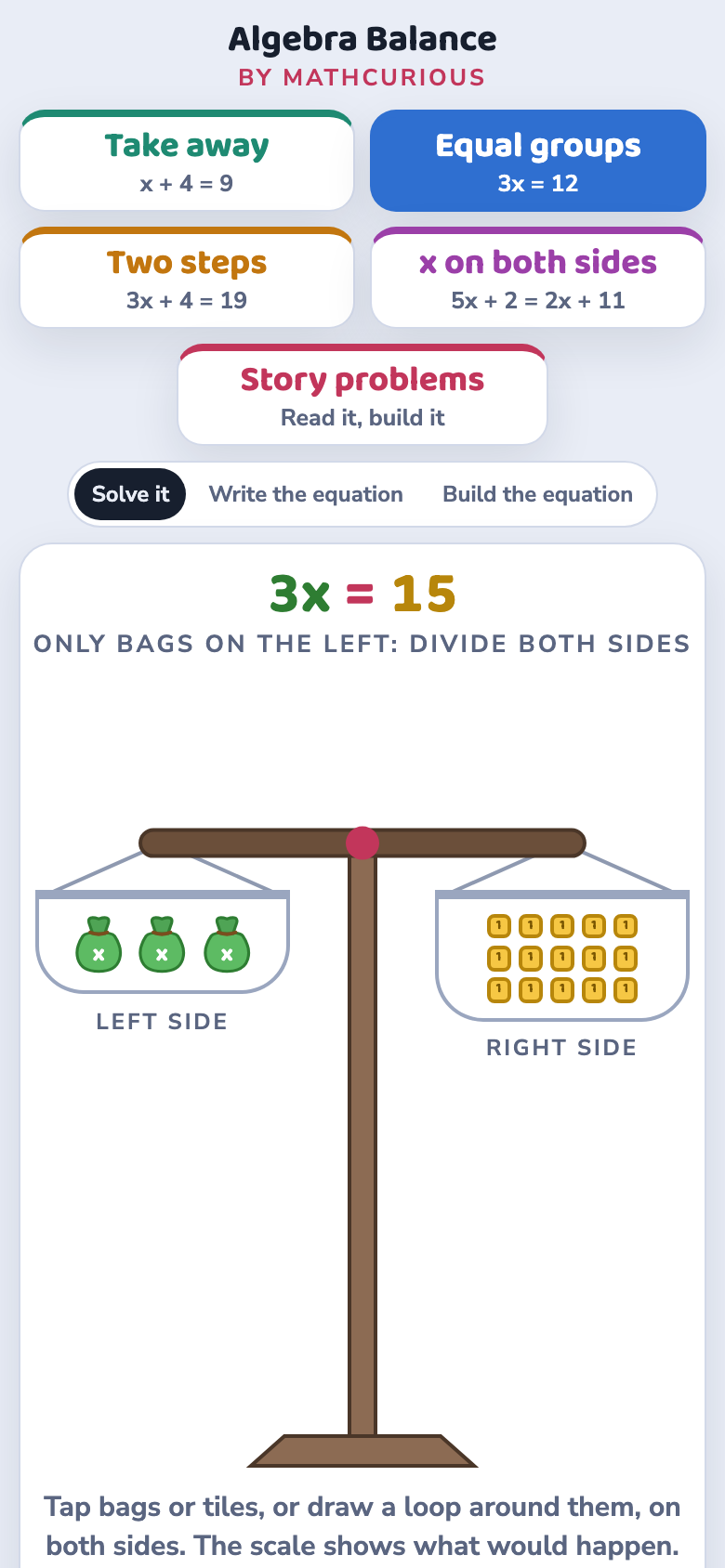
- Divide both sides by a number they type. Each side splits into equal groups, so 3x = 15 shows three groups of one bag and three groups of 5 tiles. A number that doesn't share equally gets a reason, like "3 bags can't share into 2 equal groups".
- Multiply both sides by a number, to undo a division.
A move only shows up when it can be used on the equation on the scale, so students focus on the choice that matters.
Steps written as equations
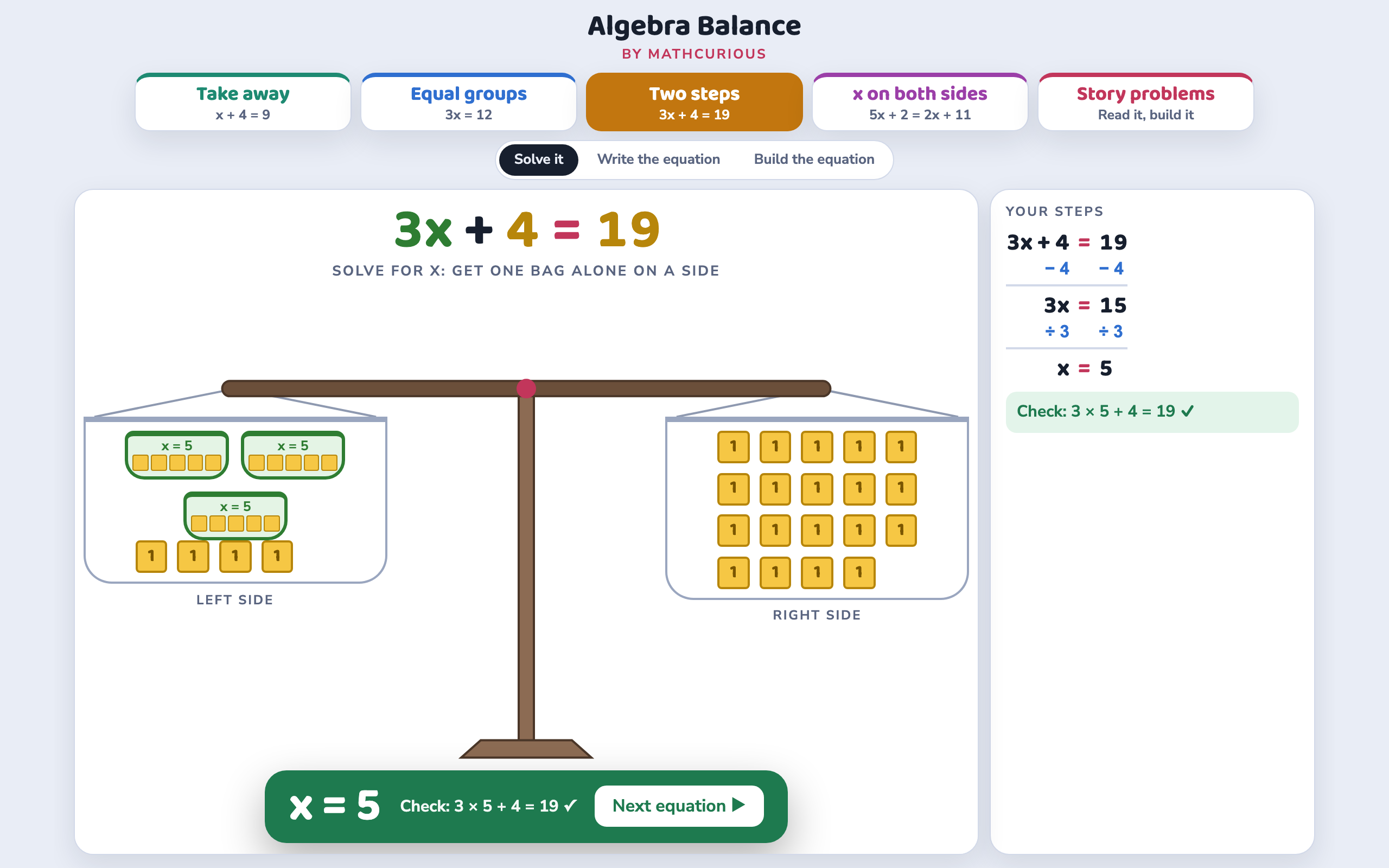
Every move is written in the steps panel as a new line, the way students would write it on paper: 3x + 4 = 19, then − 4 on both sides, then 3x = 15, then ÷ 3, then x = 5. When one bag is alone, students type x at the top. A wrong answer gets a hint; a right one opens every bag to show 5 tiles inside, with the check written out: 3 × 5 + 4 = 19.
x on both sides
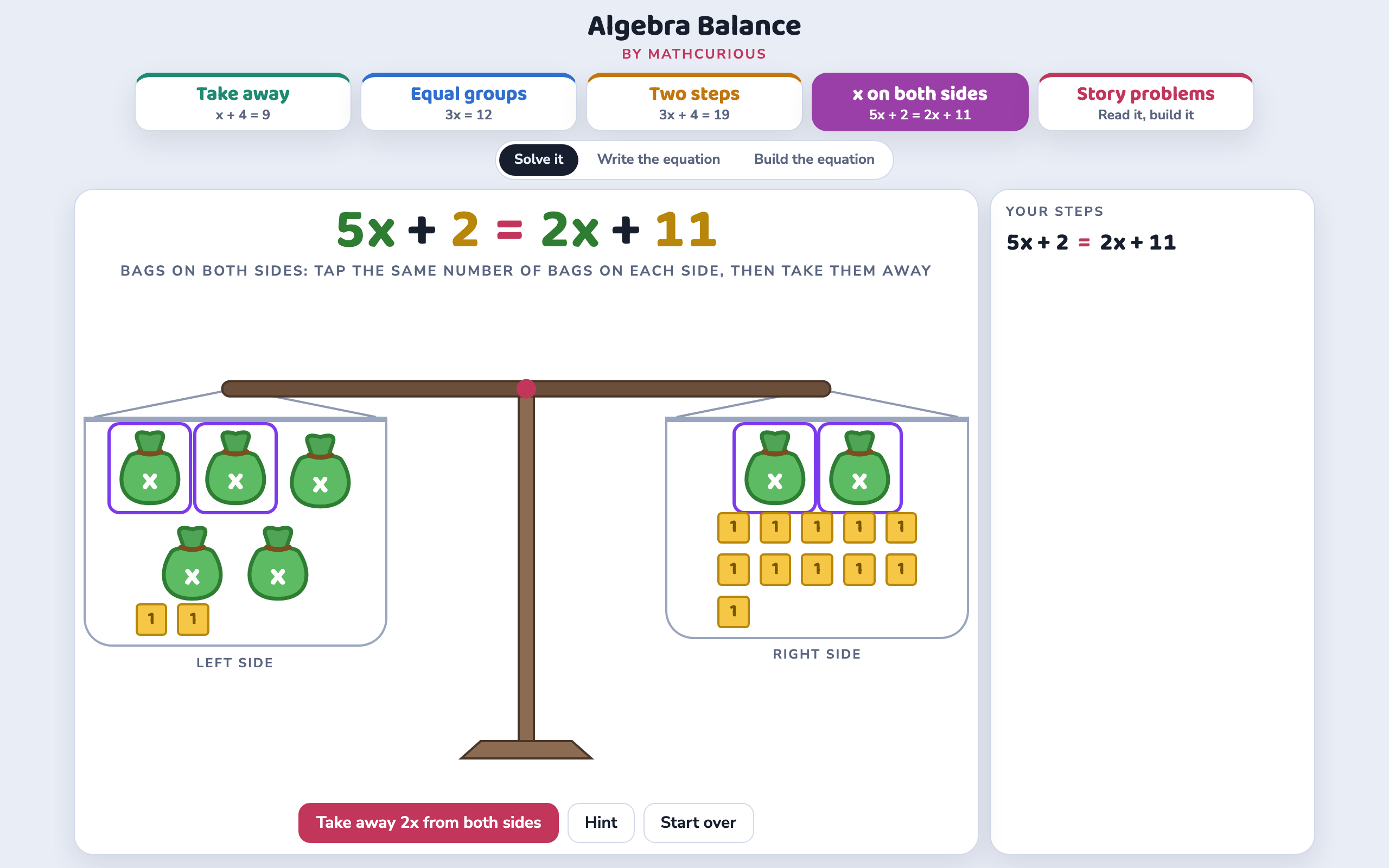
With bags on both sides, students take away bags first, then tiles, then divide. 5x + 2 = 2x + 11 becomes 3x + 2 = 11, then 3x = 9, then x = 3. Seeing two bags leave each side makes "subtract 2x from both sides" feel obvious.
x ÷ 4 = 5: undo it with multiply
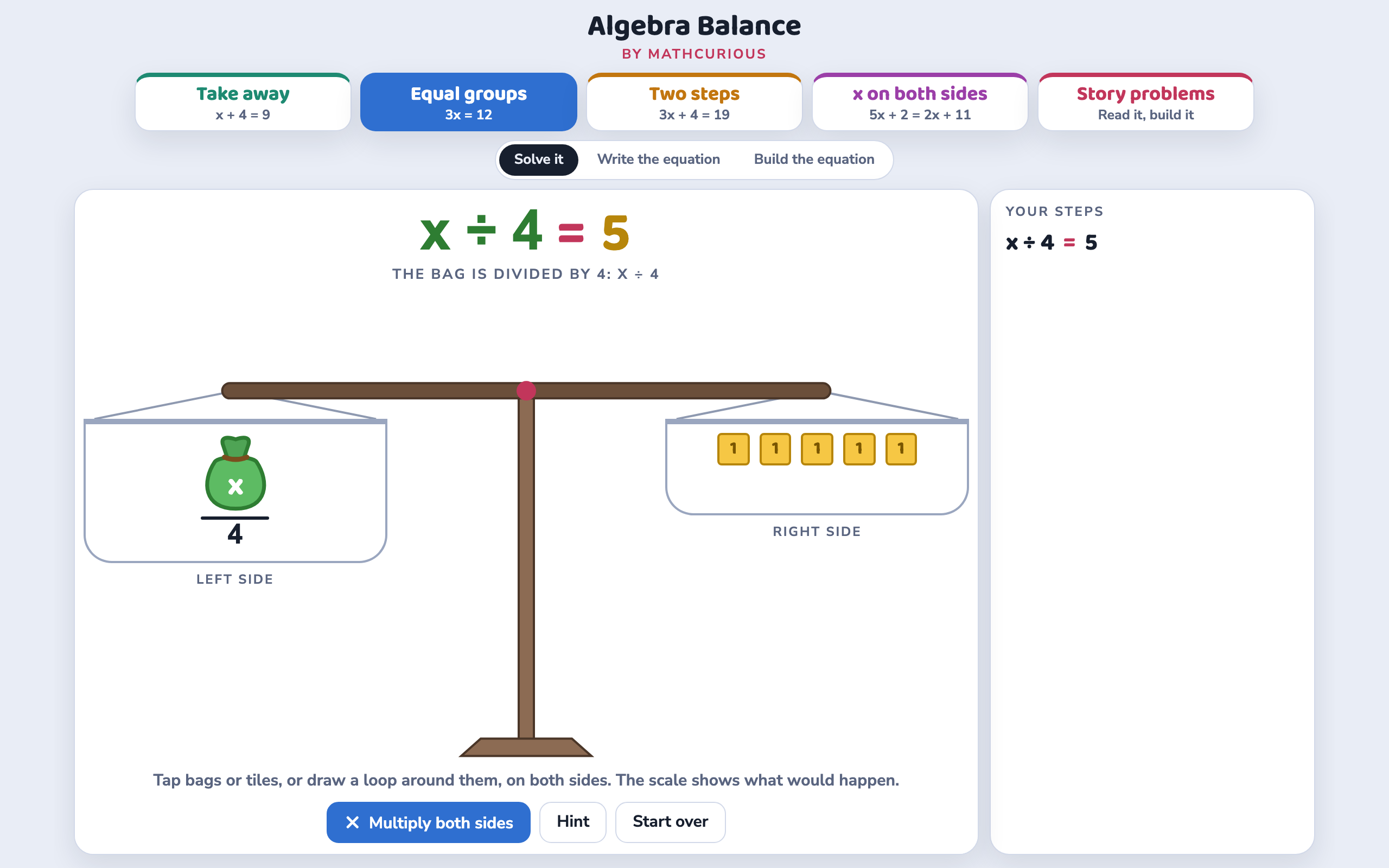
x ÷ 4 is shown as a whole bag over a line over 4, written like a fraction. The bag is never cut up. To undo it, students multiply both sides by 4:
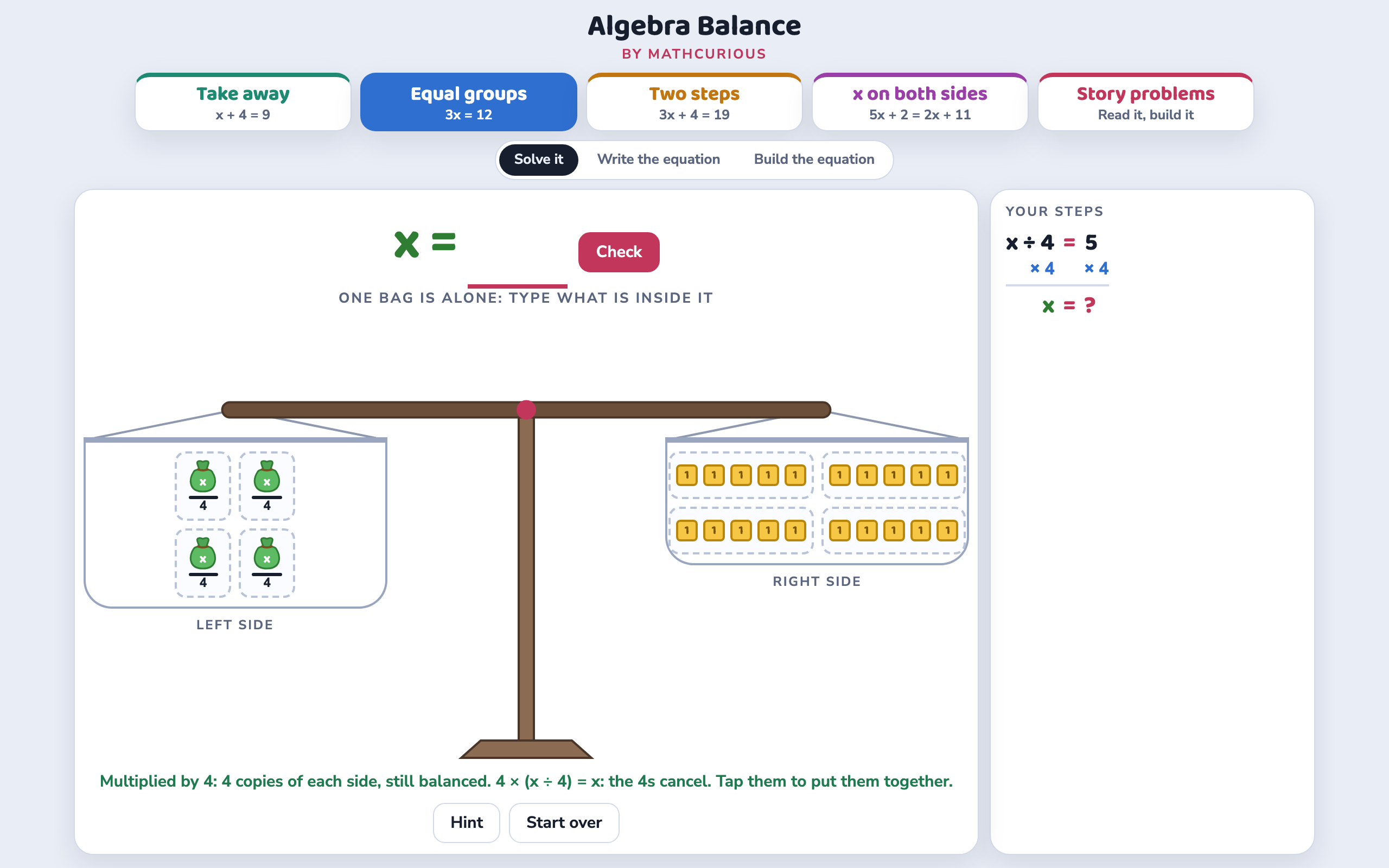
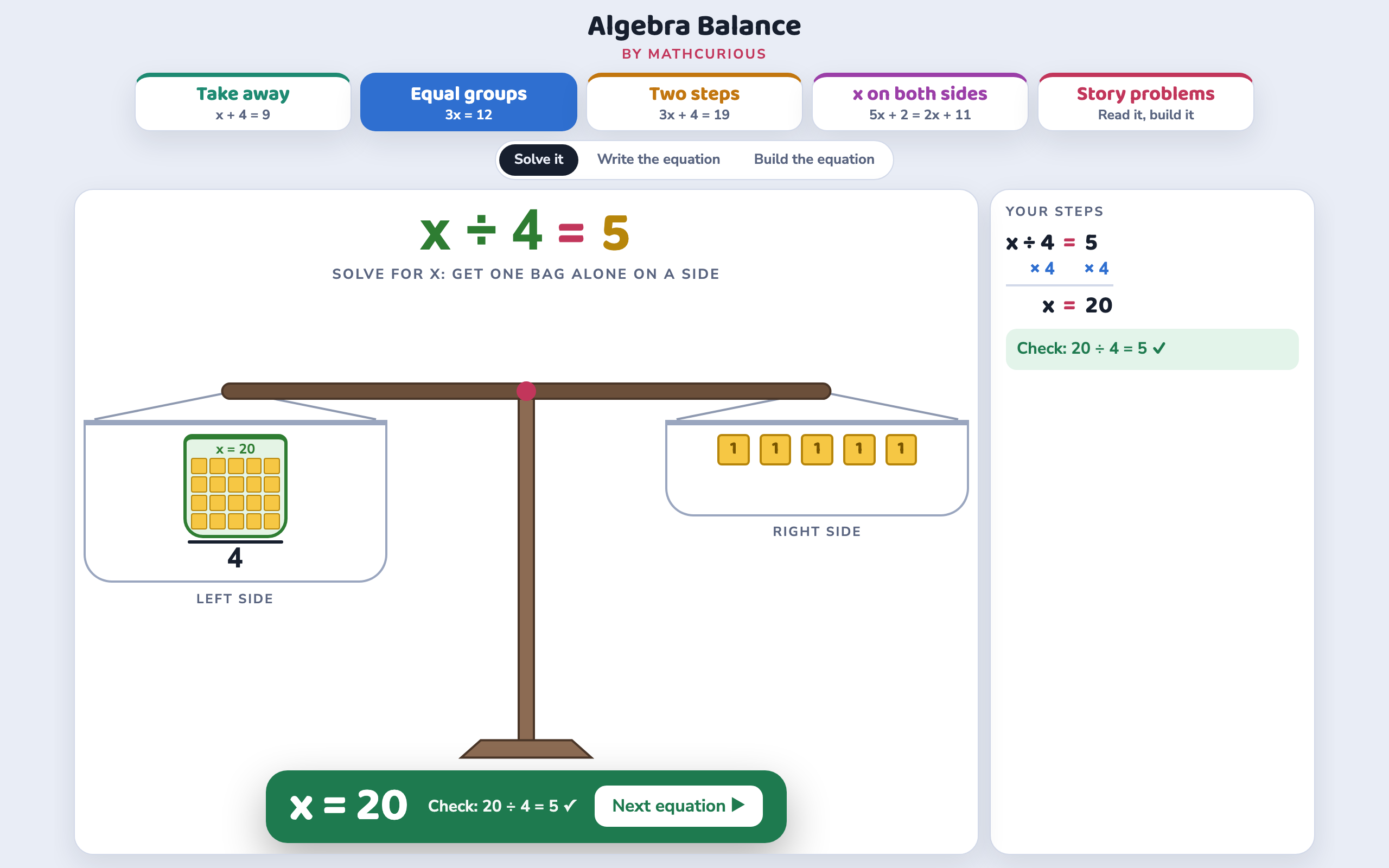
Each side gets 4 copies. When students tap to put them together, the 4s cancel and one whole bag balances 20 tiles. Open it, and there are 20 inside: 20 ÷ 4 = 5.
These equations come in after students have practised taking away and dividing: the first three rounds of Equal groups and Two steps use whole bags only.
Five levels
- Take away: x + 4 = 9
- Equal groups: 3x = 12, and later x ÷ 4 = 5
- Two steps: 3x + 4 = 19, and later x ÷ 3 + 2 = 6
- x on both sides: 5x + 2 = 2x + 11
- Story problems: read it, build it, solve it
Every level makes new equations each time, so there's always another one to try.
Story problems: build the story
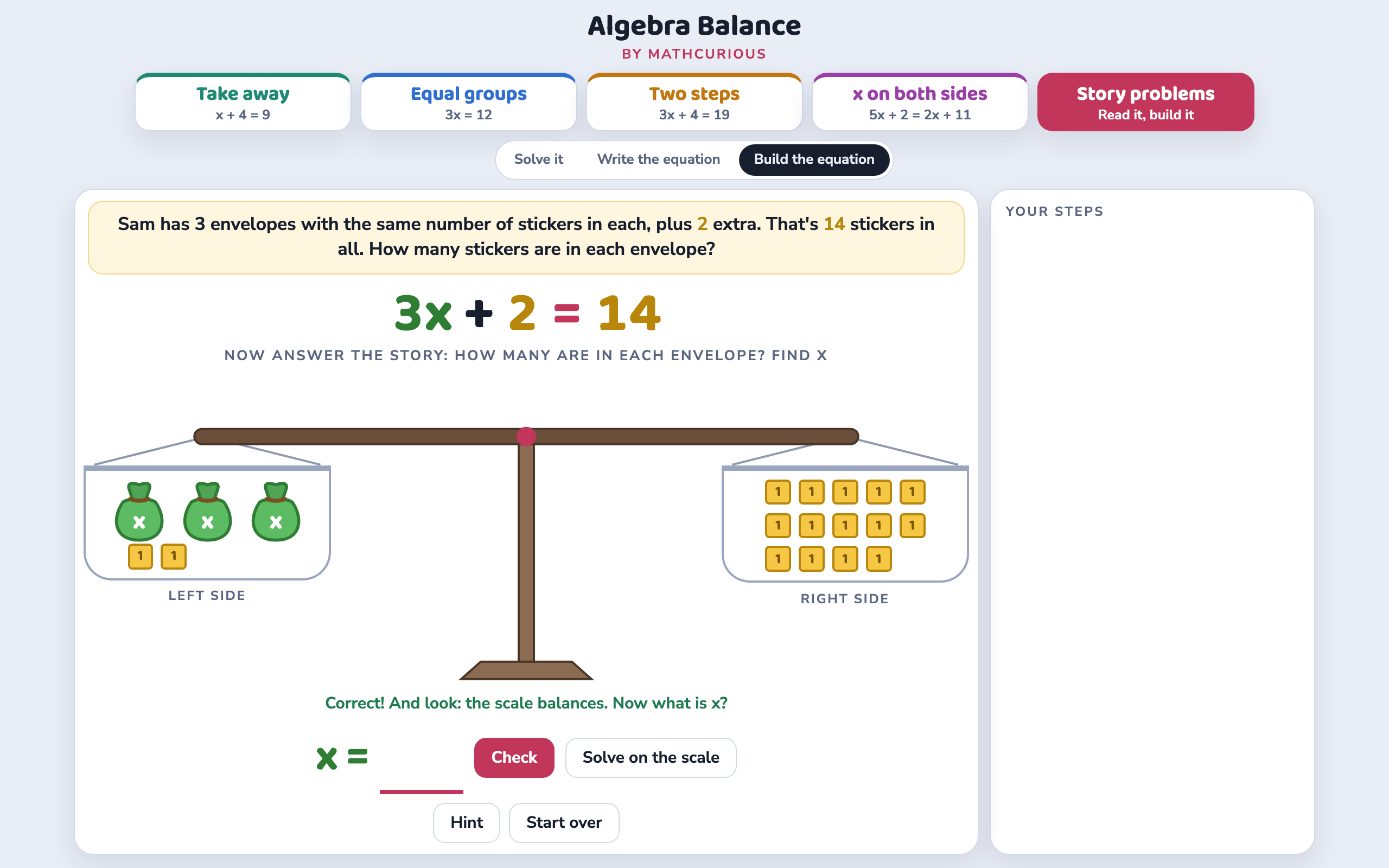
In Story problems, students read a short story, like envelopes of stickers with a few extra, and build it on the scale: each envelope is a bag. Once the scale matches the story, they find how many are in each envelope, and the answer is given back in the story's words.
Three ways to play
- Solve it: the equation is on the scale; get one bag alone.
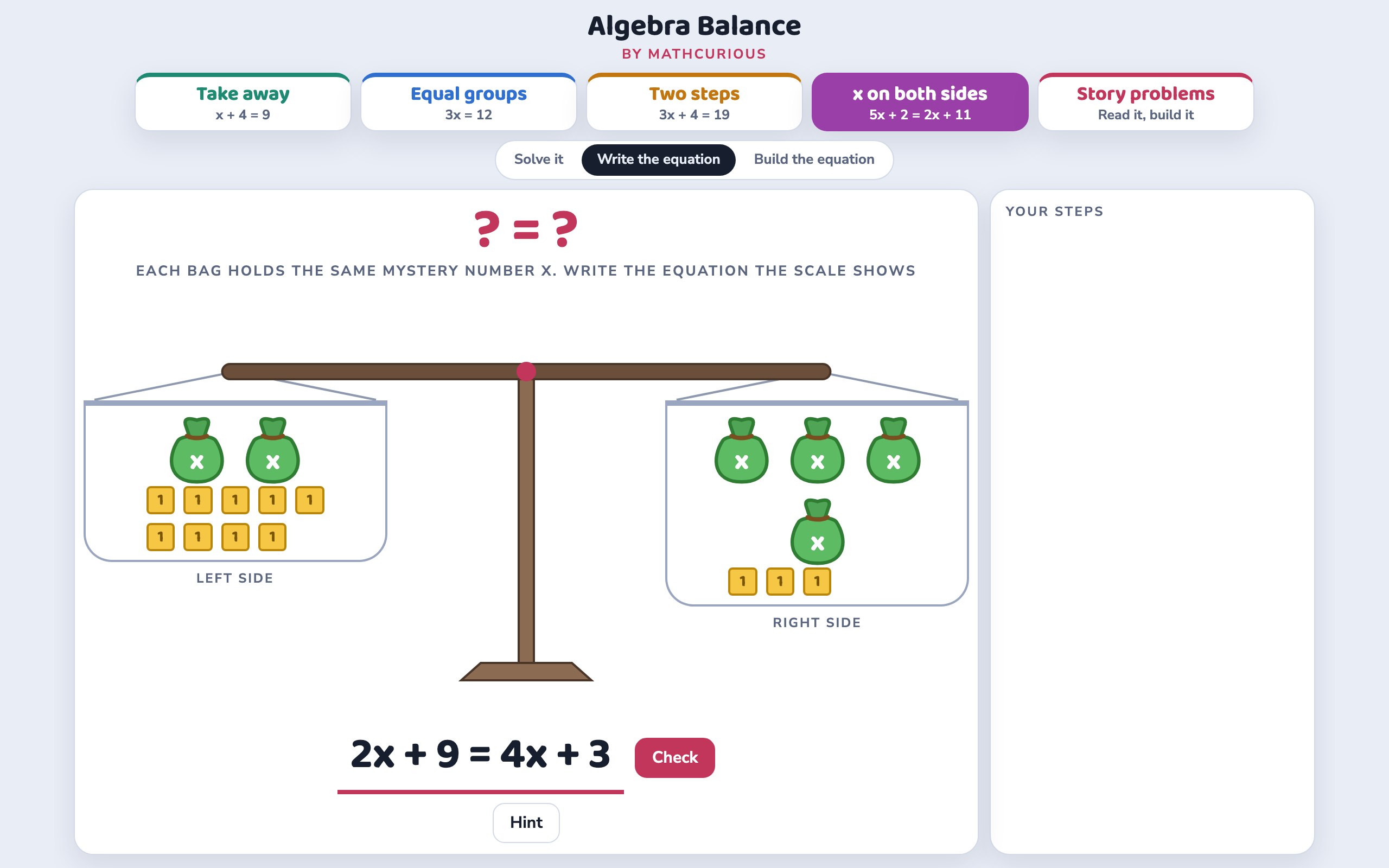
- Write the equation: the scale shows the pieces, and students type the equation it shows, then find x.
- Build the equation: students put bags and tiles on the scale to match an equation or a story, then find x or solve it on the scale.
What students practise
- One-step and two-step equations, like 3x = 12 and 3x + 4 = 19
- Equations with x on both sides
- Inverse operations: subtraction undoes addition, division undoes multiplication, multiplication undoes division
- Writing equations from a model and from a word problem
- Checking a solution by putting it back into the equation
Teaching tips
- Ask before every move: "What could we take off both sides and keep it balanced?"
- Tip it on purpose. Pick pieces on one side only and ask why the scale tipped.
- Read x from a group. After dividing, ask students what one group shows before they tap to keep it.
- Name the undo. For x ÷ 4 = 5, ask "What undoes divide by 4?" before anyone multiplies.
- Read the steps aloud as equations at the end, so the scale and the written method meet.
Standards
- 6.EE.B.5, 6.EE.B.6 and 6.EE.B.7: understand solving as finding the value that makes an equation true; write and solve one-step equations
- 7.EE.B.4a: solve equations of the form px + q = r
- 8.EE.C.7: solve linear equations, including those with the variable on both sides
Quick answers
Do students need accounts? No. It's a link, so there's nothing to sign in to.
What devices does it work on? Any device with a web browser, including Chromebooks, tablets, and the classroom board.
Is it like algebra tiles? It uses the same idea, a piece for x and pieces for 1, on a balance scale, so the "both sides" rule is built in. It works well alongside the algebra tiles in your classroom.
Get Algebra Balance
Give students a scale they can see, and "do the same to both sides" stops being a rule to memorise.