Mental Math Strategies for Addition and Subtraction: 117 Self-Checking Problems
Ask a class to work out 47 + 29 in their heads and you'll hear a dozen different answers about how. One student lines the numbers up and carries the one in the air. Another thinks "29 is almost 30, so 47 + 30 is 77, then take 1 away: 76." The second student isn't faster because they're better at arithmetic. They're faster because they have a strategy.
Mental math strategies give students that kind of flexible thinking. They build number sense, they lean on place value and the properties of addition and subtraction, and they make estimating and checking answers much easier.
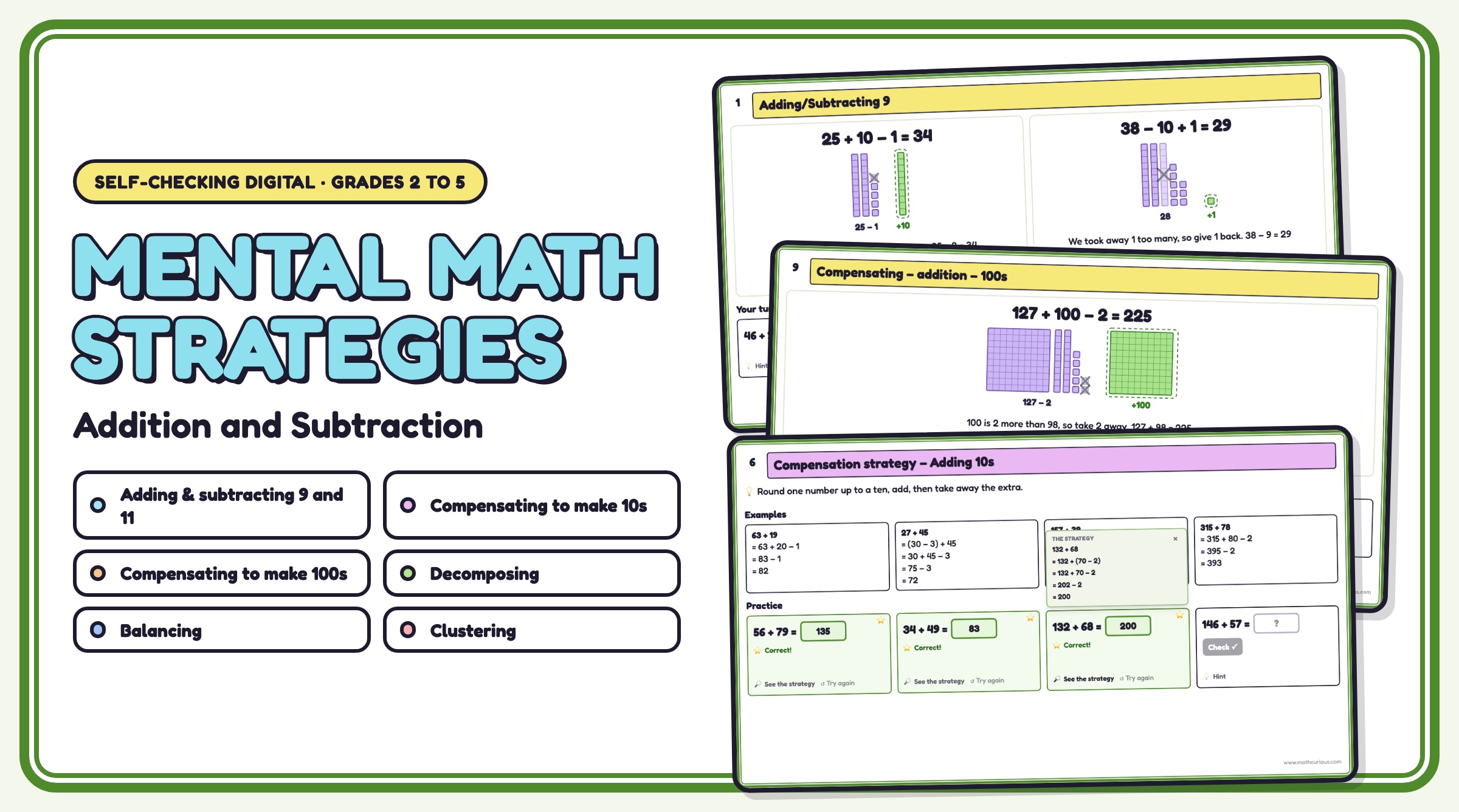
Mental Math Strategies: Addition and Subtraction is a self-checking digital version of our classroom slide deck for grades 2 to 5. It has 30 slides, base-ten block explanations for each strategy and 117 problems that check themselves.
Watch it in action
It plays in any web browser, one slide at a time, just like the deck. There's nothing to print, cut or laminate, and students don't need logins.
The mental math strategies
Start with the properties
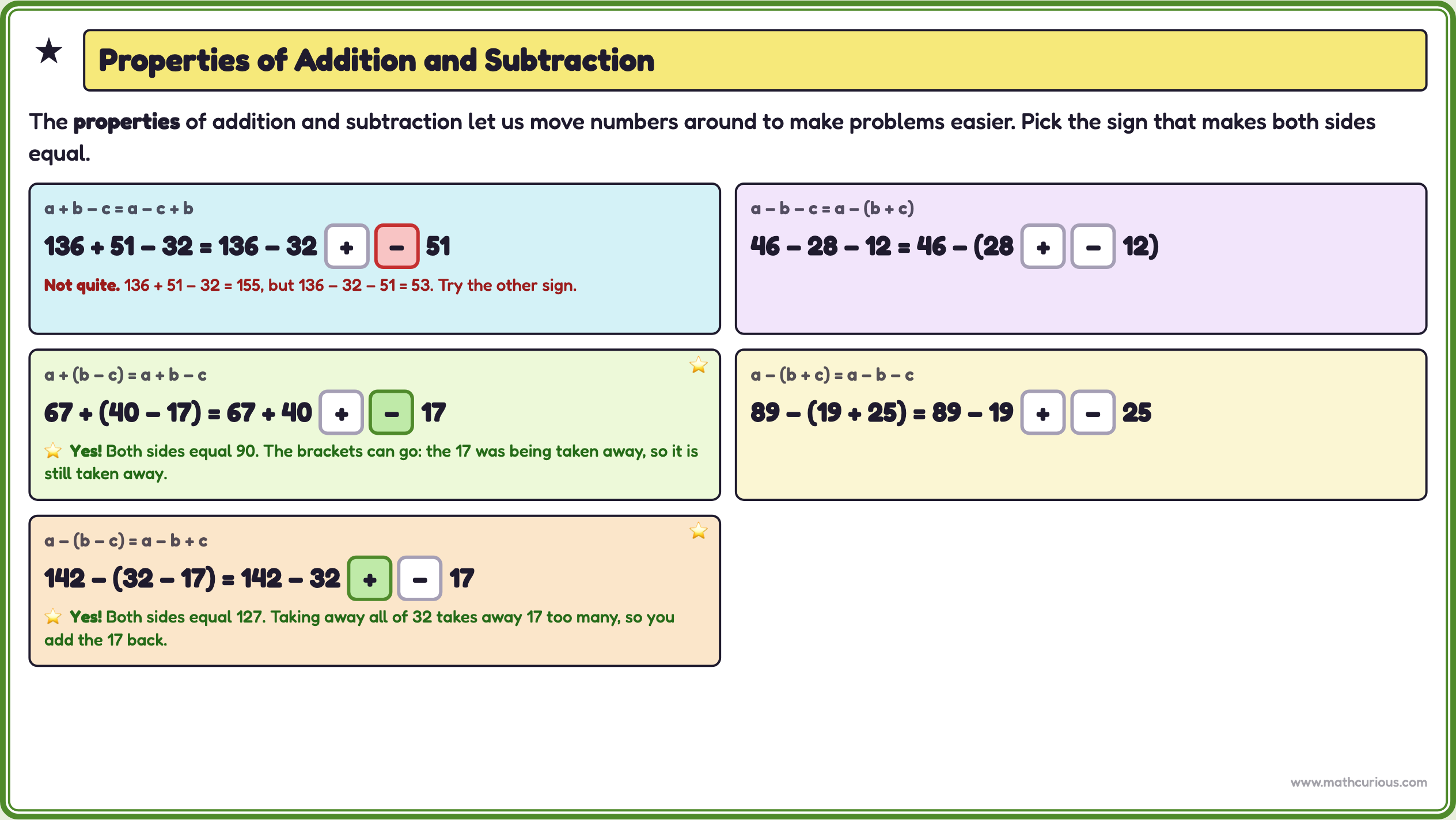
Every strategy below works because of the properties of addition and subtraction. You can add and subtract in any order, take away a group all at once, or remove brackets as long as you keep track of the signs:
- 136 + 51 − 32 = 136 − 32 + 51
- 46 − 28 − 12 = 46 − (28 + 12)
- 142 − (32 − 17) = 142 − 32 + 17
That last one surprises students: taking away all of 32 takes away 17 too many, so the 17 is added back. In the game, students pick the sign that keeps both sides equal, and a wrong pick shows why it doesn't work.
1. Adding and subtracting 9 and 11
9 is 1 less than 10, and 11 is 1 more. So use 10 and fix the extra 1.
- 25 + 9 = 25 + 10 − 1 = 34
- 38 − 9 = 38 − 10 + 1 = 29
- 178 − 11 = 178 − 10 − 1 = 167
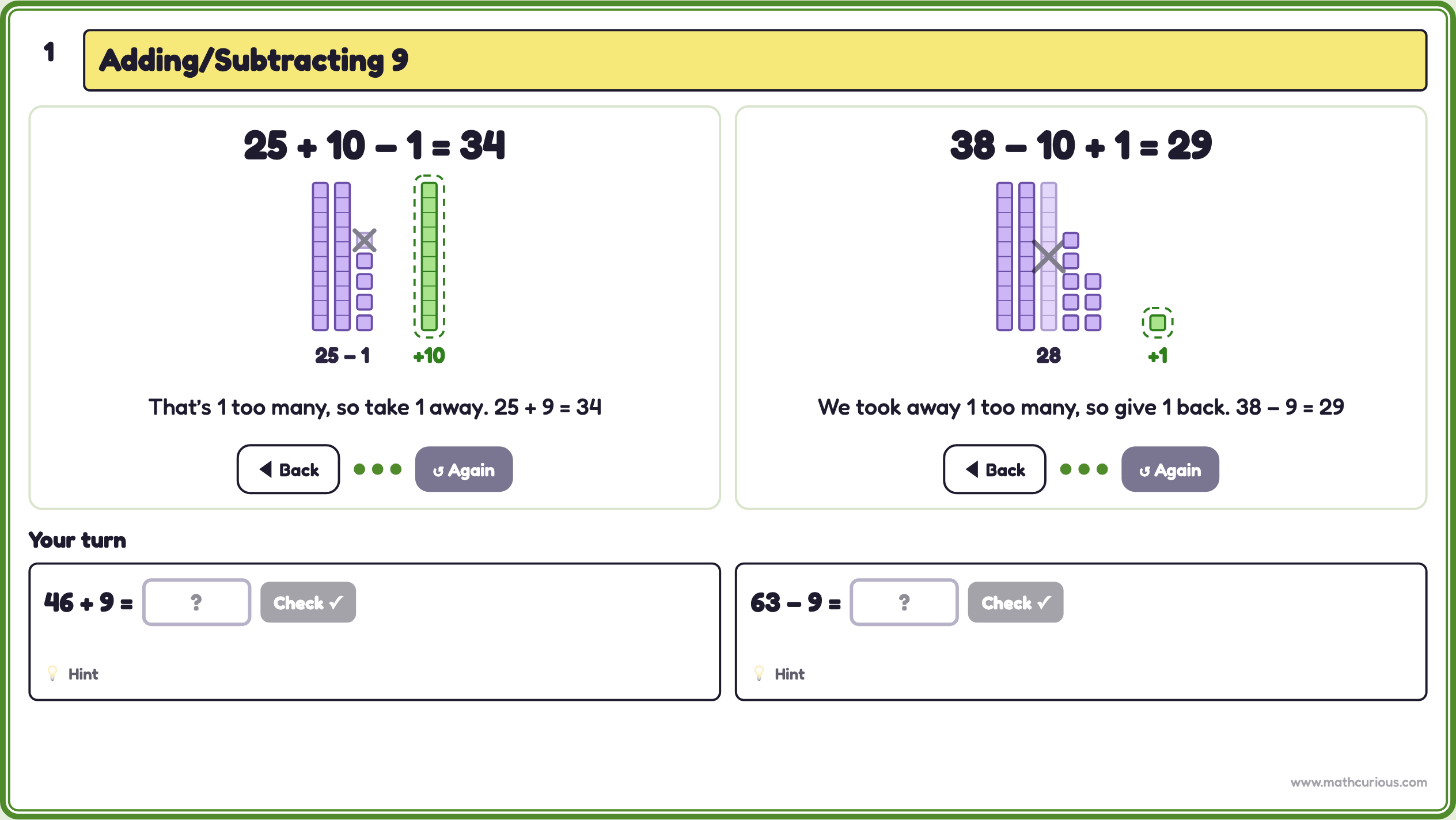
With base-ten blocks it's easy to see: add a whole ten rod, then cross out the one cube that was too many.
2. Compensating to make 10s
Round one number to a ten, work it out, then fix the difference. There are three versions, and the deck has a slide for each:
- Round an addend: 63 + 19 = 63 + 20 − 1 = 82
- Round the number you take away (the subtrahend): 73 − 19 = 73 − 20 + 1 = 54
- Round the first number (the minuend): 52 − 15 = 50 − 15 + 2 = 37
The subtraction ones are where students slip. If you take away 20 instead of 19, you took away 1 too many, so you add 1 back.
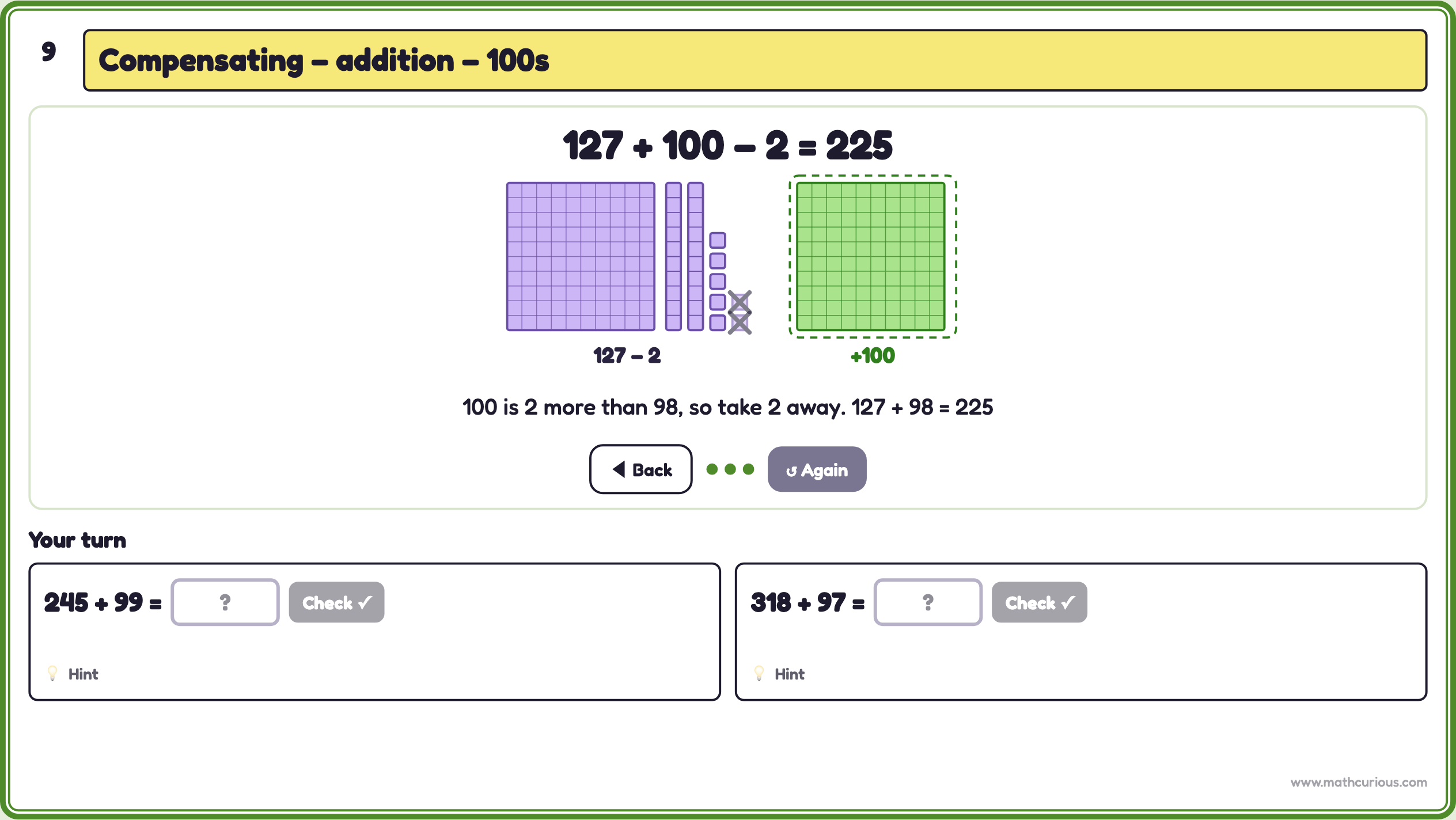
3. Compensating to make 100s
The same idea with hundreds, for numbers close to 100, 200 or 300.
- 127 + 98 = 127 + 100 − 2 = 225
- 135 − 97 = 135 − 100 + 3 = 38
- 198 − 75 = 200 − 75 − 2 = 123
4. Decomposing to compatible numbers
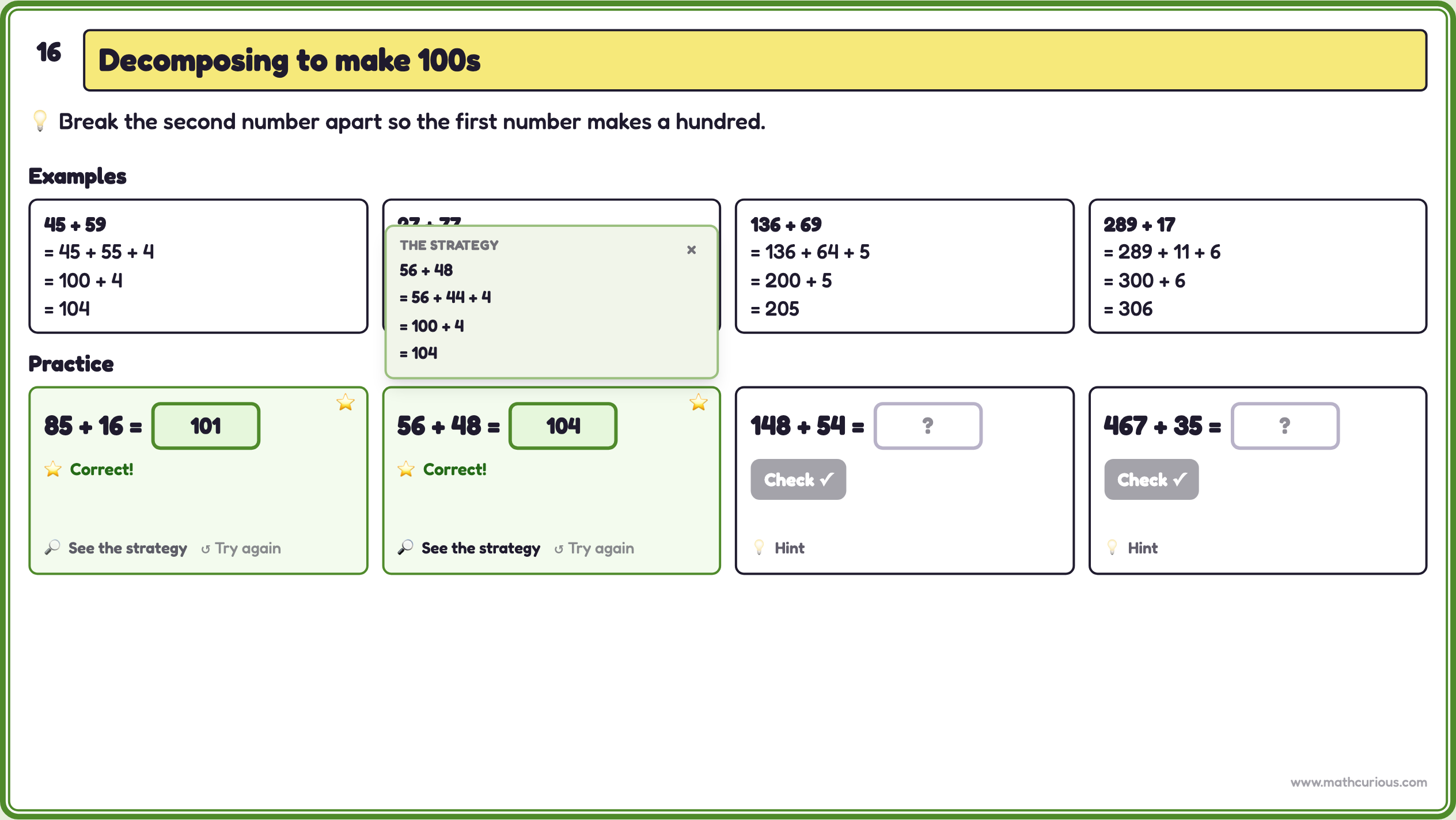
Break one number apart so the other one lands on a ten or a hundred.
- 55 + 27 = 55 + 25 + 2 = 80 + 2 = 82
- 67 − 39 = 67 − 37 − 2 = 30 − 2 = 28
- 136 + 69 = 136 + 64 + 5 = 200 + 5 = 205
In 67 − 39, taking away 37 first makes the ones disappear, and 30 − 2 is easy.
5. Balancing
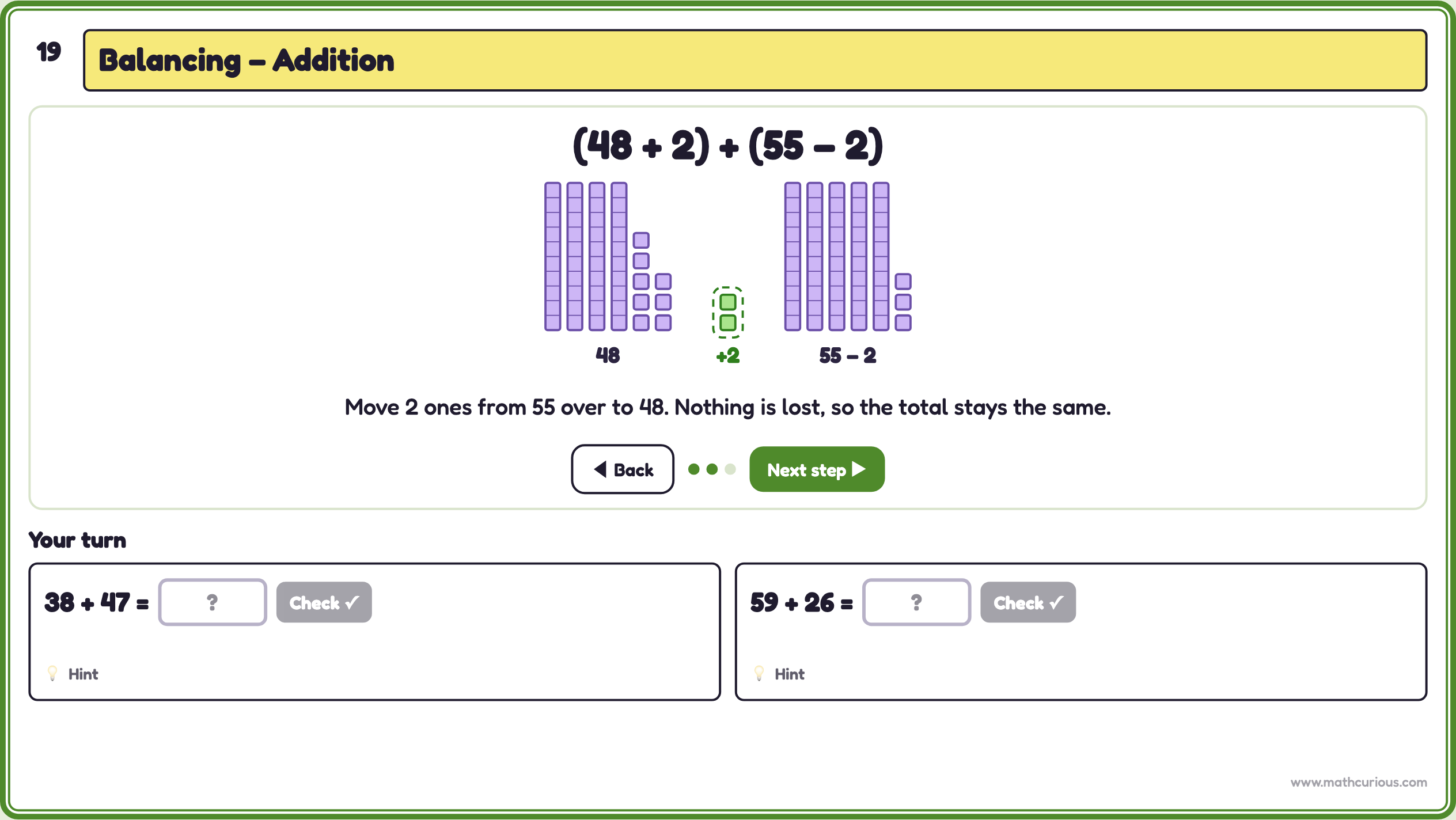
For addition, move some from one number to the other. Nothing is lost, so the total stays the same: 48 + 55 = 50 + 53 = 103.
For subtraction, add or take away the same amount from both numbers. The difference doesn't change, the same way 6 − 4 = 16 − 14 = 106 − 104.
- 62 − 47 = 60 − 45 = 15
- 999 + 561 = 1000 + 560 = 1560
- 1000 − 648 = 999 − 647 = 352, with no regrouping at all
6. Clustering
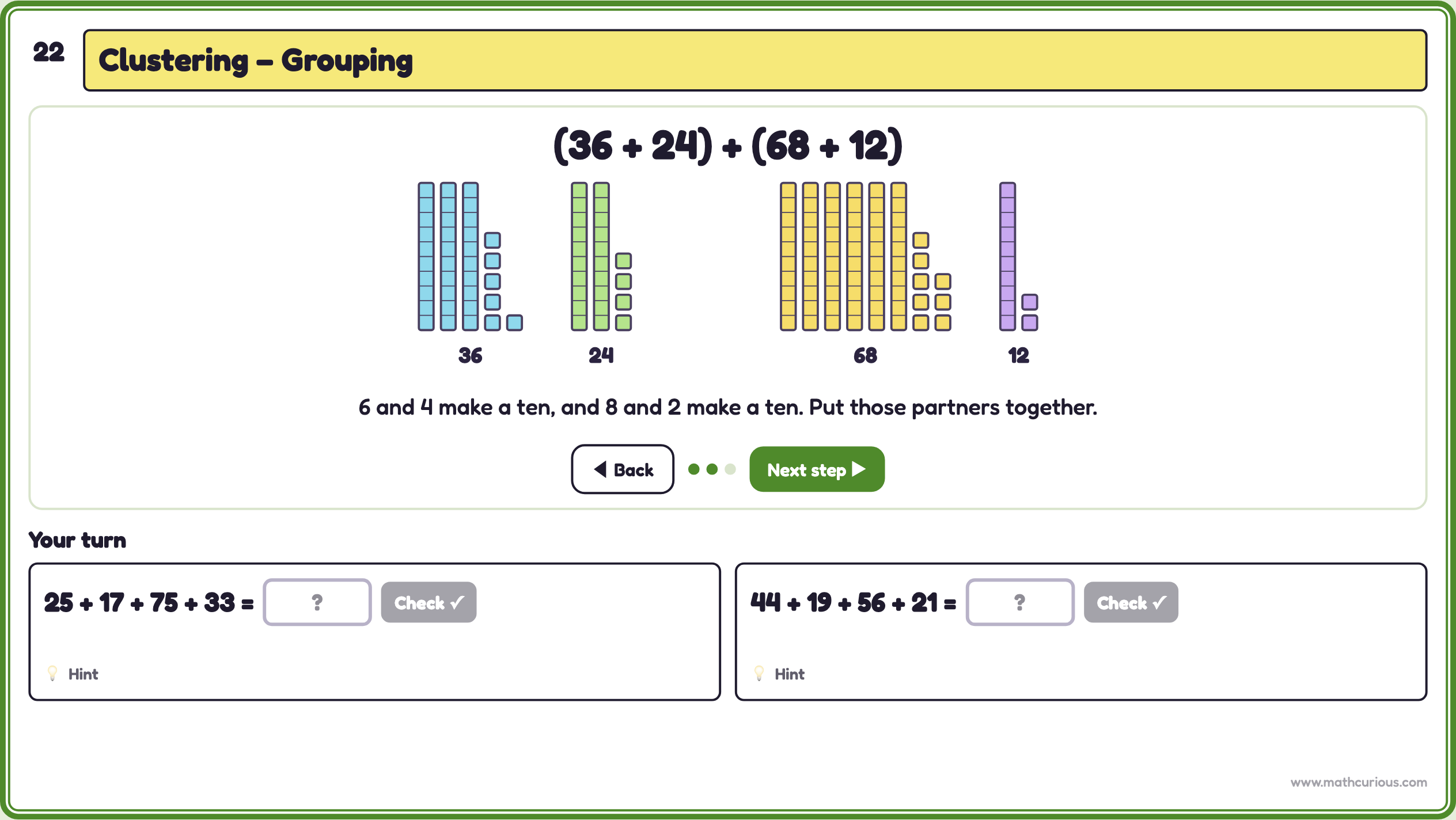
With a list of numbers, group the ones that make friendly tens or hundreds first.
- 36 + 12 + 24 + 68 = (36 + 24) + (68 + 12) = 60 + 80 = 140
- 250 − 25 − 19 − 45 − 61 = 250 − (70 + 80) = 100
For subtraction, add up everything you take away first, then subtract once.
Try these: a free number talk
Put one problem on the board, give students quiet think time, then ask "How did you do it?" Collect two or three different strategies before you reveal the answer.
- 47 + 29
- 83 − 39
- 196 + 48
- 72 − 48
- 25 + 38 + 75 + 12
- 1000 − 368
Answers: 76, 44, 244, 24, 150, 632.
Listen for compensation (47 + 30 − 1), decomposing (196 + 4 + 44), balancing (1000 − 368 = 999 − 367) and clustering (25 + 75 first). Problem 4 is a good one to compare: some students balance to 74 − 50, others decompose to 72 − 42 − 6.
How the self-checking works
Explanation slides with base-ten blocks
Seven slides explain a strategy step by step. Students press Next step to add a ten, cross out a one, give a hundred back or move blocks from one number to the other, with one sentence for each step. Then they try two problems of their own.
Worked examples, then practice
Practice slides look just like the deck: the worked examples at the top and practice problems underneath. Students type an answer and press Check.
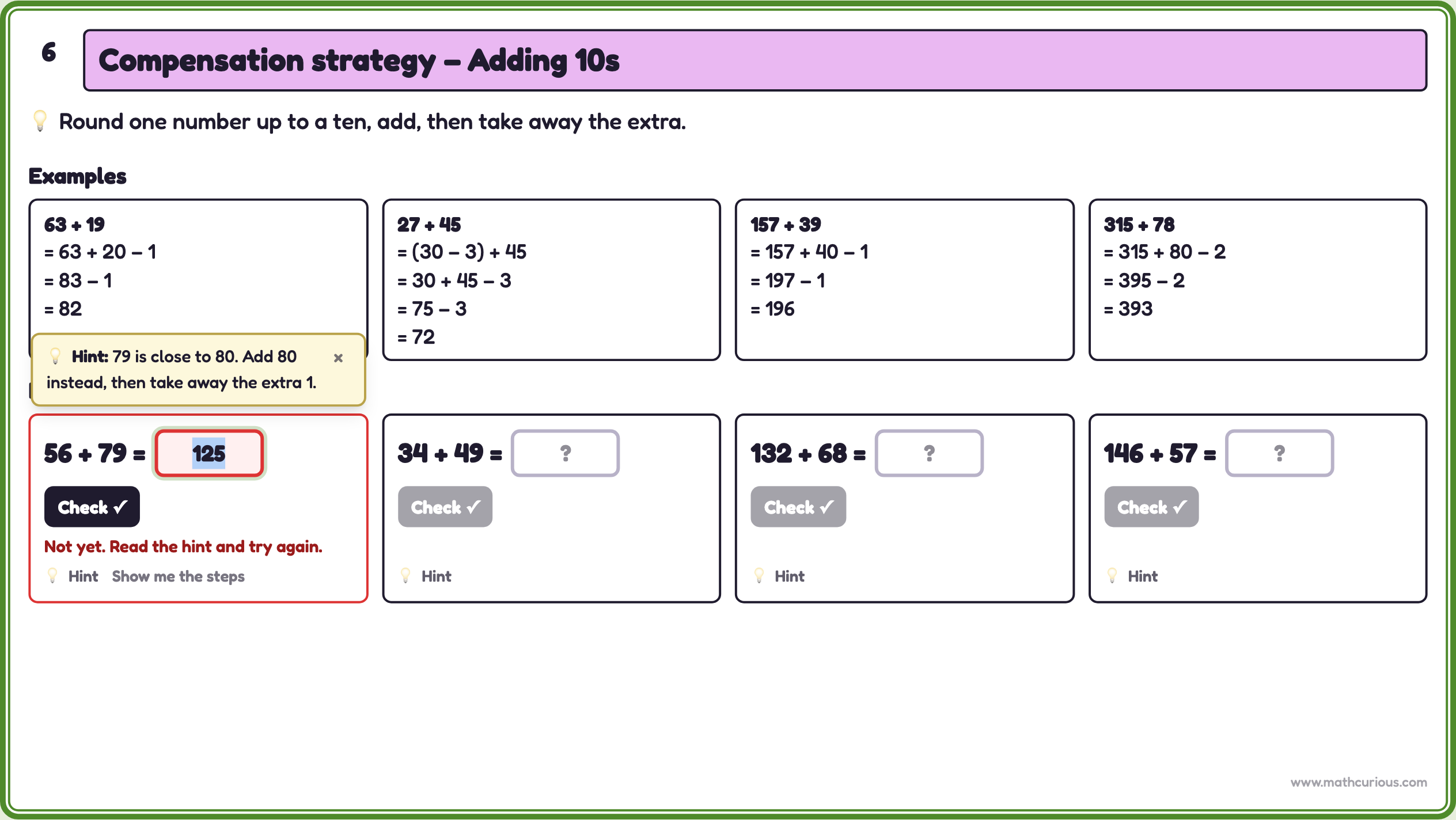
A wrong answer turns the box red and opens a hint for that strategy, like 79 is close to 80. Add 80 instead, then take away the extra 1.
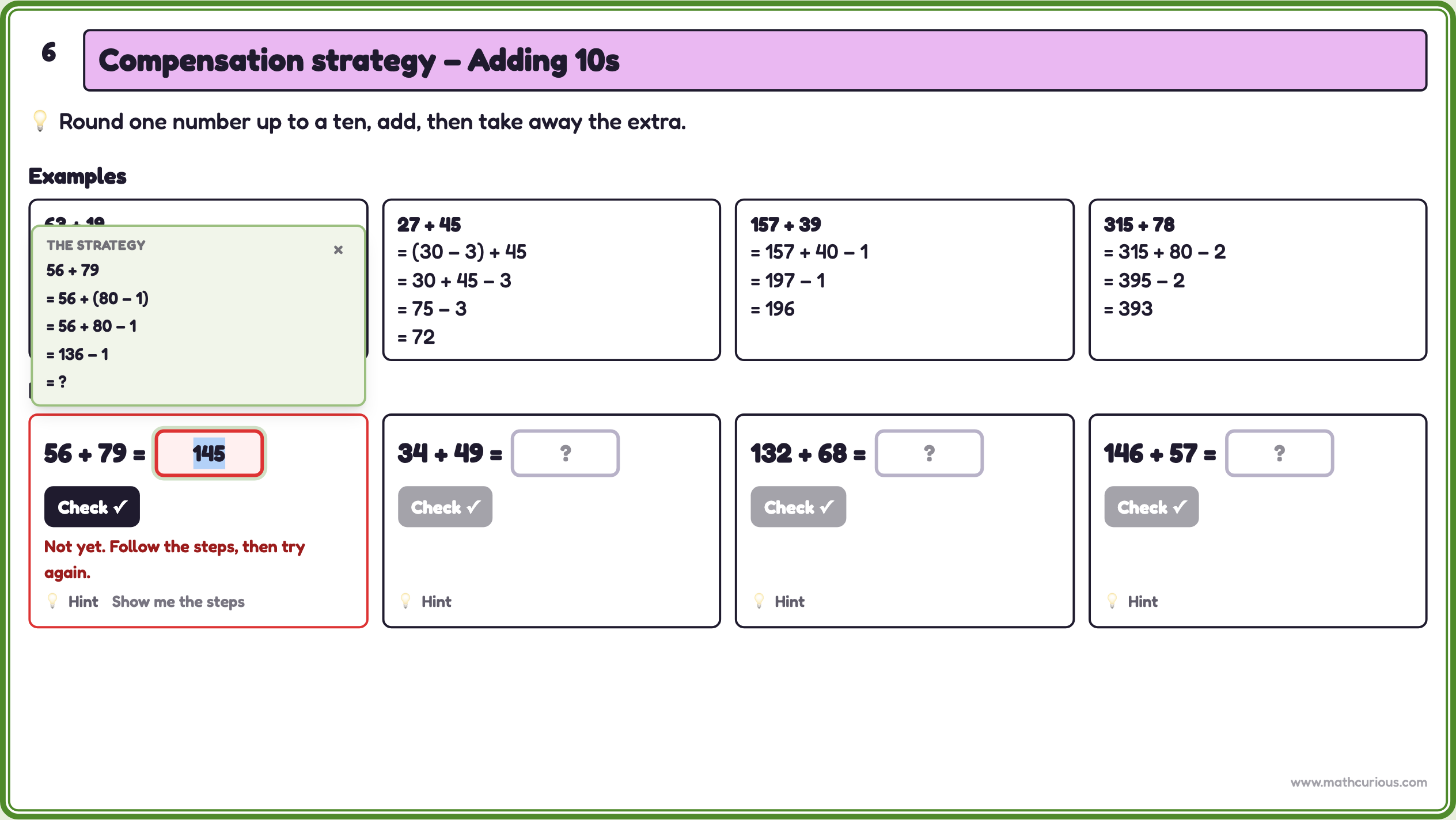
A second wrong answer shows the worked steps with the last line hidden, so students still finish the problem themselves.
A right answer earns a star, as long as the steps weren't opened first. See the strategy shows one way to solve any problem they've finished.
Mixed practice: any strategy
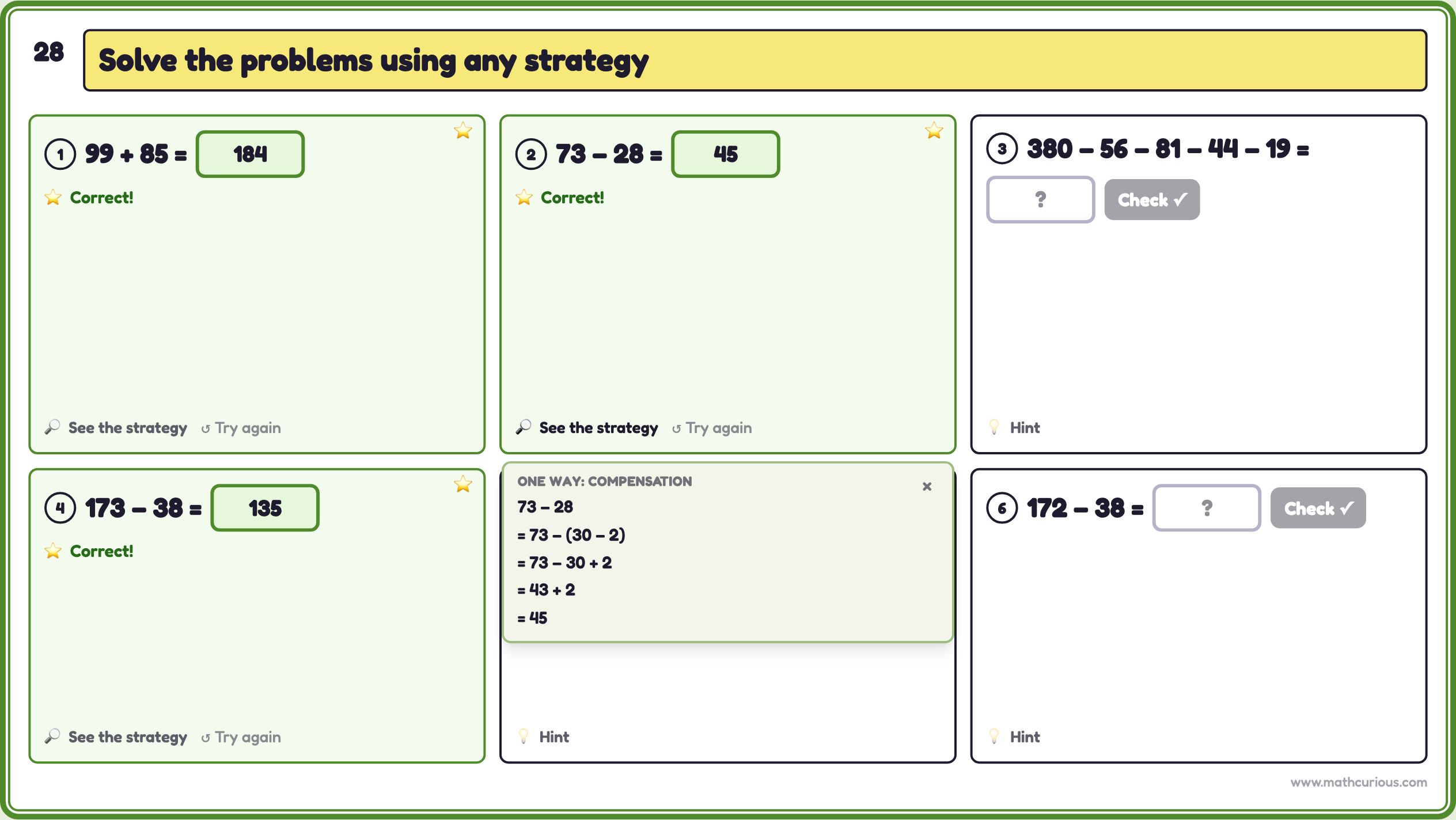
The last four slides mix everything up. Students choose their own strategy, and after solving they see one way it could be done, labelled with the strategy name.
One slide at a time
Like the original deck, it opens on a title slide and moves with Next and Back or the arrow keys. All slides jumps straight to any strategy and shows the stars on each one. Slides always open blank, so the next student on the device never sees the answers.
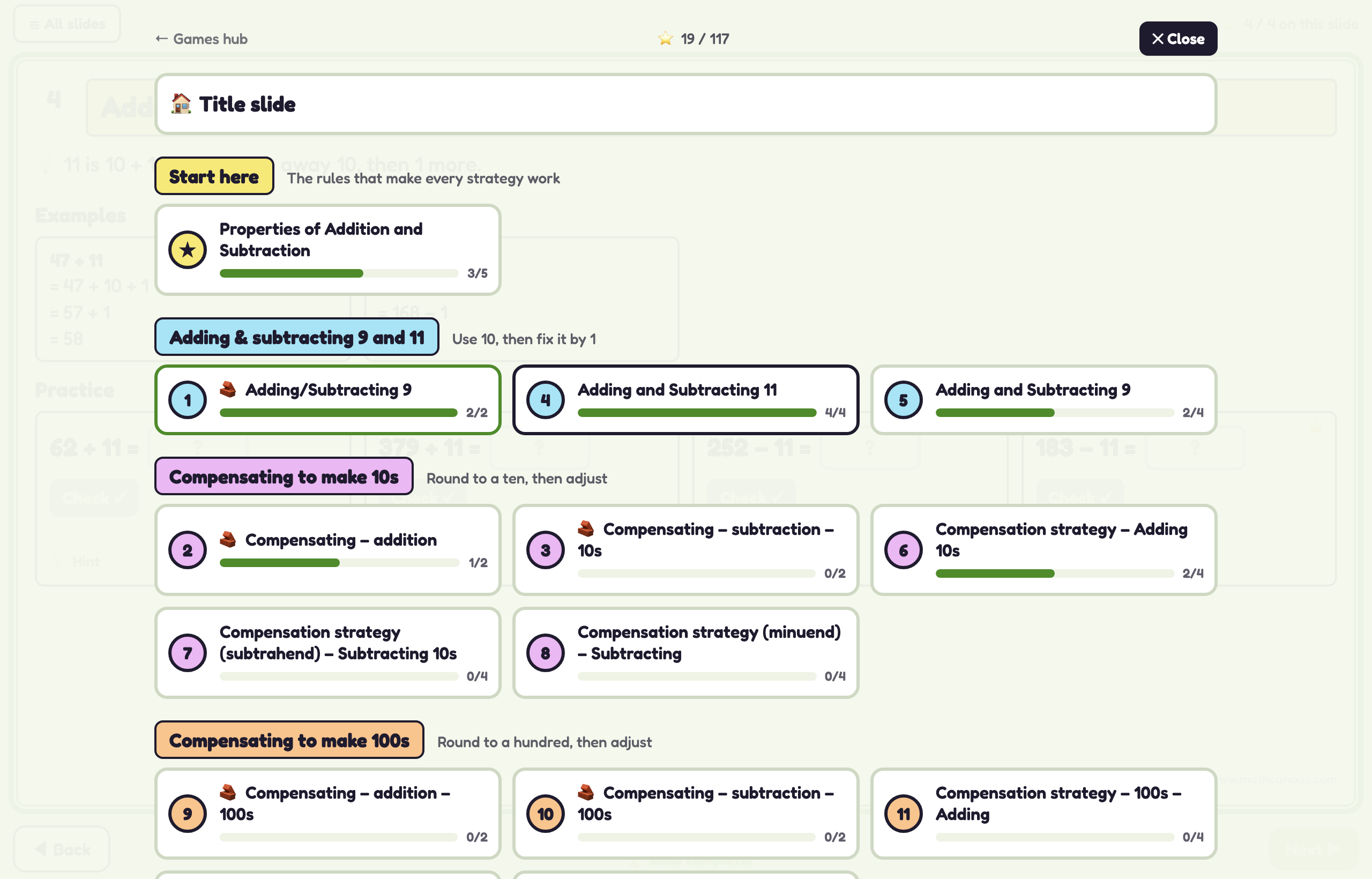
What's inside
- Properties of addition and subtraction
- Adding and subtracting 9 and 11
- Compensating to make 10s and 100s, on the addend, the subtrahend and the minuend
- Decomposing to compatible numbers, to make 10s and 100s
- Balancing for addition and subtraction, up to numbers like 1999 + 974
- Clustering for lists of numbers
- Mixed practice: 24 problems to solve with any strategy
Teaching tips
- Model it first. Project an explanation slide and step through the blocks together before students try "Your turn".
- Say the strategy out loud. "19 is close to 20, so I add 20 and take 1 away."
- Watch the subtraction signs. When students round the number they take away, ask "Did you take away too much or too little?" before they fix it.
- Compare strategies. On the mixed slides, the same problem can be solved more than one way. Ask which way was quickest, and why.
- Revisit often. One slide makes a five-minute warm up, and stars show which strategies each student has tried.
Standards
- 2.NBT.B.5: Fluently add and subtract within 100 using strategies based on place value and properties of operations
- 2.NBT.B.7 / 3.NBT.A.2: Add and subtract within 1000 using strategies based on place value and properties of operations
- 2.NBT.B.9: Explain why addition and subtraction strategies work
- 4.NBT.B.4: Fluently add and subtract multi-digit whole numbers
Quick answers
Do students need accounts? No. It's a link, so there's nothing to sign in to.
What devices does it work on? Any device with a web browser, including Chromebooks, iPads, laptops and the classroom board.
What grades is it for? Grades 2 to 5. Second graders can start with the 9 and 11 slides and compensating with 10s. The 100s, balancing with greater numbers and clustering slides stretch older students.
Do I need to check answers? No. Every problem checks itself, and every one has a hint and worked steps.
Get the new Mental Math Strategies self- checking
Find the google slides version here
Find the print task cards Version here
Get the worksheets version here
More from Math Curious
- Mental Math Strategies: Multiplication
- Division Mental Math Strategies
- Games and activities to practice mental math
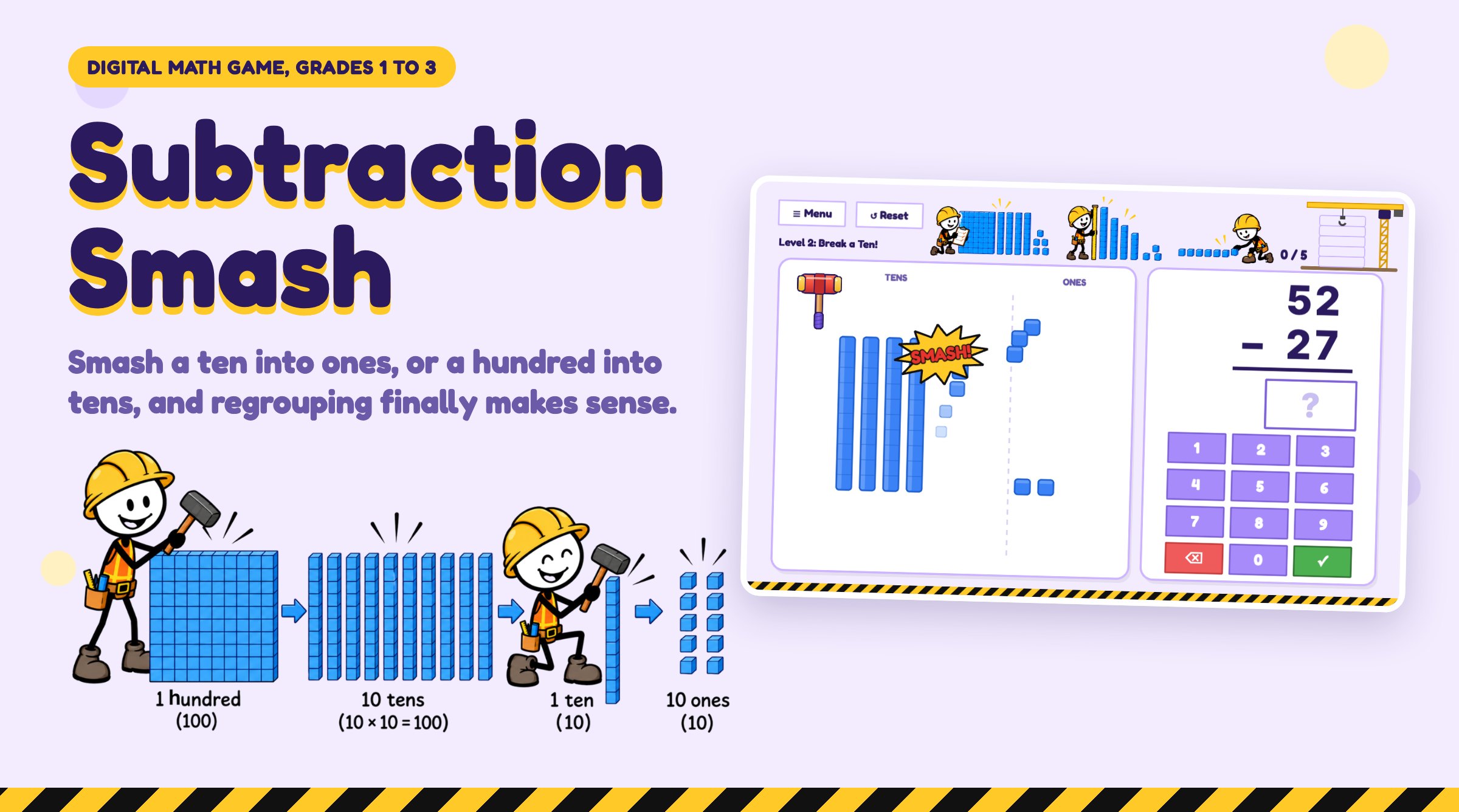
- Subtraction Smash: subtraction with regrouping for grades 1 to 3
- Problem Solving Strategies: 112 self-checking word problems for grades 4 to 6