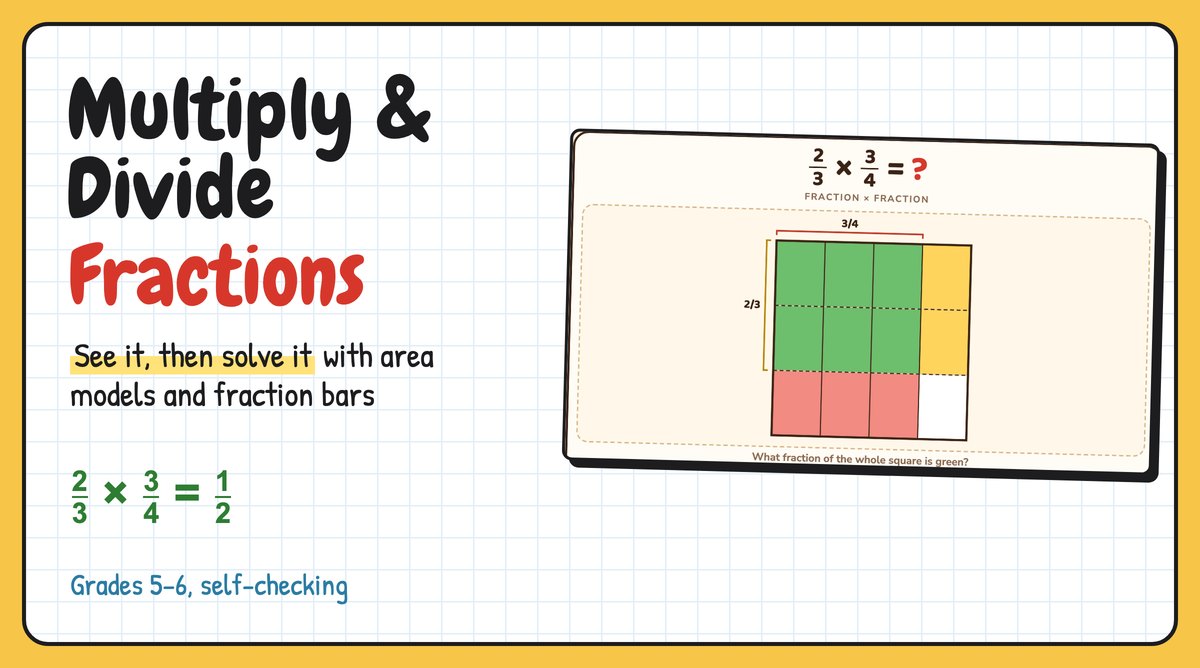
Multiplying and Dividing Fractions with Area Models and Fraction Bars: Multiply & Divide Fractions
Multiply & Divide Fractions is a digital tool for the part of the fractions unit where the rules take over. "Multiply across" and "keep, change, flip" get answers, but ask a student what 2/3 × 3/4 means, or why 3/4 ÷ 3/8 is 2, and the rules don't help.
In this tool, students build every answer before they write it. They shade area models to find a fraction of a fraction, put shaded parts together to make wholes, and lay fraction pieces along a bar to see how many fit. Every answer is checked, and every answer ends in simplest form.
Watch it in action
The tool runs in any web browser. There's nothing to print, cut or laminate, and students don't need logins.
A fraction of a fraction: 2/3 × 3/4
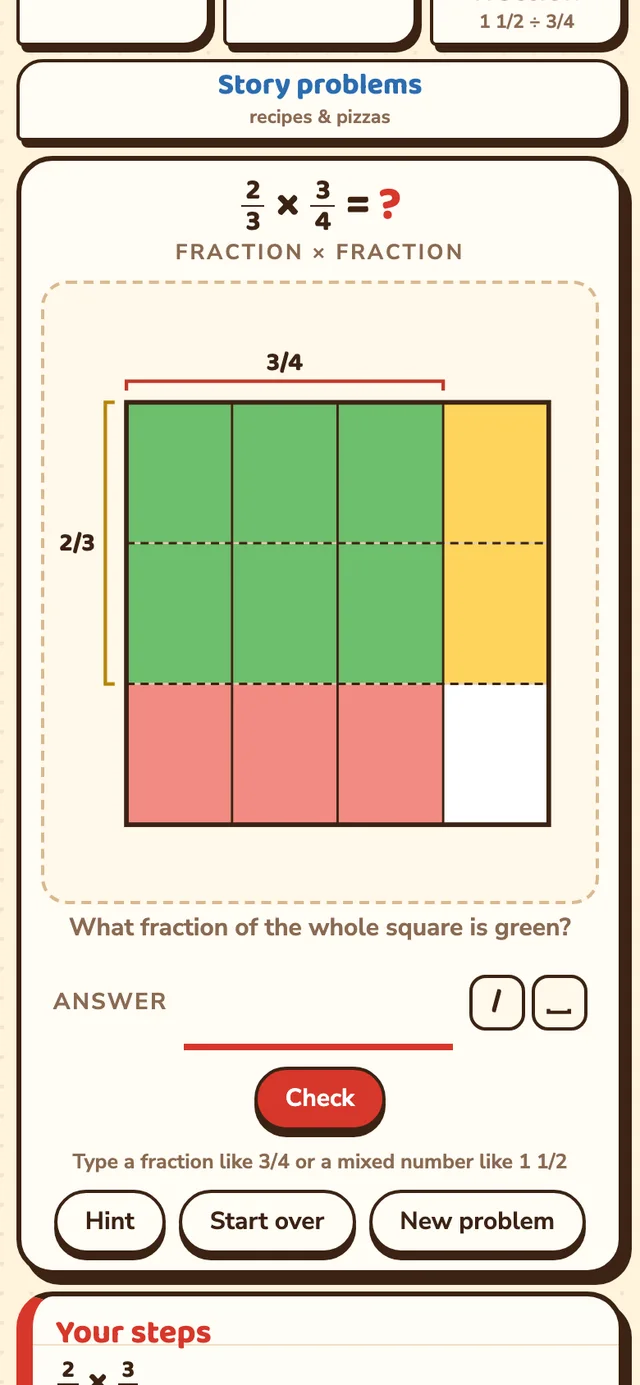
2/3 × 3/4 means 2/3 of 3/4. On the area model, students start with one of the fractions: they cut the square into 4 columns and shade 3 of them.
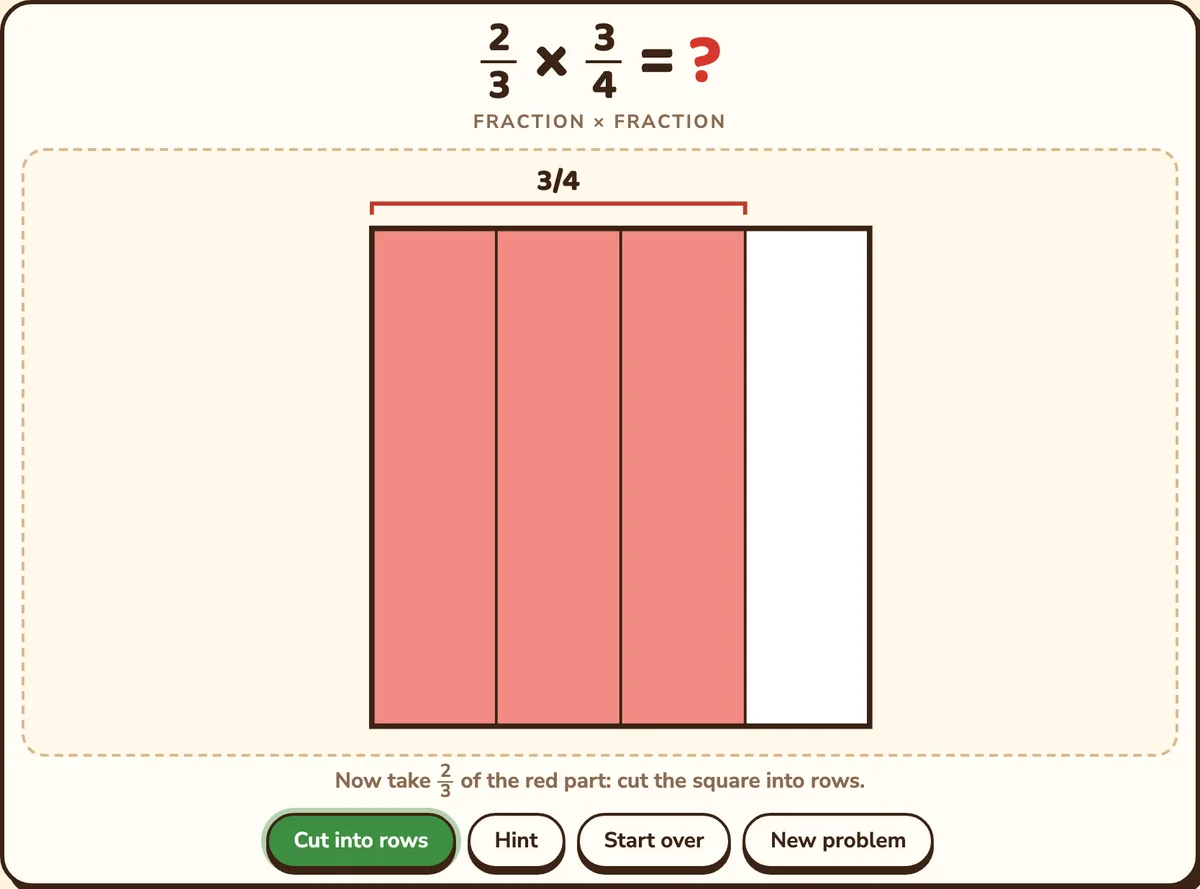
Then they take 2/3 of the red part: they cut the square into 3 rows and shade 2. Where the two overlap is green, and that's 2/3 of 3/4.
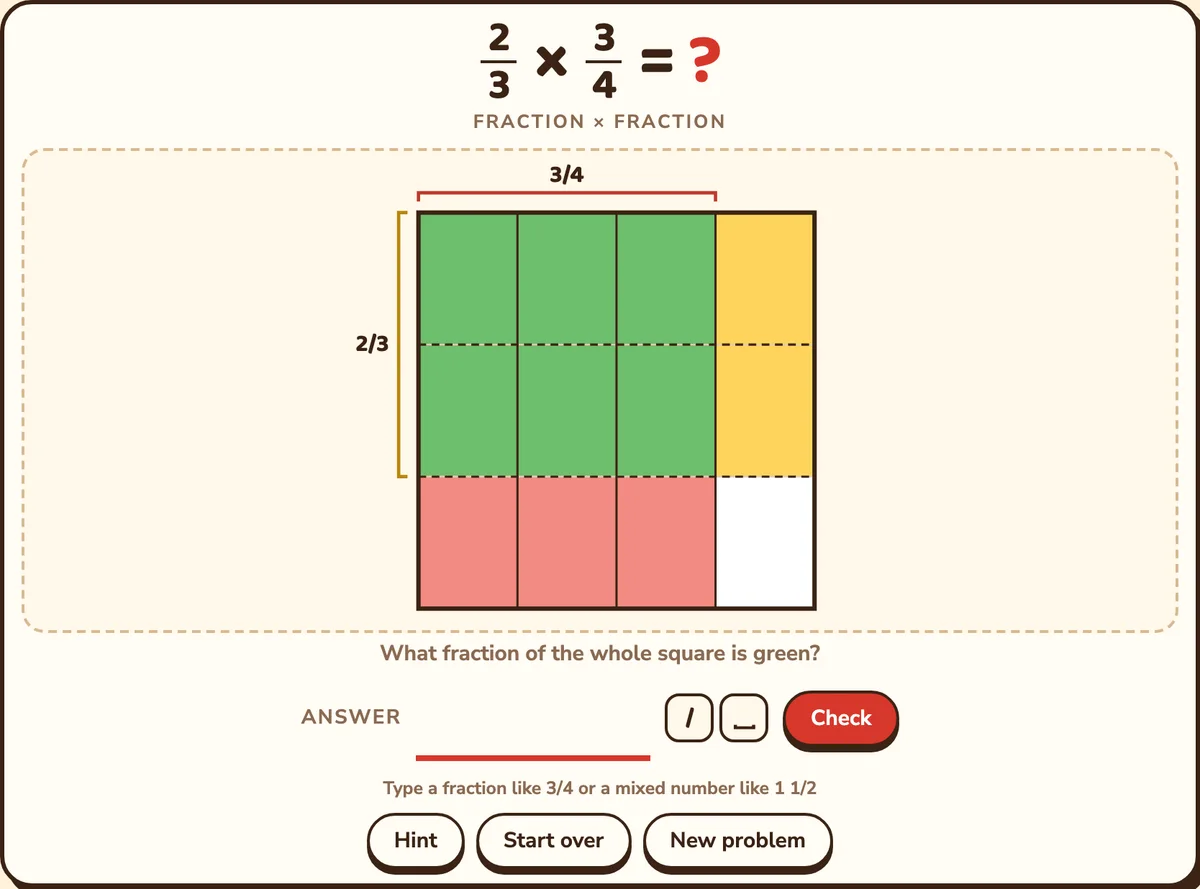
The green is 6 of the 12 equal parts, so 2/3 × 3/4 = 6/12. That's also where "multiply the tops, multiply the bottoms" comes from: 2 × 3 green parts, out of 3 × 4 parts in all.
- Either fraction can go first, as columns or as rows. 2/3 × 1/5 works as 5 columns and 3 rows, or 3 columns and 5 rows.
- The cut has to match a fraction. A square cut into 5 columns for 1/4 × 2/3 gets "Cut into 4 or 3 columns: the bottom number of one of the fractions."
- Adding instead of multiplying gets caught. An answer of 5/7 gets "Don't add the tops and bottoms. Count the green parts and all the parts."
Simplest form, every time
6/12 is right, but it isn't finished. When a right answer can be simpler, it turns into a fraction bar, and Group the parts joins every 6 small parts into one bigger part:
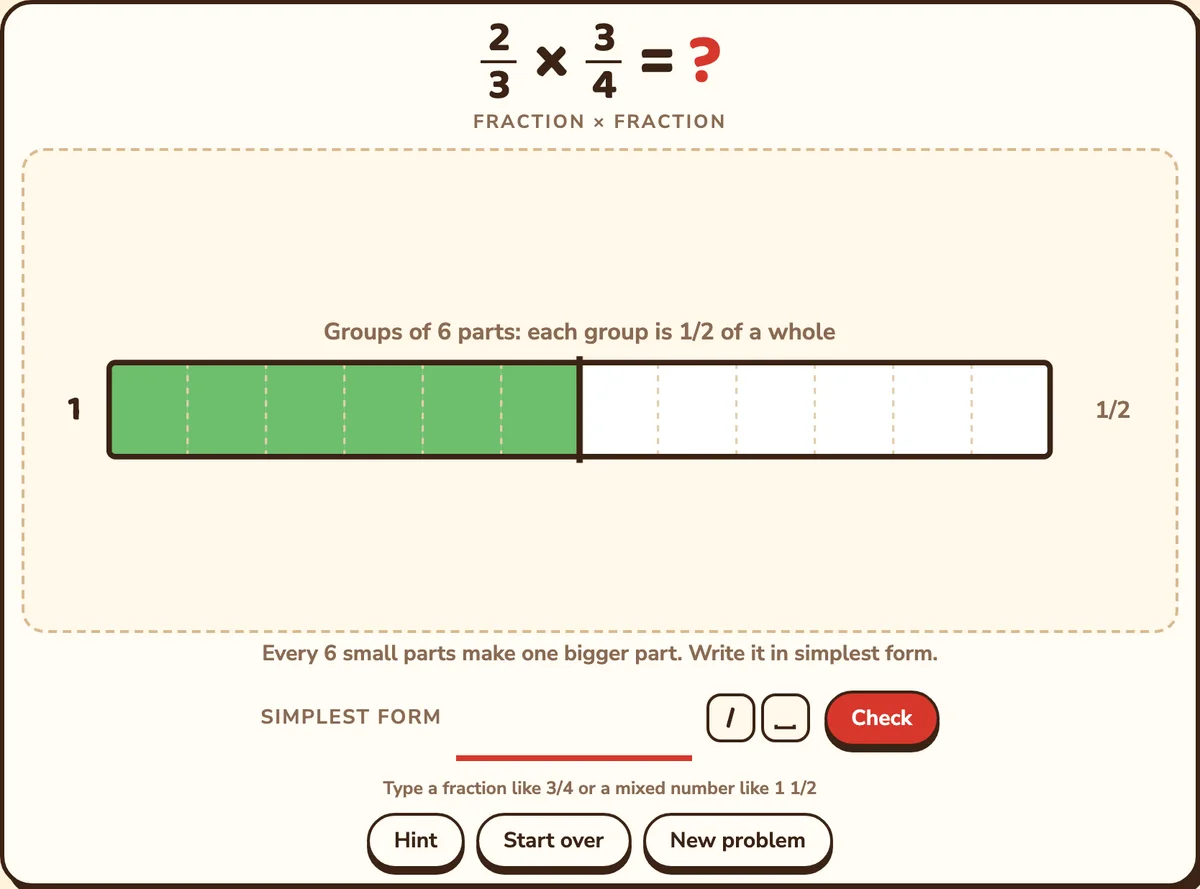
The same amount is now 1 of 2 bigger parts: 6/12 = 1/2. Answers that are more than 1 work the same way: students write them as mixed numbers, with the whole bars counted first.
Fraction × whole: put the parts together
For 3/4 × 5, students cut each of the 5 wholes into fourths and shade 3/4 of every whole.
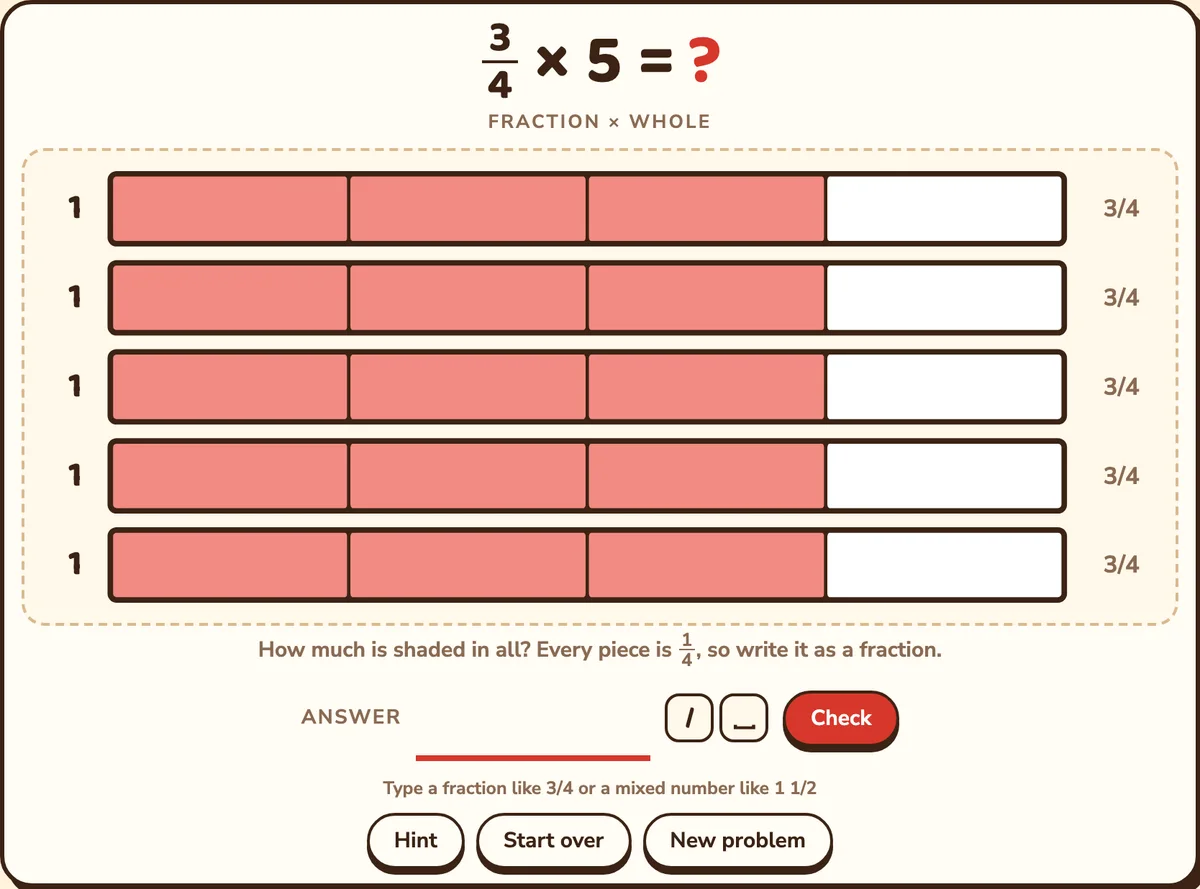
They write what they see first, 15 fourths: 15/4. Then Put the shaded parts together slides the shaded fourths into full wholes:
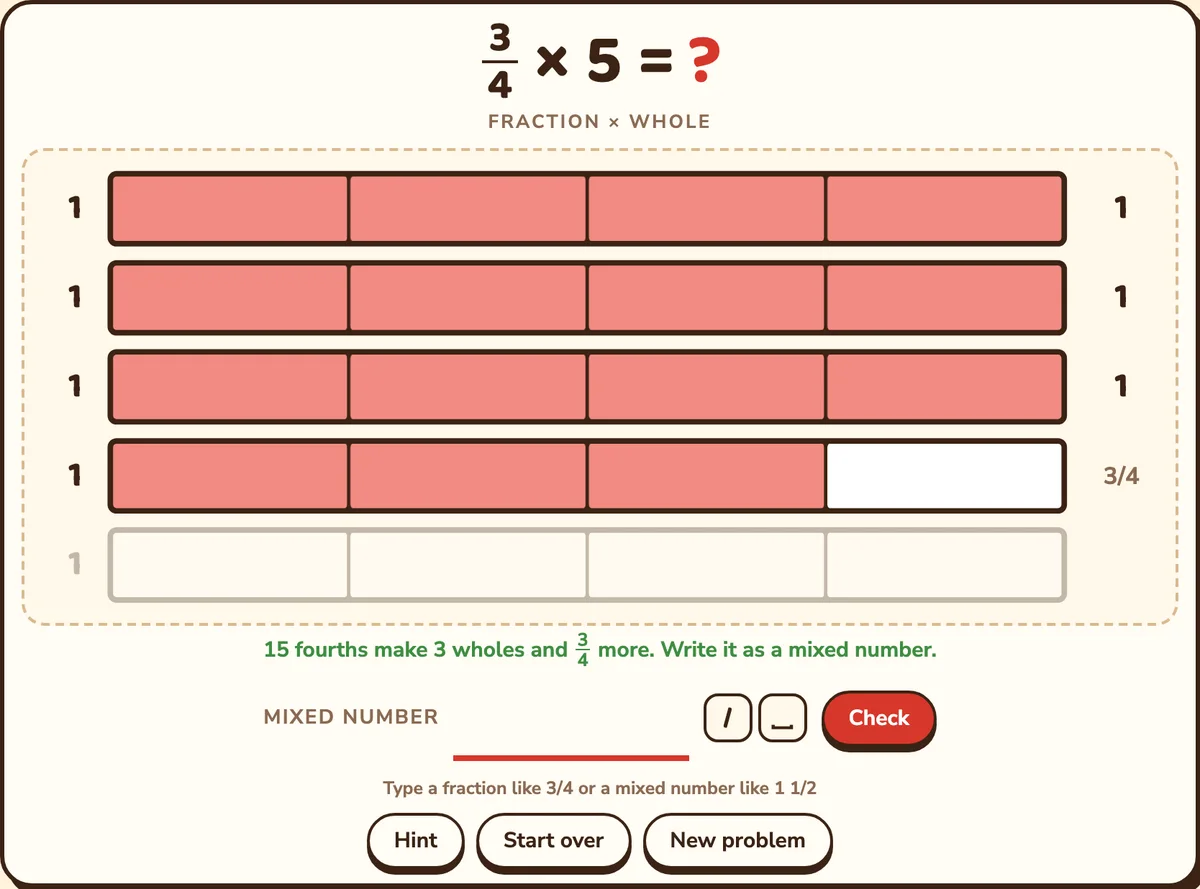
15 fourths make 3 wholes and 3/4 more, so 3/4 × 5 = 3 3/4. Students see where the mixed number comes from instead of dividing 15 by 4 on the side.
Dividing with unit fractions
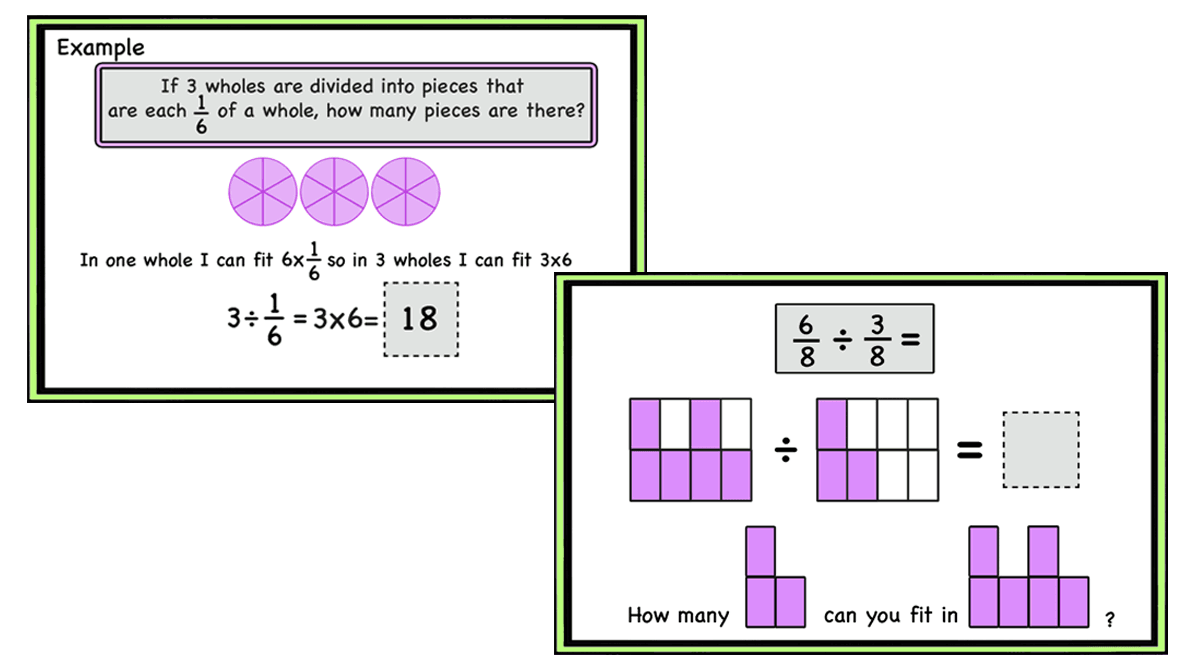
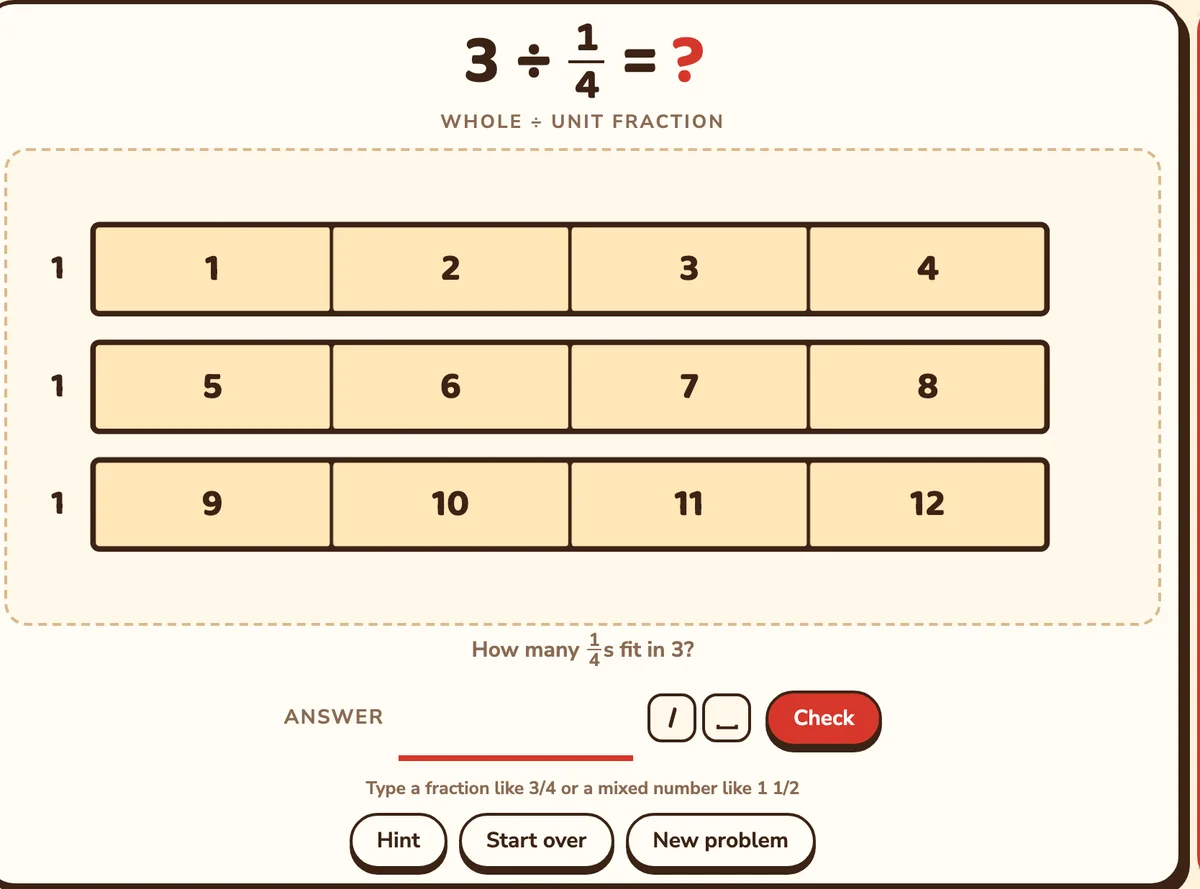
Whole ÷ unit fraction: 3 ÷ 1/4 asks how many fourths fit in 3. Students cut each whole into fourths and count them: 12.
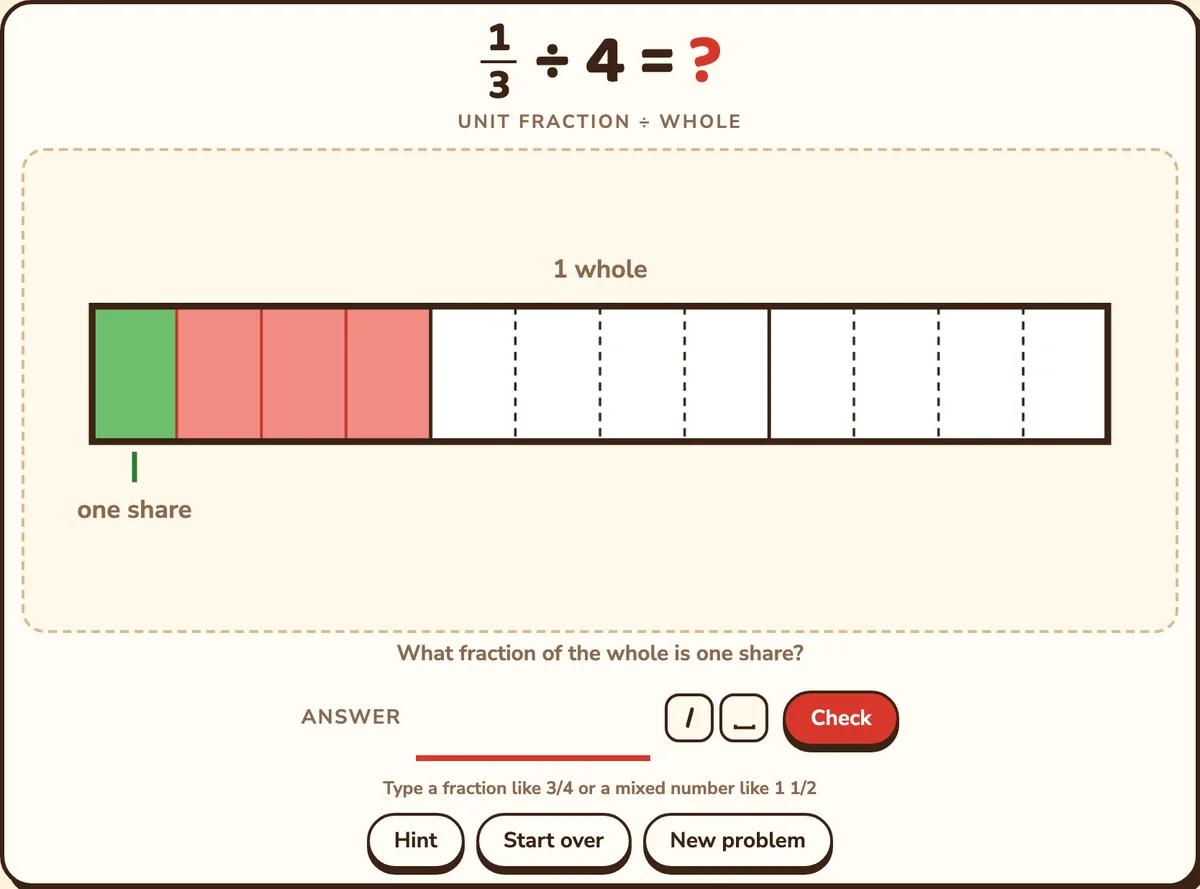
Unit fraction ÷ whole: 1/3 ÷ 4 shares a third among 4. Students shade 1/3, share it into 4, then cut the whole the same way to name one share. It's 1 of 12 equal parts: 1/12.
Fraction ÷ fraction: how many pieces fit?
For 3/4 ÷ 3/8, the tool shows two bars: what you have (3/4, in red) and one piece of the size you divide by (3/8, in yellow). First, students cut both into the same size parts. Eighths work for both, so 3/4 becomes 6/8:
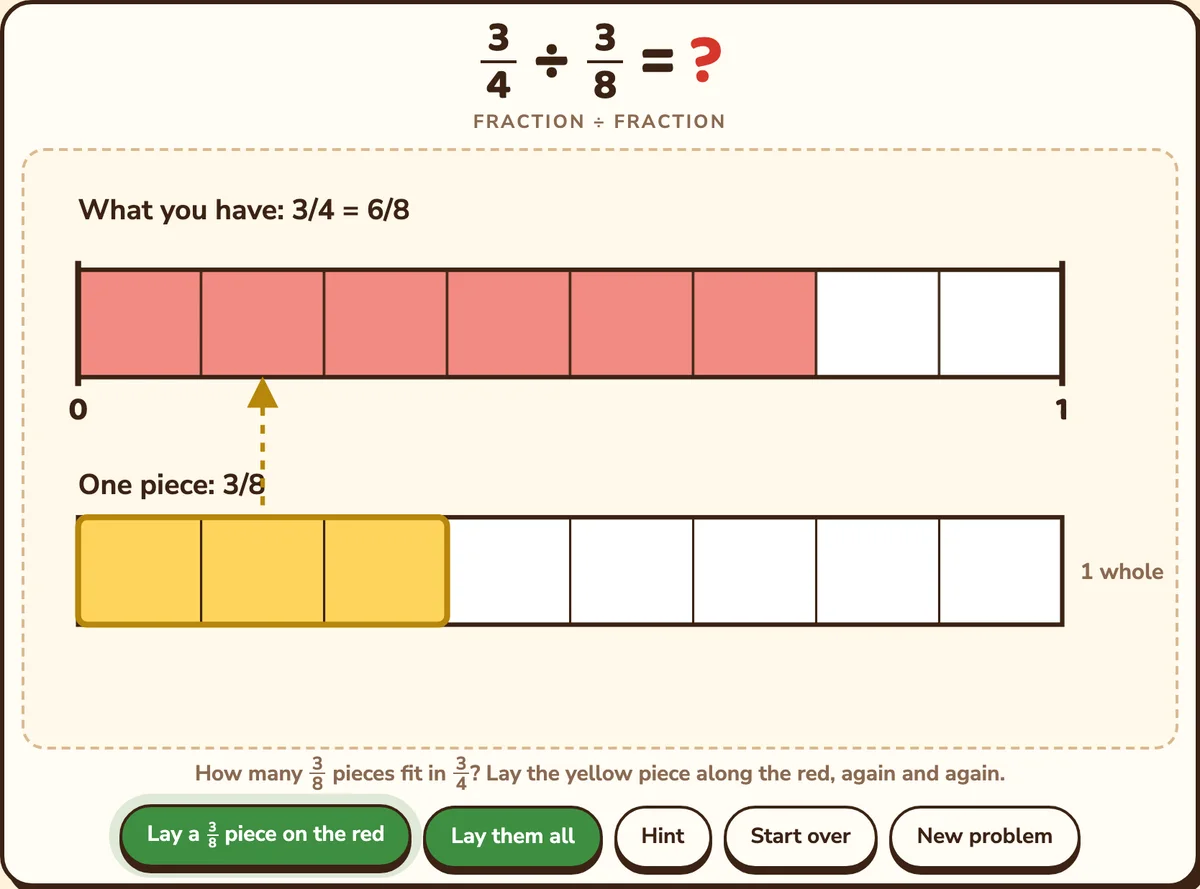
Then they lay the yellow piece along the red bar, again and again. Each piece slides up from the yellow bar and lands on the red, numbered:
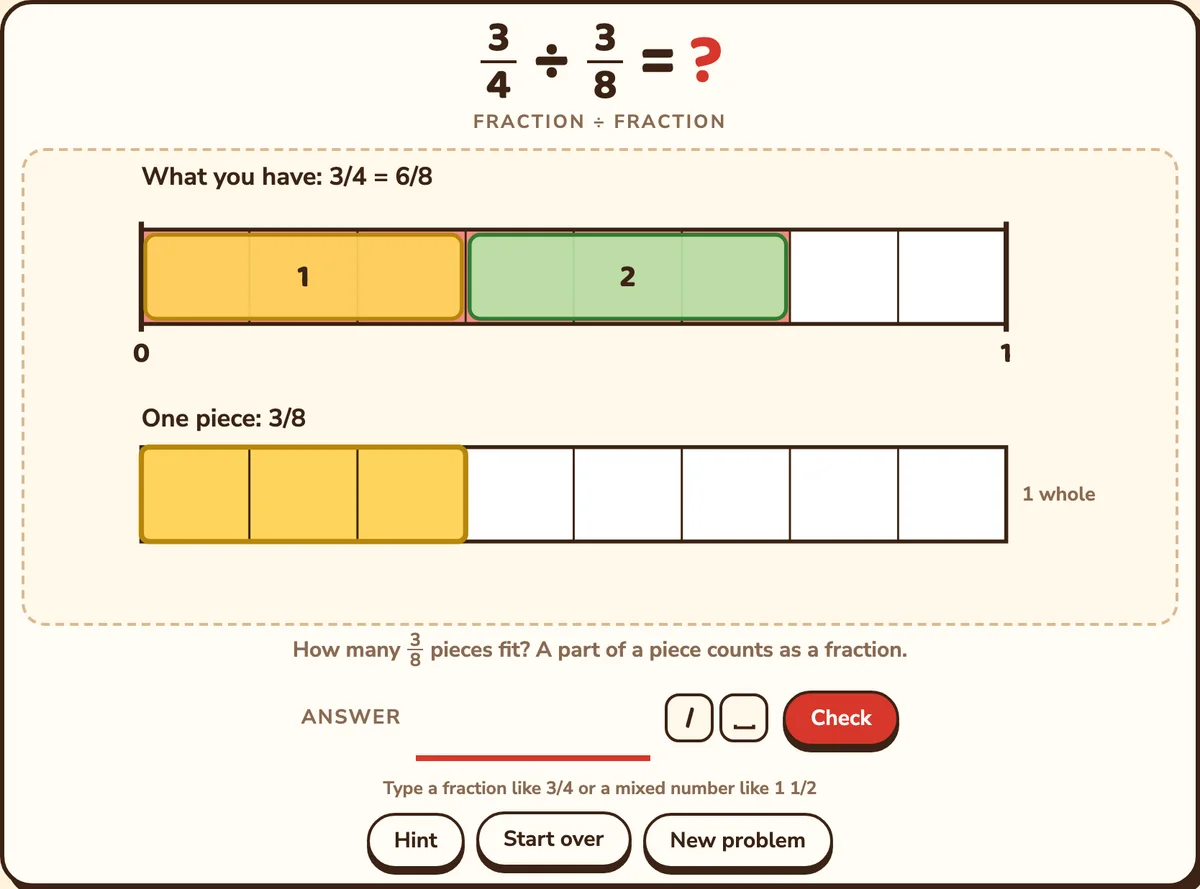
Two pieces fit, so 3/4 ÷ 3/8 = 2. In eighths, it's just 6 eighths ÷ 3 eighths = 6 ÷ 3.
Why 1 2/9 and not 1 2/12?
The hardest part of fraction division is the leftover. In 11/12 ÷ 3/4, one 3/4 piece fits, and 2 twelfths are left over. Many students write 1 2/12.
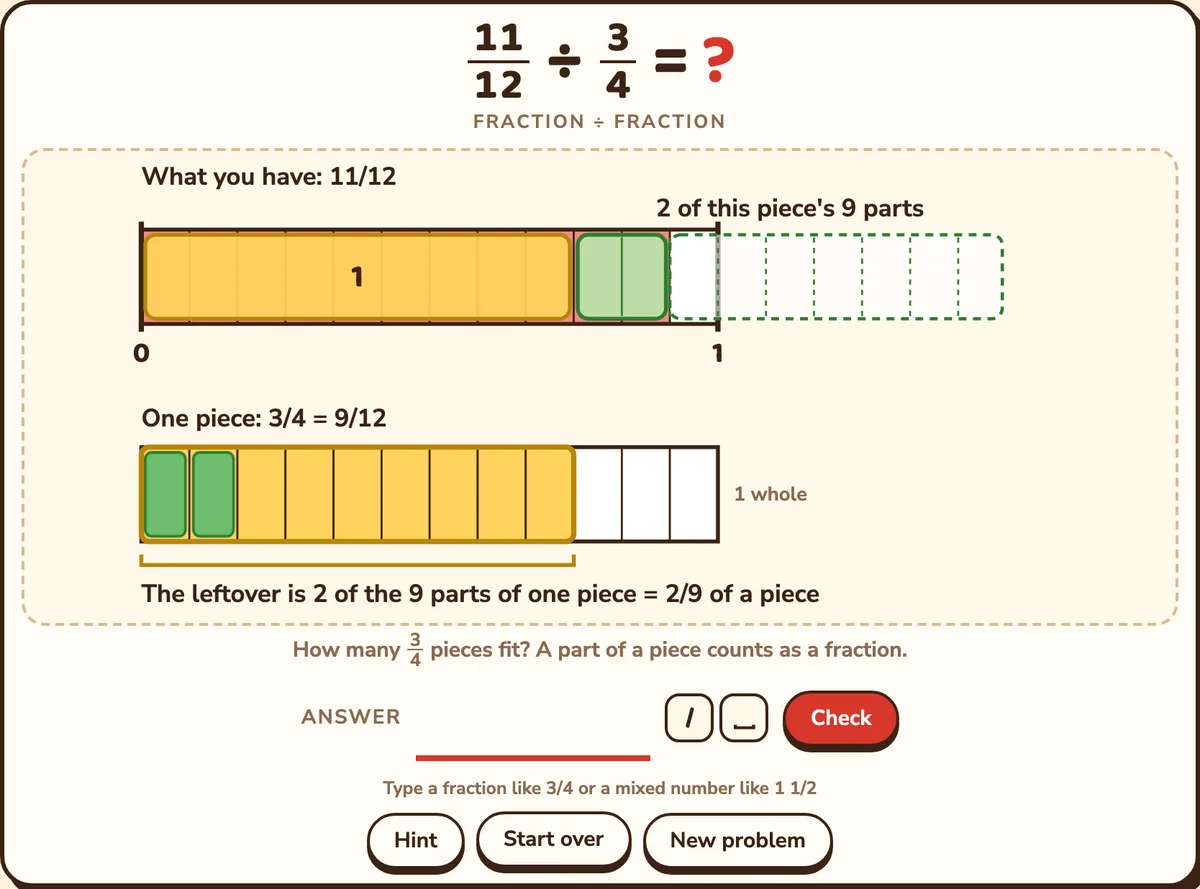
But the question is how many pieces fit, and one piece is 9 twelfths. The last piece shows its own 9 parts with 2 of them filled, and the yellow bar lights up the same 2 of its 9 parts: the leftover is 2/9 of a piece. So 11/12 ÷ 3/4 = 1 2/9. An answer of 1 2/12 gets a hint that says exactly that.
Mixed number ÷ fraction
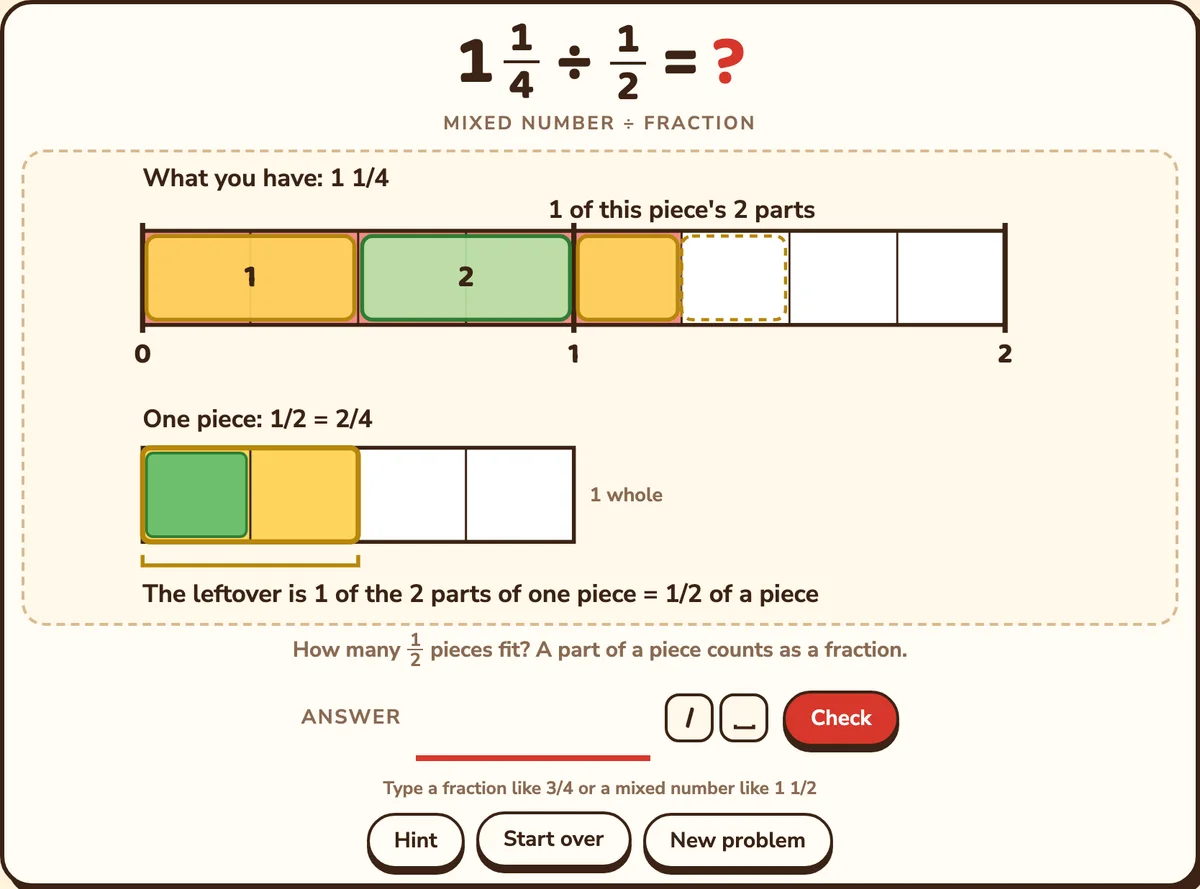
Mixed numbers get a level of their own. For 1 1/4 ÷ 1/2, the bar runs across two wholes: 2 halves fit, with half a piece left over, so the answer is 2 1/2.
Seven levels
- Fraction × whole: 2/3 × 6, 3/4 × 5
- Fraction × fraction: 2/3 × 3/4, 1/4 × 2/3
- Whole ÷ unit fraction: 3 ÷ 1/4
- Unit fraction ÷ whole: 1/3 ÷ 4
- Fraction ÷ fraction: 3/4 ÷ 3/8, 5/6 ÷ 1/3
- Mixed number ÷ fraction: 1 1/2 ÷ 3/4
- Story problems: recipes, ribbon, pizza and more
Every level makes new problems each time.
Story problems: which operation?
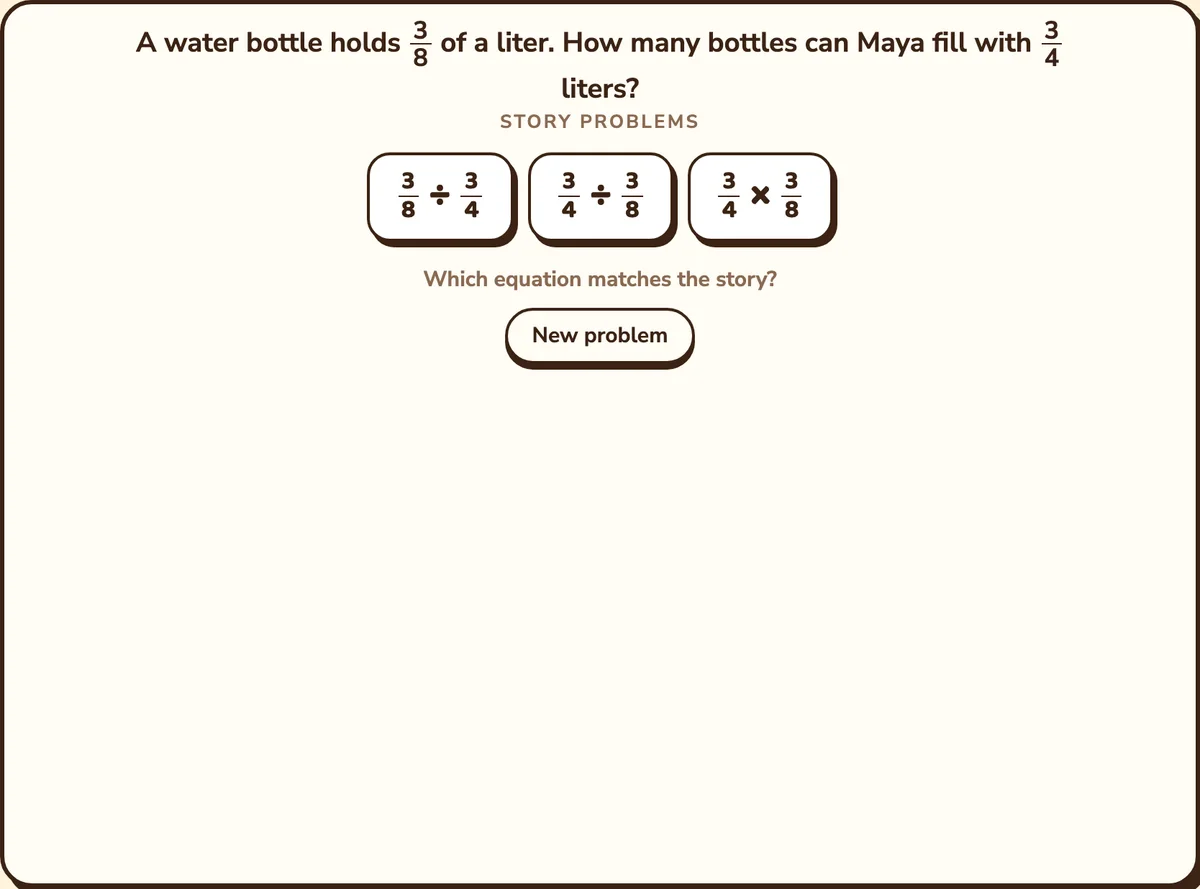
In Story problems, students read a short story first and choose the equation that matches it, before any model appears. "A water bottle holds 3/8 of a liter. How many bottles can Maya fill with 3/4 liters?" is 3/4 ÷ 3/8, not 3/8 ÷ 3/4. Then they solve it with the right model.
What students practise
- Multiplying fractions by whole numbers and by fractions, with area models
- Dividing whole numbers by unit fractions, and unit fractions by whole numbers
- Dividing fractions by fractions with common denominators
- Simplifying fractions and writing improper fractions as mixed numbers
- Reading a remainder as a fraction of the divisor
- Choosing the operation for a word problem
Teaching tips
- Predict first. Before multiplying, ask: "Will the answer be more or less than what we started with?"
- Say "of". Read 2/3 × 3/4 as "2/3 of 3/4" and point at the red part before cutting the rows.
- Estimate the pieces. Before laying any pieces, ask how many will fit.
- Ask about the leftover. "Is that a fraction of a whole, or of a piece?"
- Read the steps aloud at the end, so the model and the written method meet.
Standards
- 5.NF.B.4: multiply a fraction by a whole number or a fraction, including with area models
- 5.NF.B.6: solve real-world problems with multiplying fractions and mixed numbers
- 5.NF.B.7: divide unit fractions by whole numbers and whole numbers by unit fractions
- 6.NS.A.1: divide fractions by fractions, with visual models
Quick answers
Do students need accounts? No. It's a link, so there's nothing to sign in to.
What devices does it work on? Any device with a web browser, including Chromebooks, tablets and the classroom board.
How do students type a mixed number? With a space, like 1 2/9. The tool also has buttons for the fraction bar and the space.
Can I turn the sound off? Yes, with the speaker button at the top. The tool remembers it.
Get Multiply & Divide Fractions
Let students see what multiplying and dividing fractions means, and the rules start to make sense.