Multiplying Decimals Visually: Choco Decimals
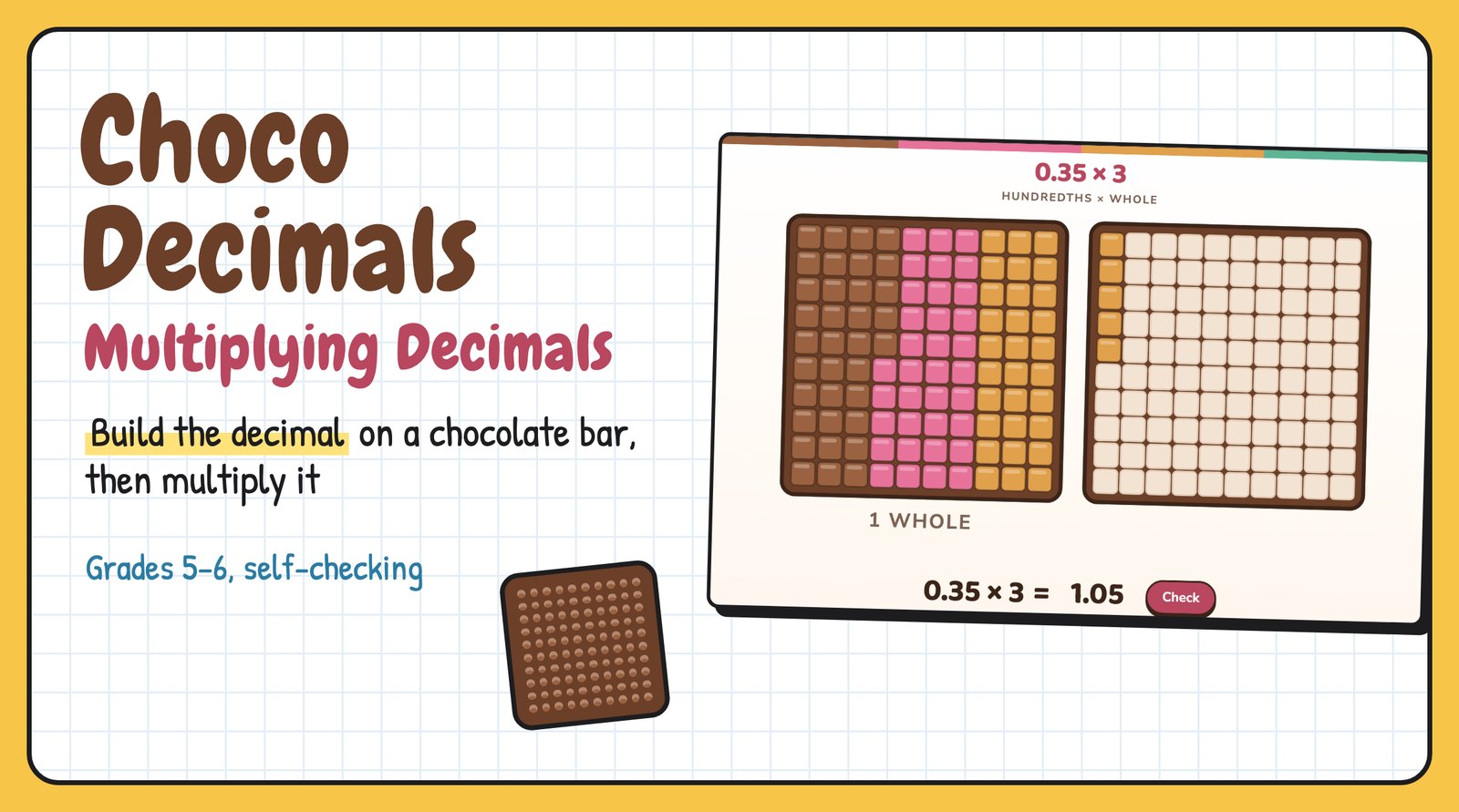
Save to PinterestChoco Decimals is a digital tool for multiplying decimals. Students can often count the decimal places and get the right digits, but ask them why 0.4 × 0.3 is smaller than both numbers, and the rule falls apart. They put the point in the wrong place, they turn 35 hundredths into 3.5, and they're surprised when "multiplying" makes a number smaller.
In Choco Decimals, every decimal is chocolate. One bar is 1 whole, a column is a tenth and a single piece is a hundredth. Students build the decimal first, then they do the multiplying themselves: they make the groups and pour them together, or shade across and down and put the overlap into one bar. The answer is something they can count.
Watch it in action
The tool runs in any web browser. There's nothing to print or set up, and students don't need logins.
Build the decimal first
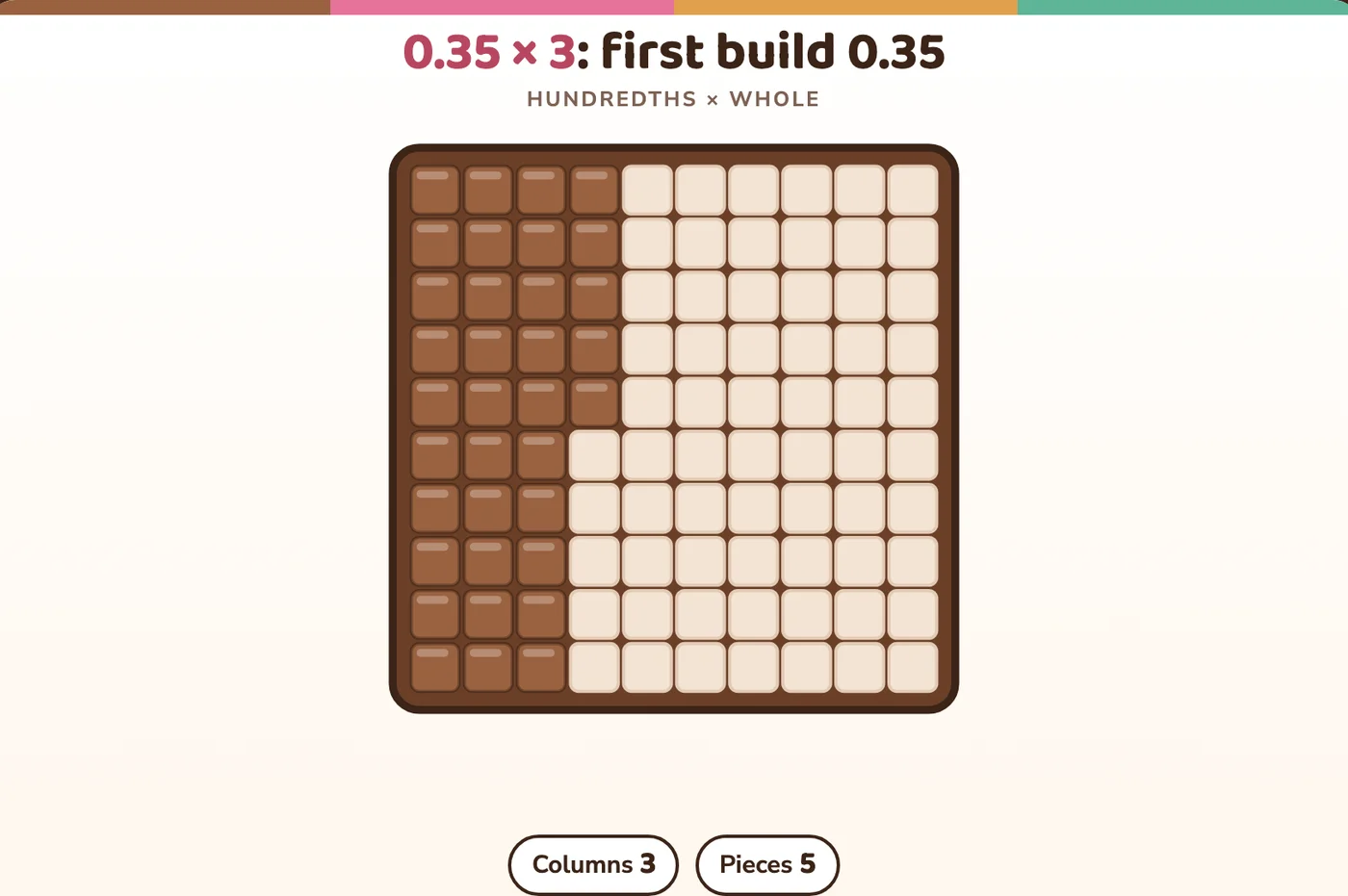
Every problem starts with the decimal itself. For 0.35 × 3, students first build 0.35: they tap a piece, and the bar fills up to it, column by column. Counters under the bar show the columns and the pieces: 3 full columns and 5 pieces.
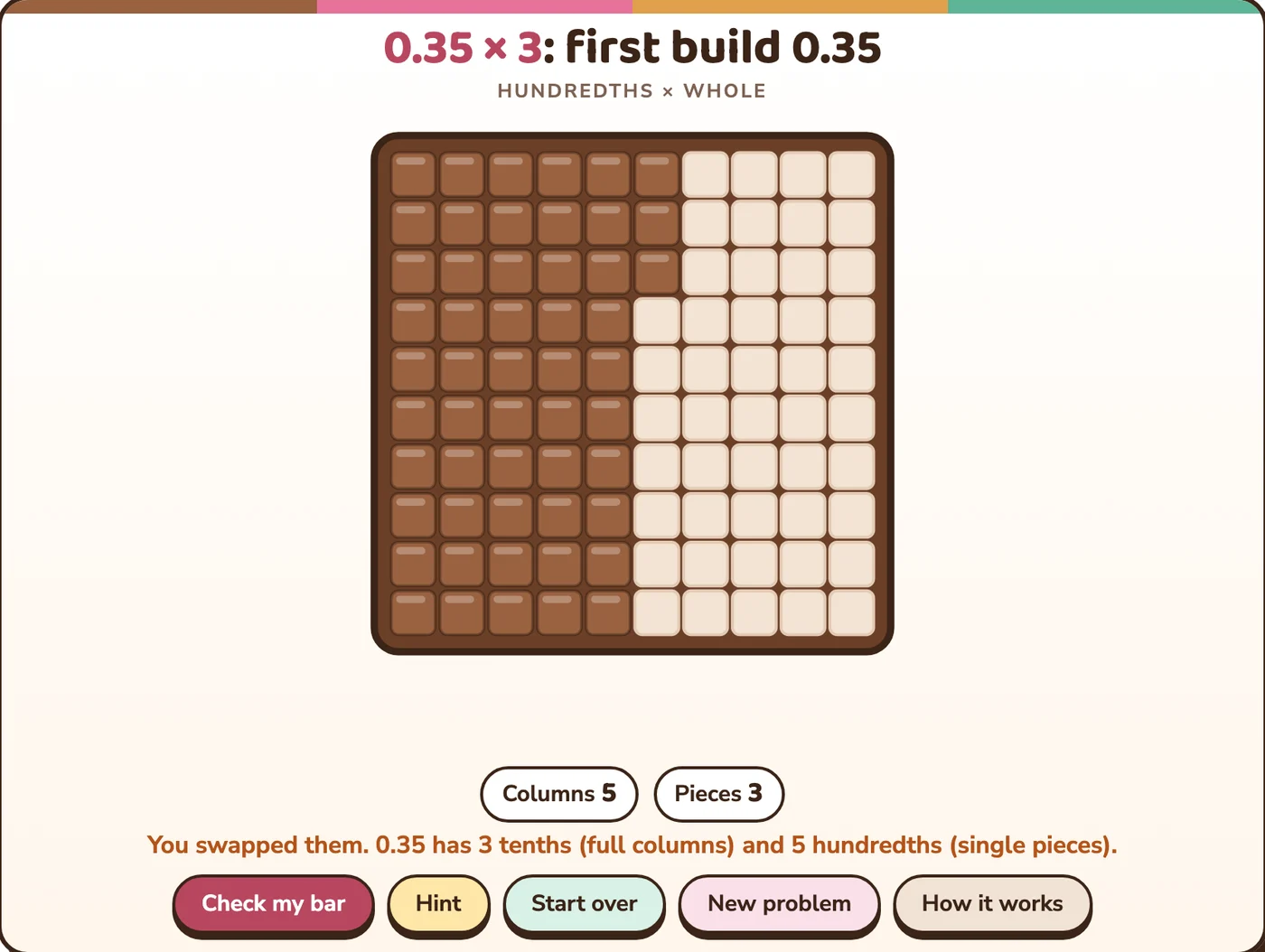
A student who builds 5 columns and 3 pieces is told they swapped them: 0.35 has 3 tenths (full columns) and 5 hundredths (single pieces).
× a whole number: make the groups
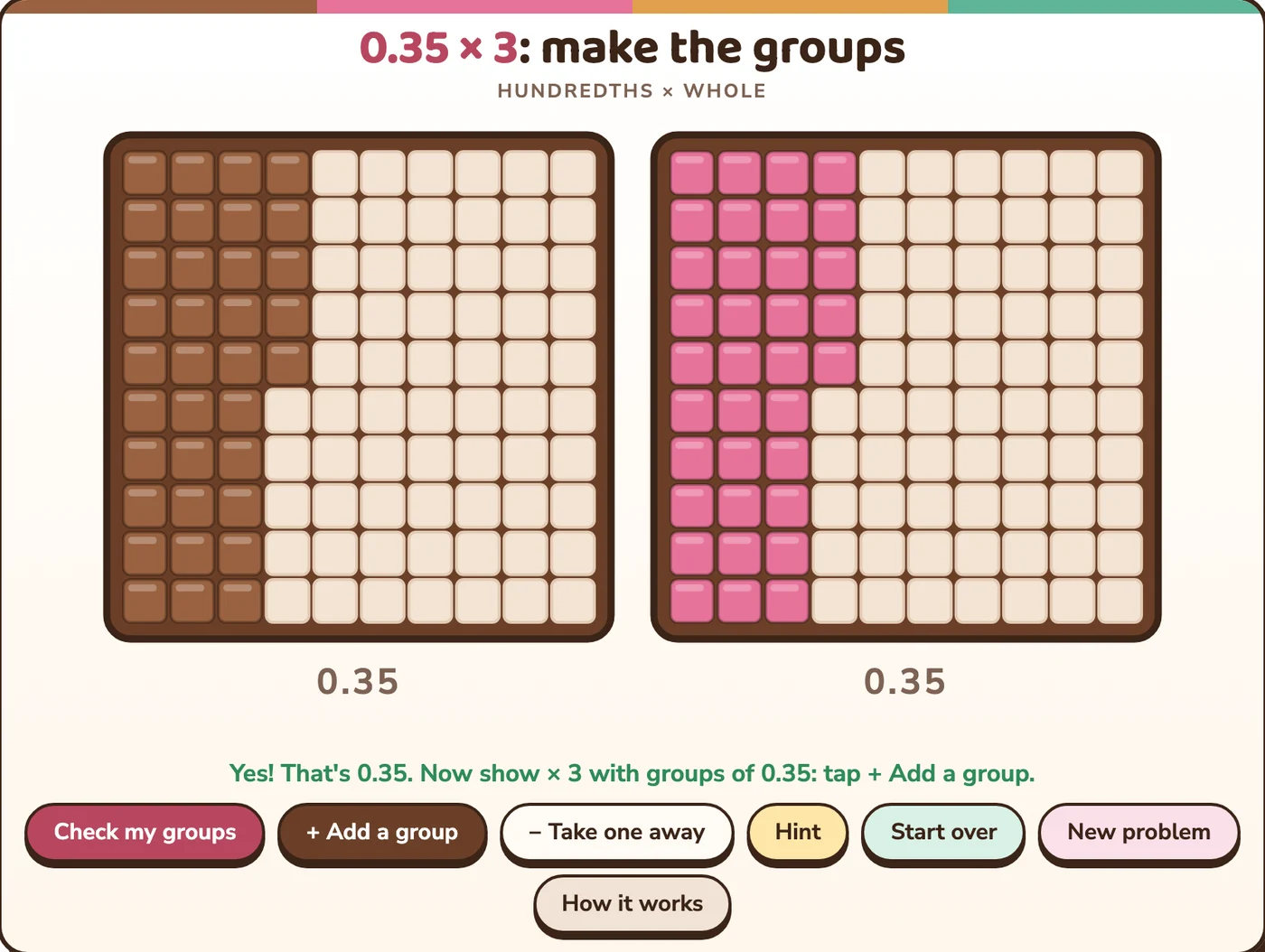
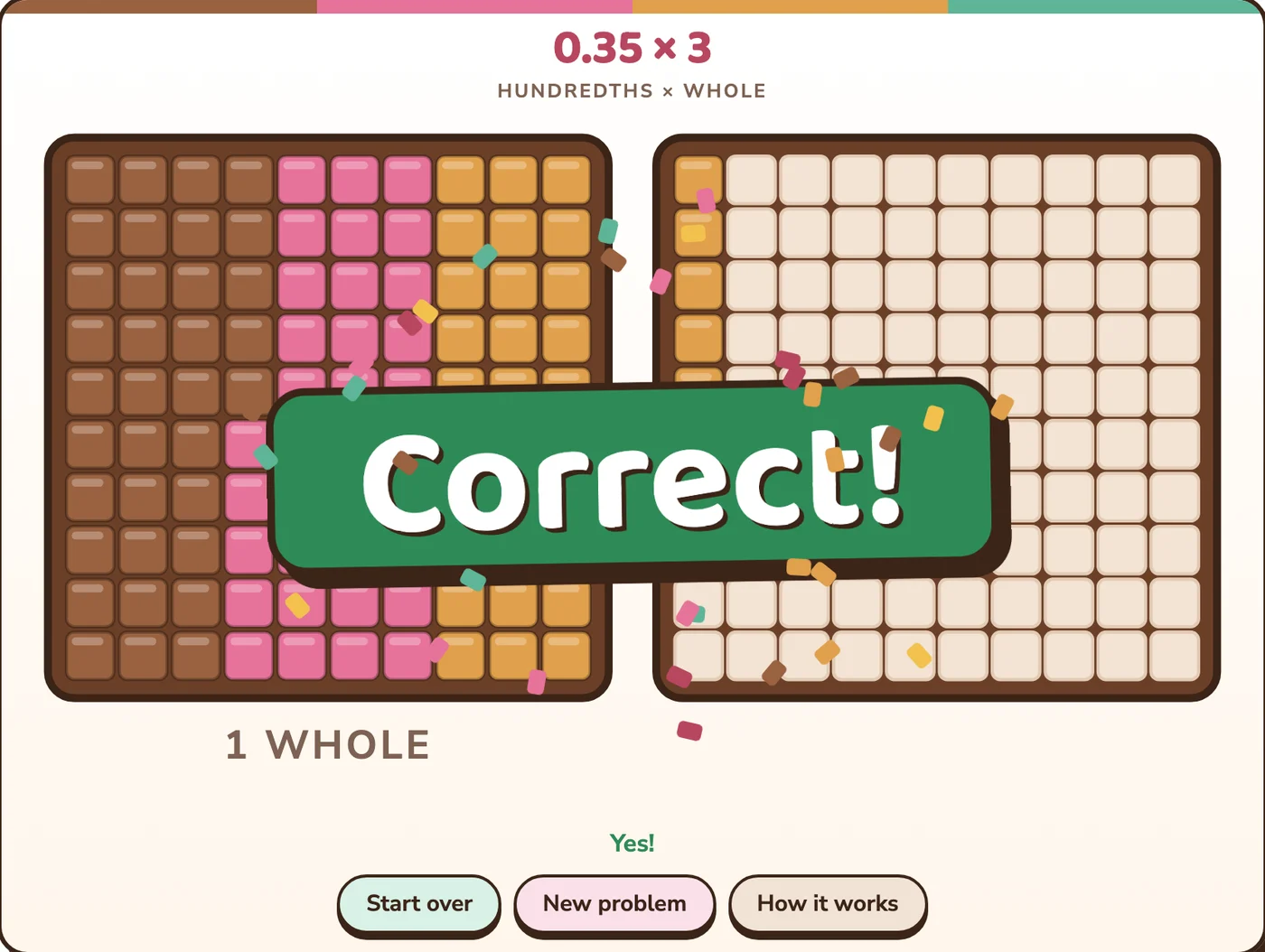
× 3 means 3 groups of 0.35, and students make them. They tap + Add a group until there are 3 copies of their bar, each in its own flavor. Too many or too few, and the tool says how many groups they have and how many × 3 needs.
Pour them together
Then students tap each group to pour it into the answer bars. The pieces fill the bars after the ones already there, so when a bar is full, the next group spills into a new one.
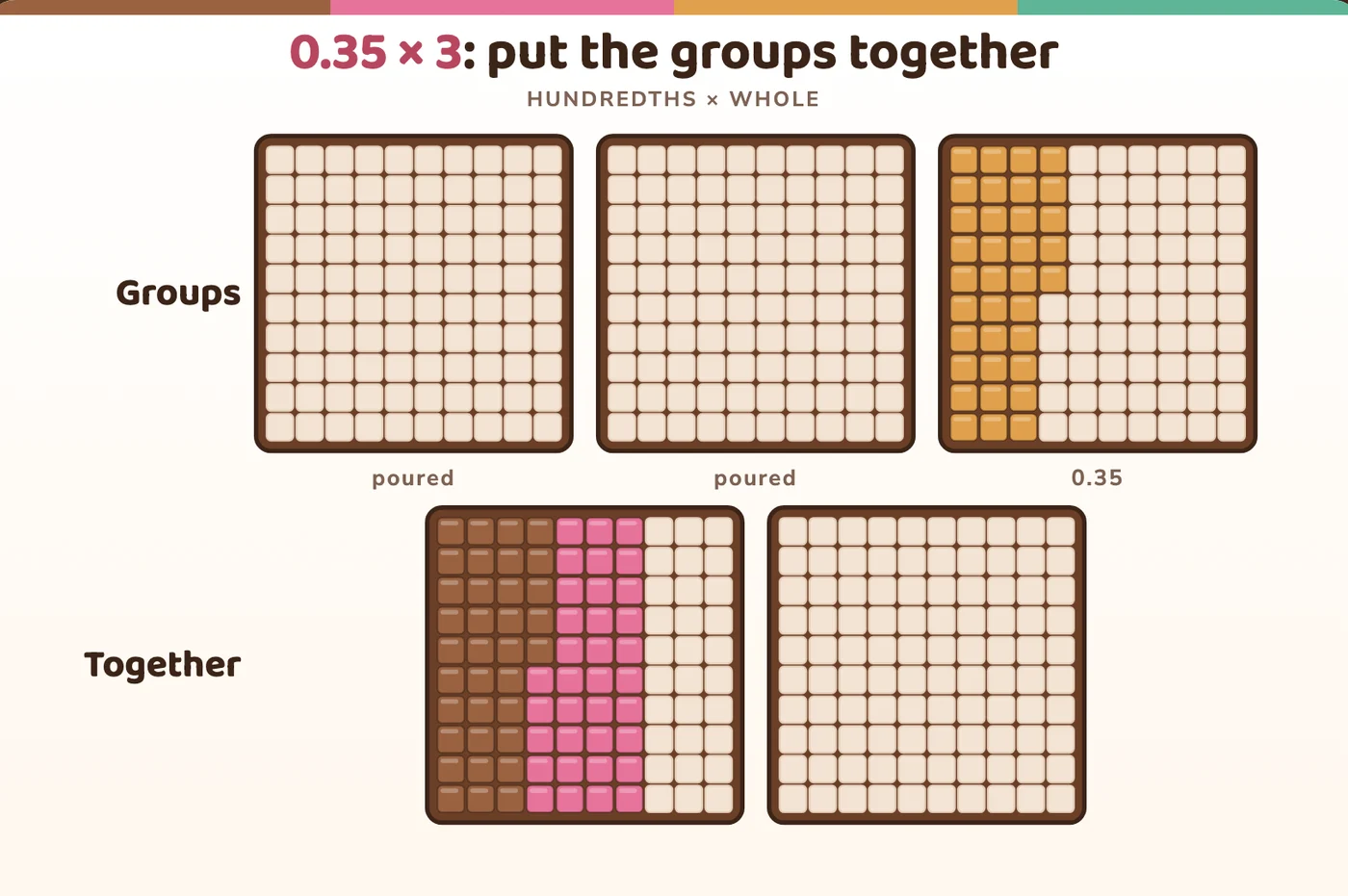
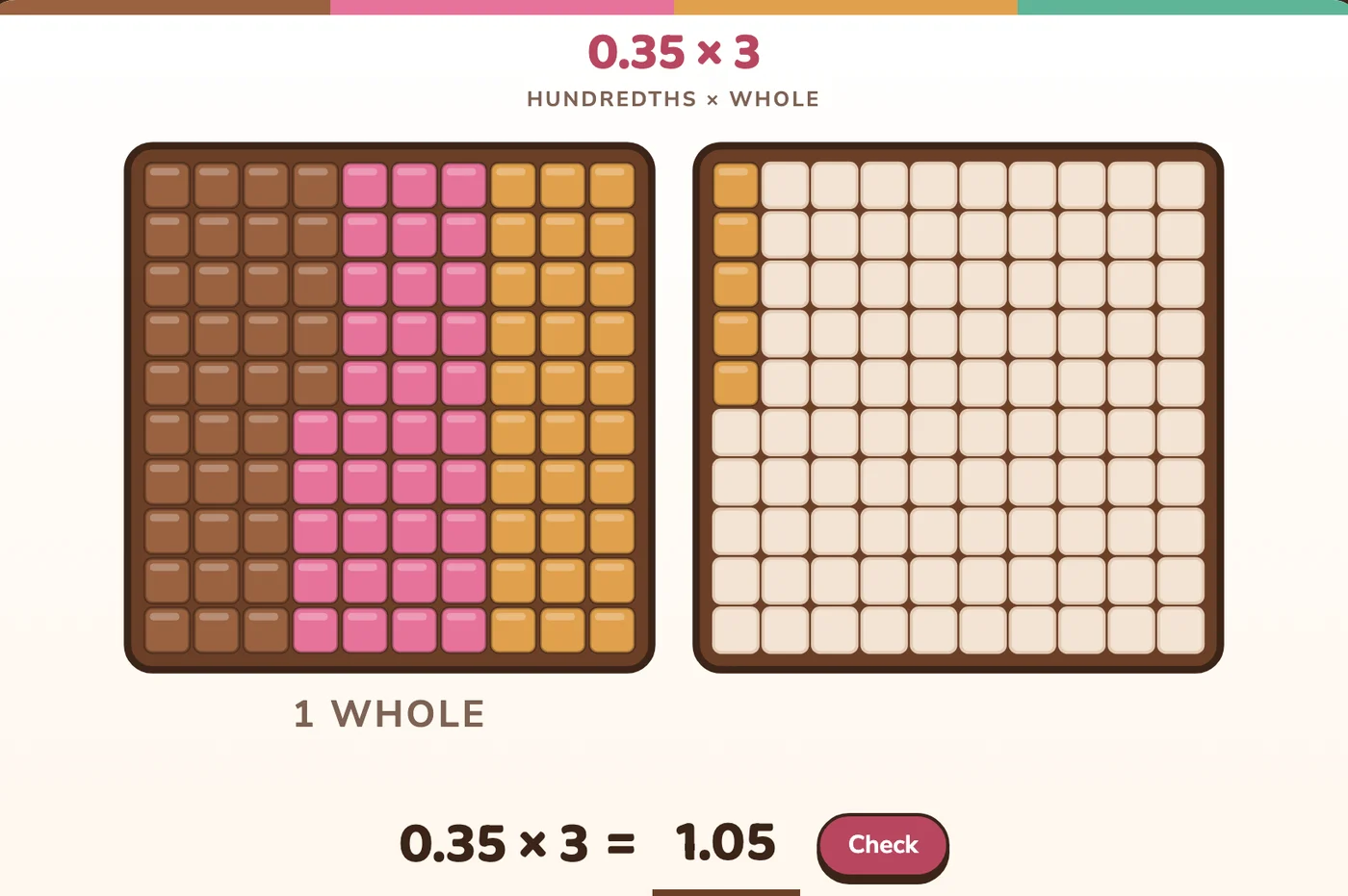
After the third group, there's 1 full bar and 5 more pieces: 1 whole and 5 hundredths. Students type the answer, 1.05.
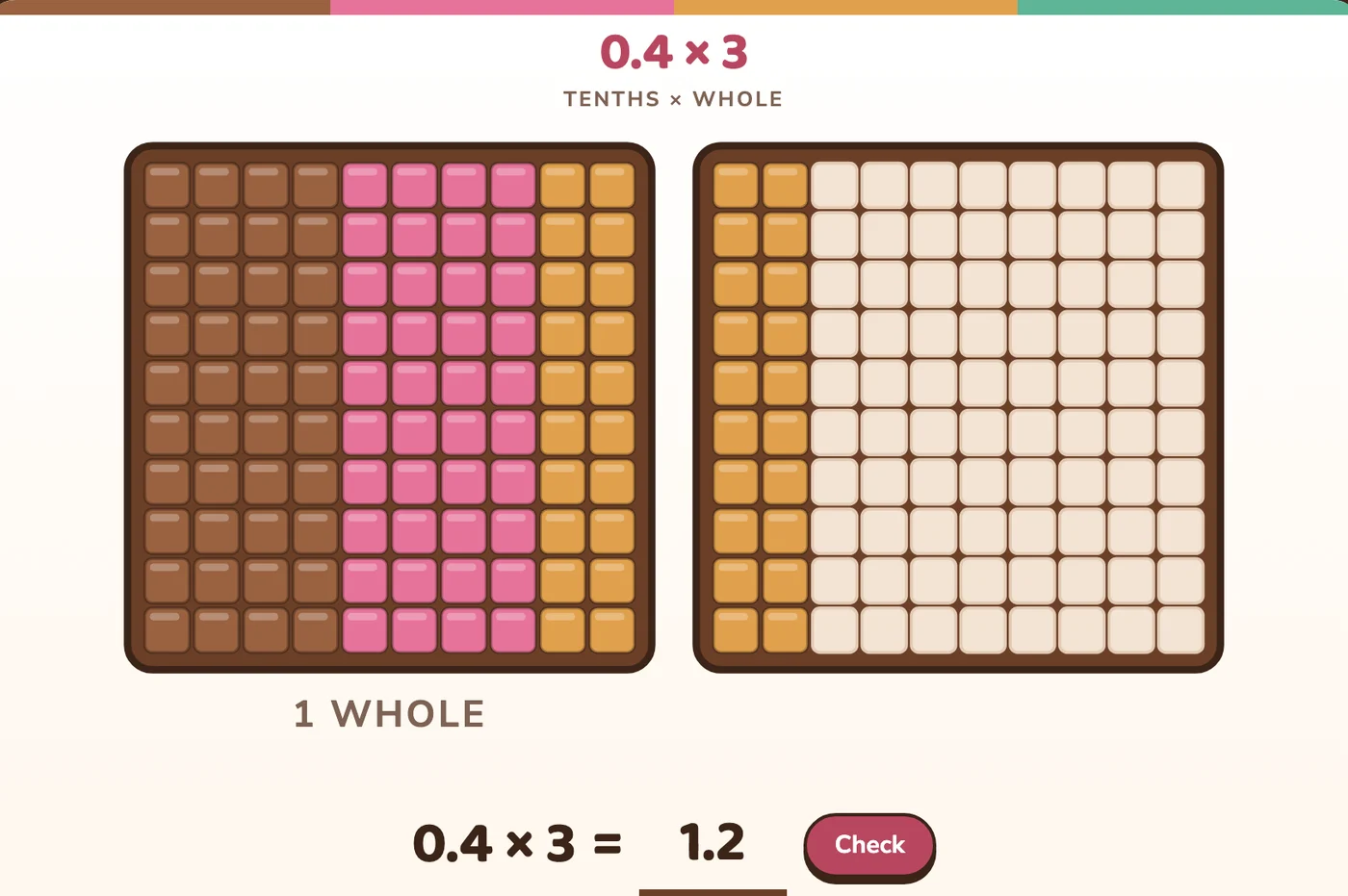
With tenths, it's the same idea with full columns: 0.4 × 3 is 12 columns, a whole bar and 2 more columns, so 1.2.
× a decimal: across and down
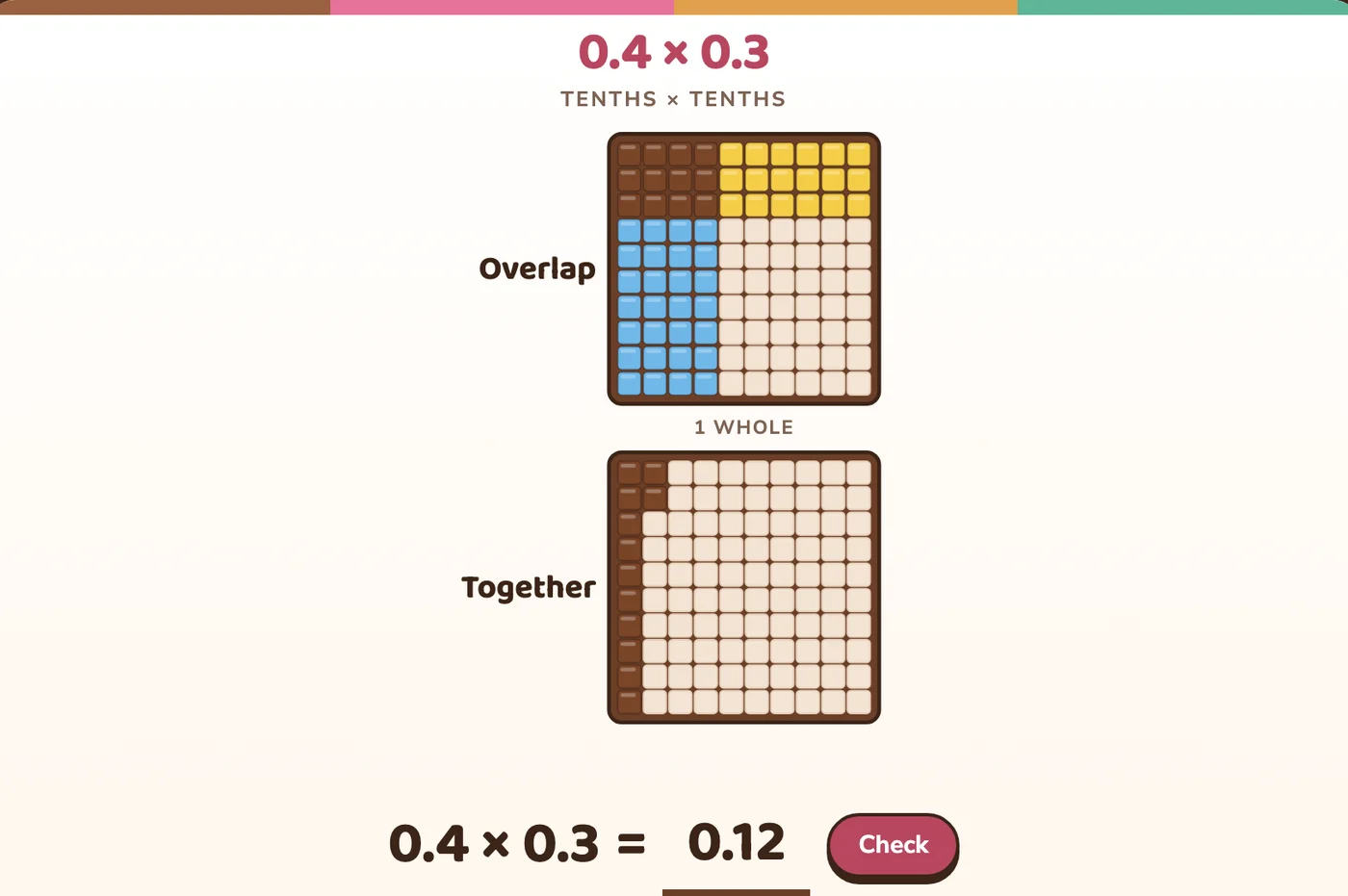
Times a decimal is the area model. For 0.4 × 0.3, students shade 0.4 across in blue (4 columns), then 0.3 down in yellow (3 rows). Where the two overlap is the answer, in chocolate.
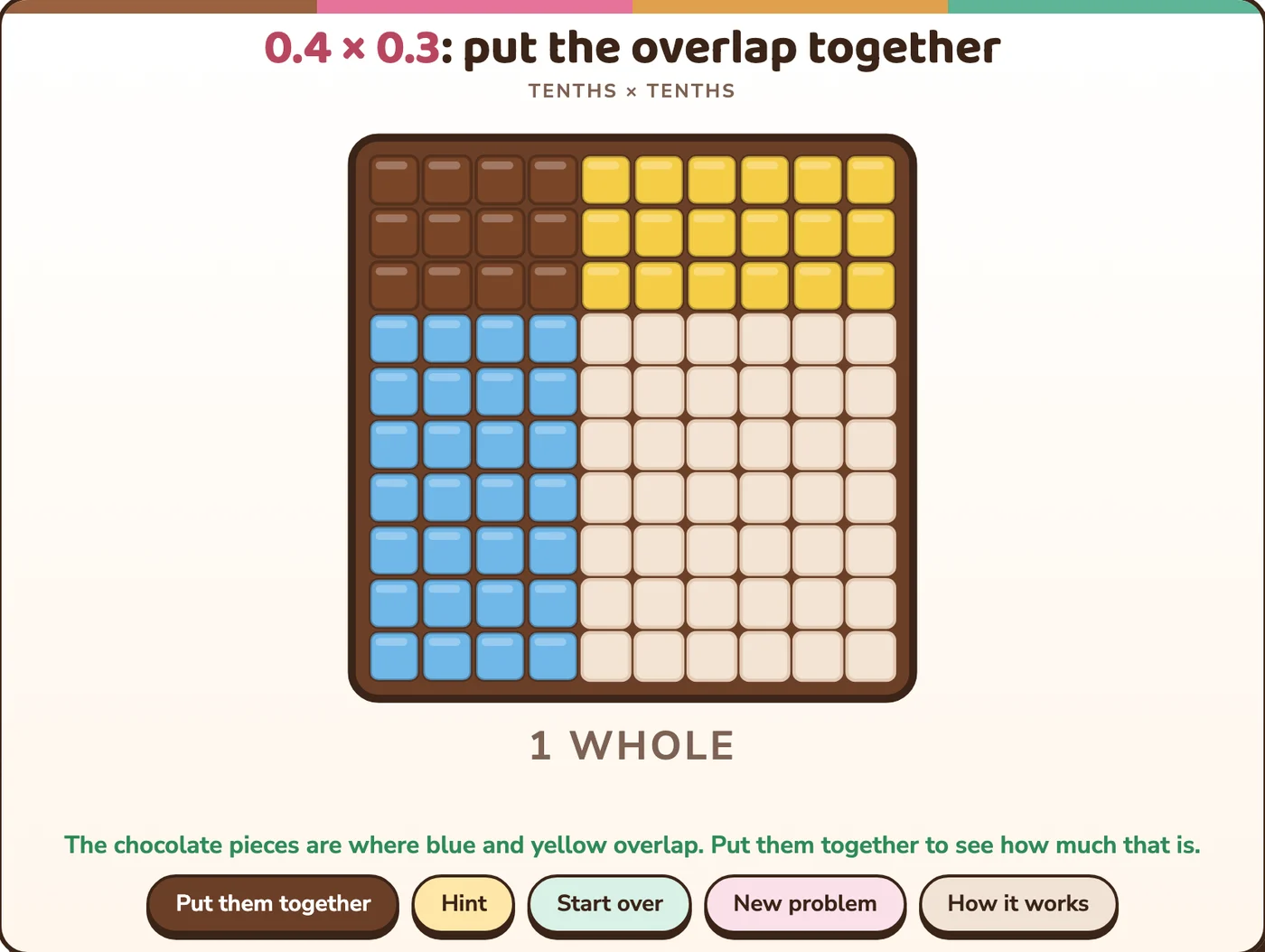
Put them together moves the chocolate overlap into one bar, so it can be read as a decimal: 12 pieces, 0.12. It's smaller than both numbers, and students can see why: it's part of a part.
Decimal × decimal
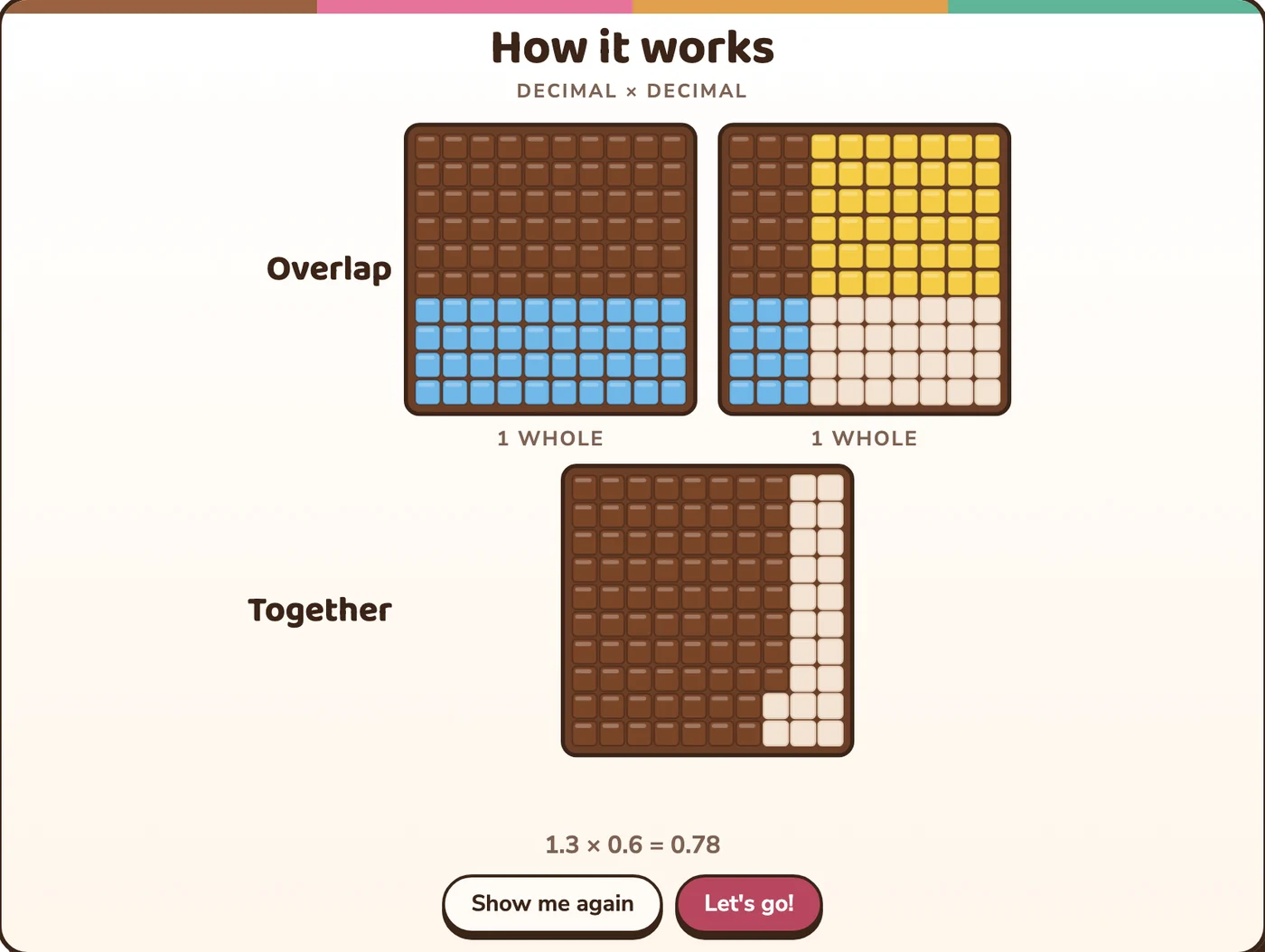
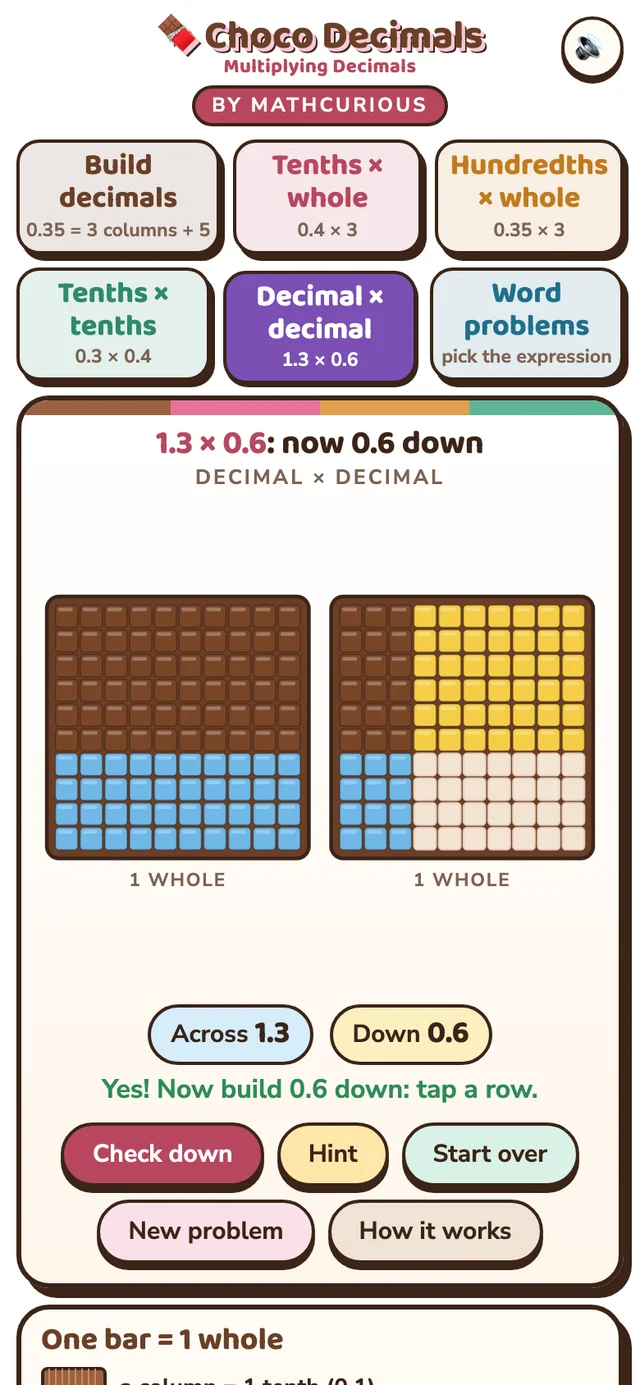
For 1.3 × 0.6, 1.3 across takes two bars: 1 whole bar and 3 more columns. 0.6 down is 6 rows on both bars.
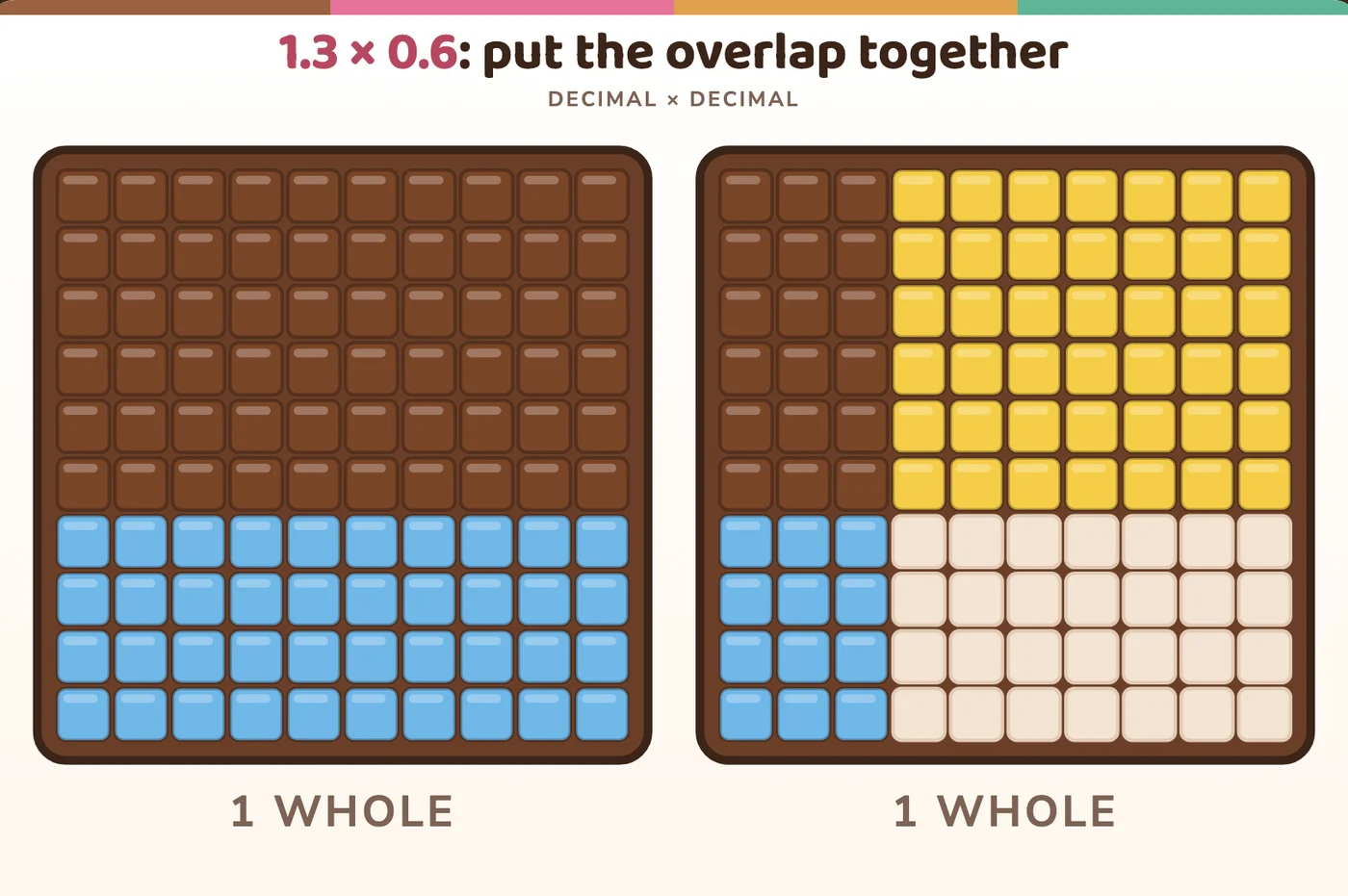
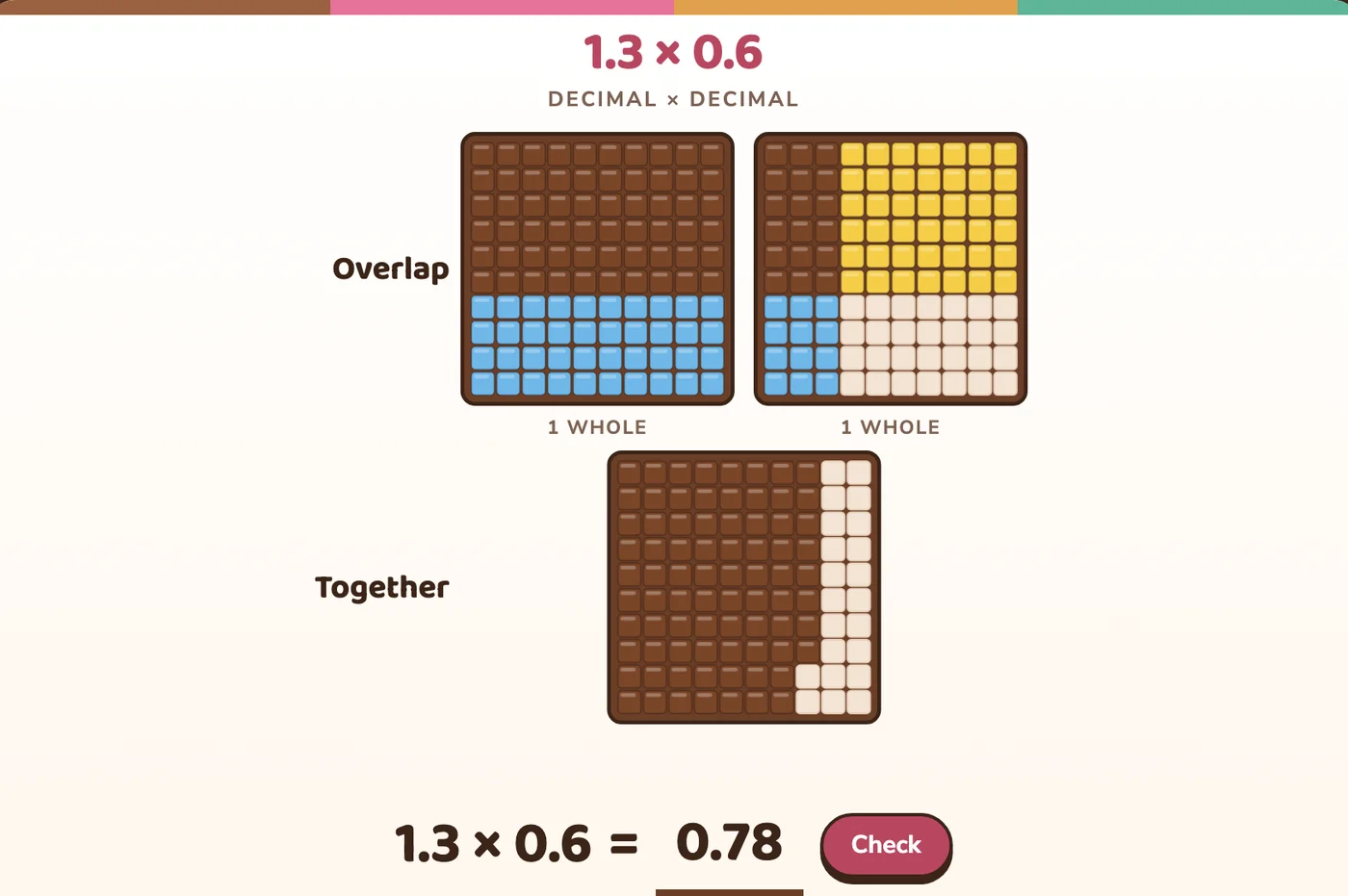
The overlap is 13 × 6 = 78 pieces. Put together, they fill 7 columns and 8 pieces of one bar: 0.78.
The wrapper
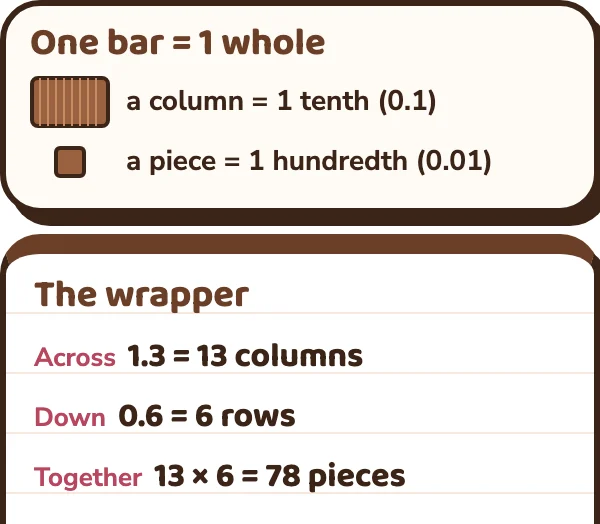
Every step is written on the wrapper beside the bars, so the model and the numbers meet: across 1.3 = 13 columns, down 0.6 = 6 rows, together 13 × 6 = 78 pieces.
Hints for the mistakes students make
Students who type 105 for 0.35 × 3 are told that each piece is only a hundredth. Answers that are off by a place, like 10.5 or 0.105, get "Check the place value." And in the area model, a wrong answer points back to the chocolate: count the columns times the rows, and each piece is a hundredth.
How it works, for every level
The first time a level is opened, it starts with a worked example on the bars, with a short explanation. It's always one tap away with the How it works button.
Six levels
- Build decimals: show tenths and hundredths on a bar, like 0.35
- Tenths × whole: like 0.4 × 3
- Hundredths × whole: like 0.35 × 3
- Tenths × tenths: the area model on one bar, like 0.4 × 0.3
- Decimal × decimal: the area model across two bars, like 1.3 × 0.6
- Word problems: pick the expression, then solve it on the bars
Every level makes new problems each time.
Word problems
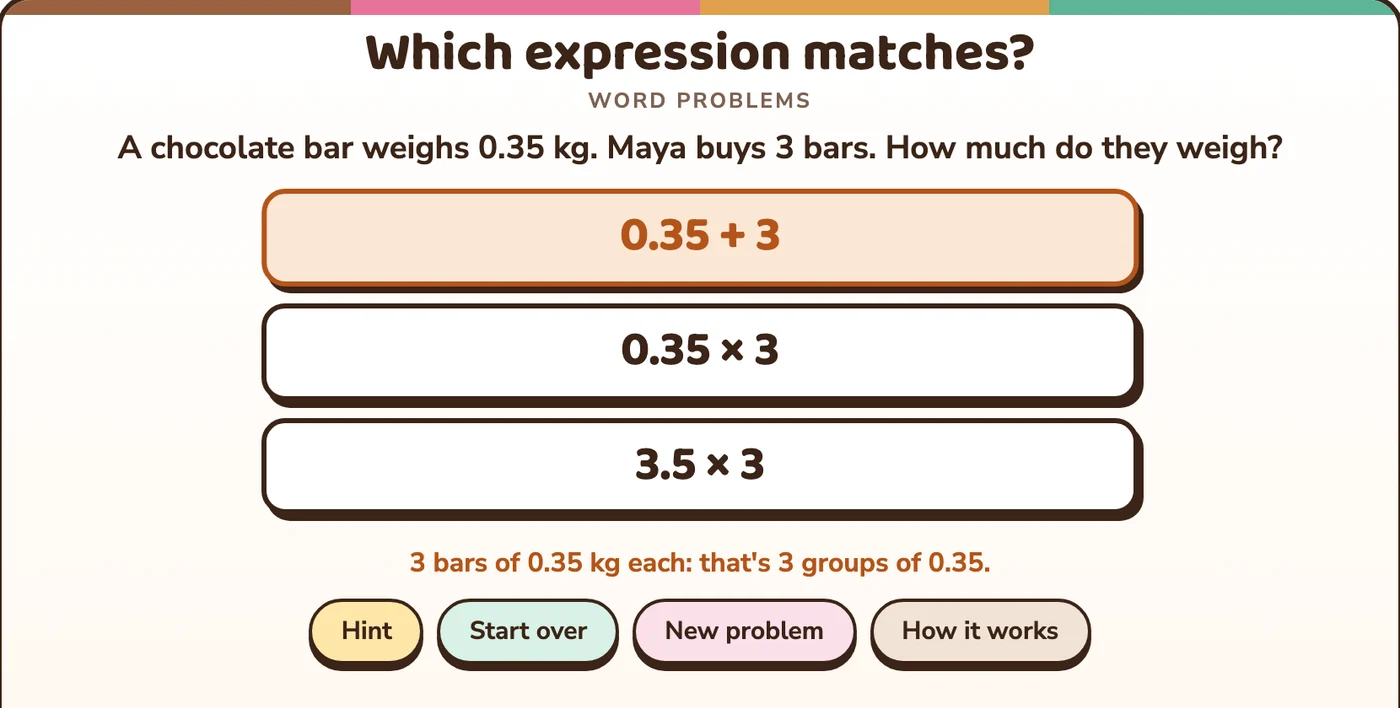
"A chocolate bar weighs 0.35 kg. Maya buys 3 bars. How much do they weigh?" Students pick the matching expression first.
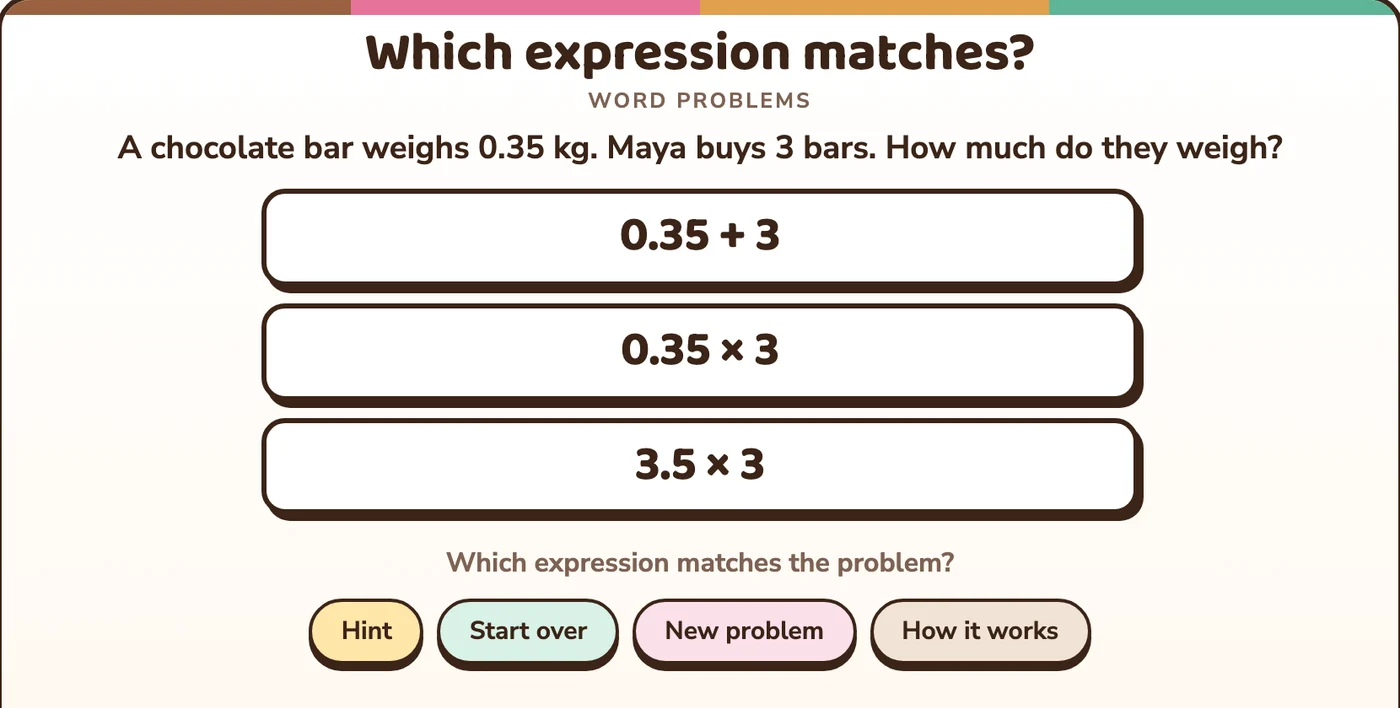
Picking 0.35 + 3 gets "3 bars of 0.35 kg each: that's 3 groups of 0.35." The right one is then solved on the bars, from building 0.35 to pouring the groups.
Choco Decimals works on phones too.
What students practise
- Representing tenths and hundredths on a hundredths grid
- Multiplying a decimal by a whole number as equal groups
- Multiplying a decimal by a decimal with the area model
- Reading the product from full bars, columns and pieces
- Seeing why multiplying by a decimal less than 1 makes a number smaller
- Choosing the right operation in word problems
Teaching tips
- Model How it works on the class board before students try a level.
- Ask before they multiply: "Will the answer be bigger or smaller than the decimal?"
- Estimate first. 0.35 is about a third of a bar, so 0.35 × 3 should be a little over 1.
- Link the pieces to the digits. 13 columns × 6 rows = 78 pieces, so 1.3 × 0.6 = 0.78.
- Read the wrapper aloud at the end, so the model and the written method meet.
Standards
- 5.NBT.B.7: multiply decimals to hundredths using concrete models and drawings, and explain the reasoning
- 5.NBT.A.1 and 5.NBT.A.3: place value of tenths and hundredths
- 5.NF.B.5: multiplication as scaling
- 6.NS.B.3: fluency with decimal multiplication
Quick answers
What grades is it for? Grades 5–6, and it's good review in grade 7.
Do students need accounts? No. It's a link, so there's nothing to sign in to.
What devices does it work on? Any device with a web browser, including Chromebooks, tablets, phones and the classroom board.
Can I turn the sound off? Yes, with the speaker button at the top. The tool remembers it.
Get Choco Decimals
Build it, multiply it, count it: decimal multiplication students can see.