Adding and Subtracting Fractions with Fraction Bars: Add & Subtract Fractions
Add & Subtract Fractions is a digital tool for the moment students first meet unlike denominators. "Find a common denominator" is the rule, but most students never see why thirds and fourths can't just be added, or why 1/3 + 1/4 isn't 2/7.
In this tool, both fractions sit on fraction bars of the same size whole. Students cut both bars into the same size parts, slide the parts together to add or take them away to subtract, and count what they have. Every answer is checked, and every answer ends in simplest form.
Watch it in action
The tool runs in any web browser. There's nothing to print, cut or laminate, and students don't need logins.
Two bars, different size parts
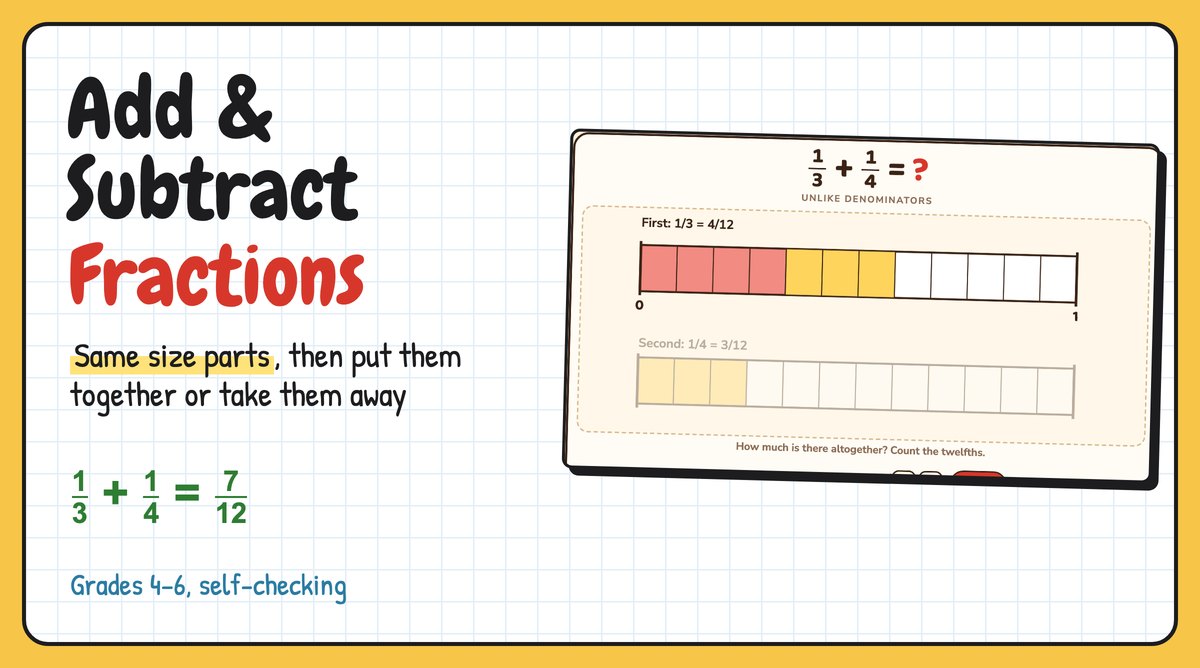
For 1/3 + 1/4, the first number is a red bar cut into thirds and the second is a yellow bar cut into fourths, both on the same size whole.
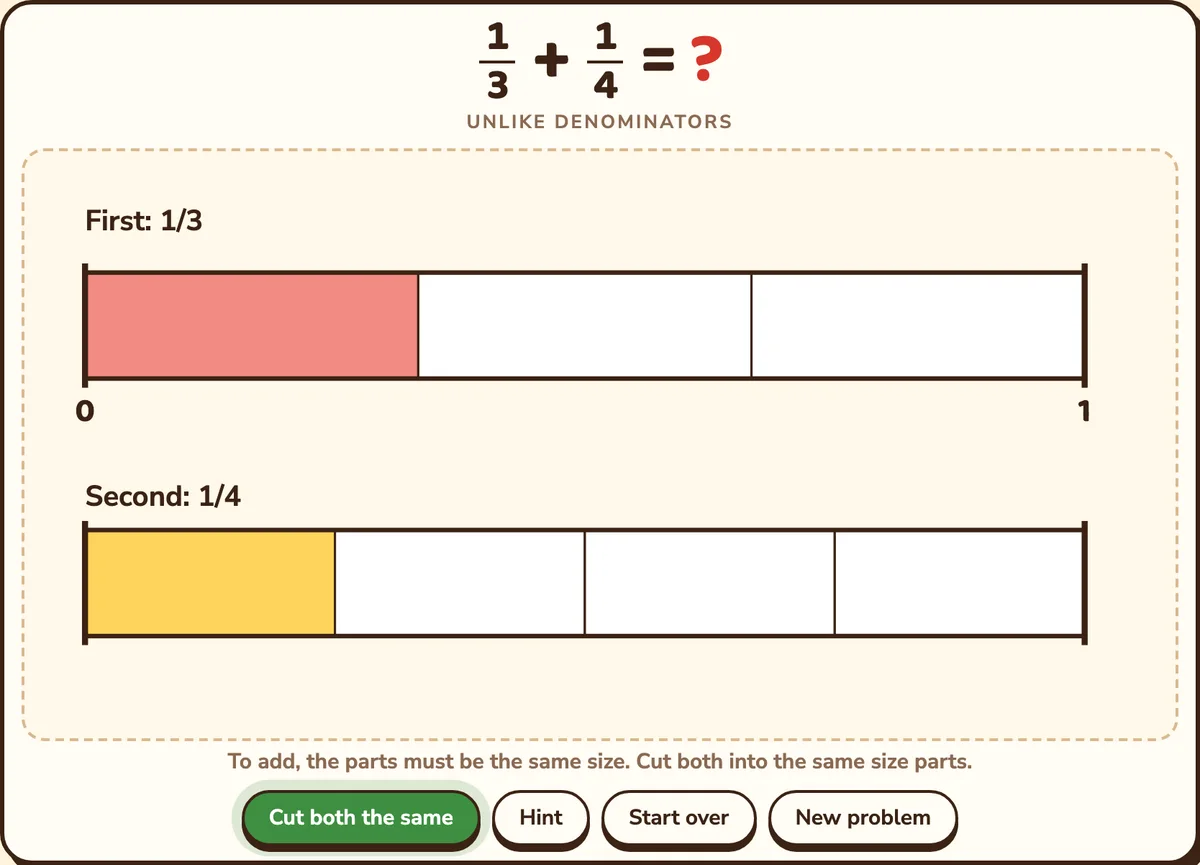
The parts are different sizes, so there's nothing to count yet: one third and one fourth don't make "two" of anything.
Cut both the same
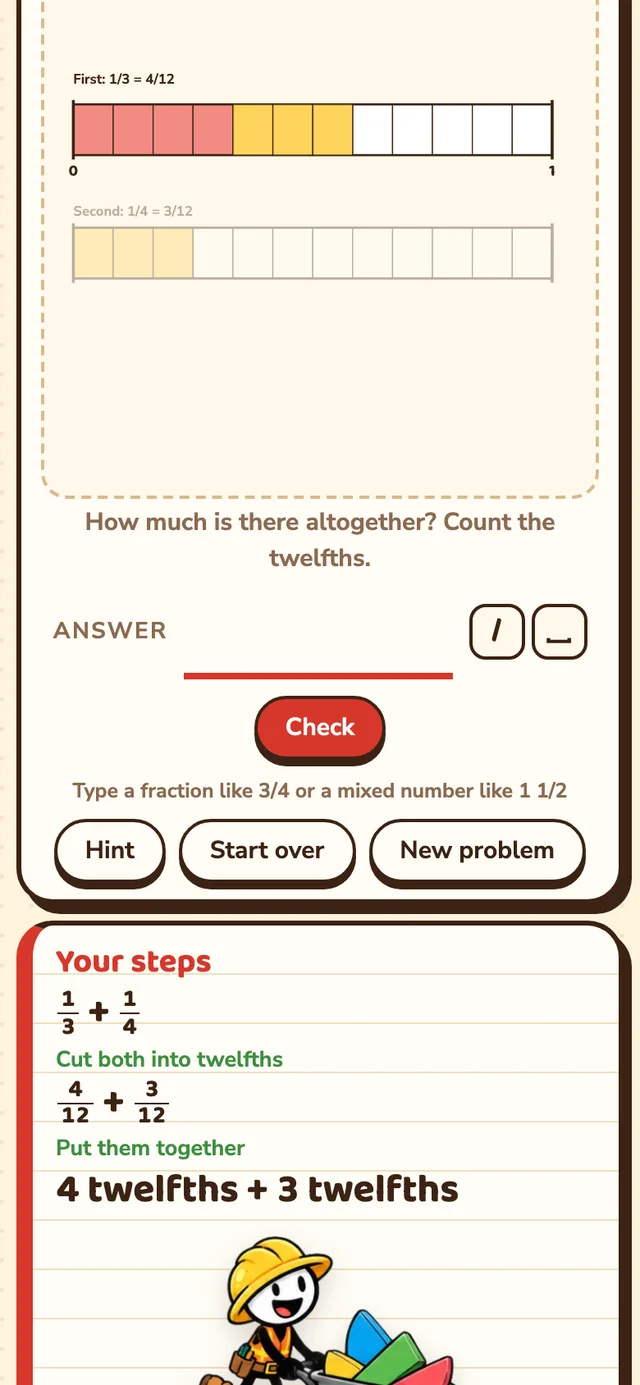
Students type a number that both 3 and 4 go into. Twelve works, and so does 24. Both bars are cut again, and the labels show the new names: 1/3 = 4/12 and 1/4 = 3/12.
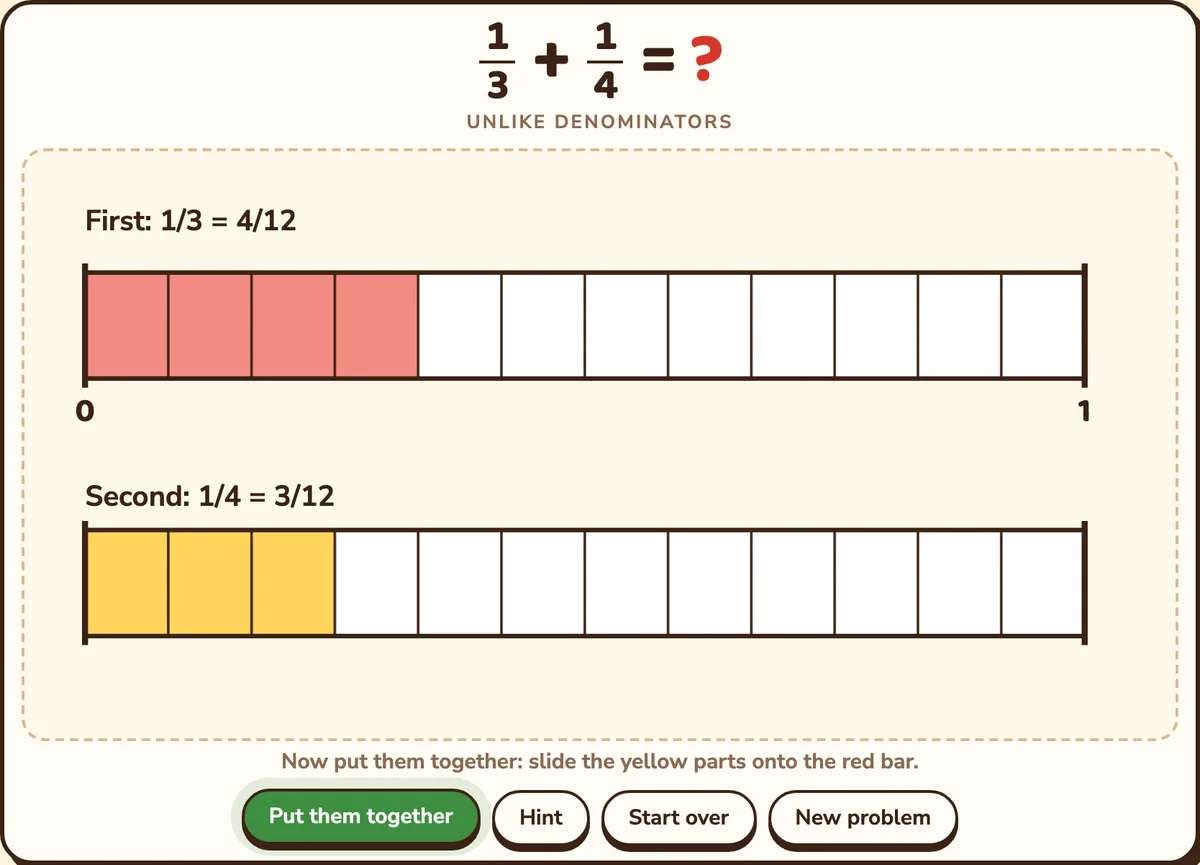
A number that doesn't work, like 6, gets "Pick a number that both 3 and 4 go into, like 12." When the denominators already match, the tool skips this step.
Put them together
The yellow parts slide up and join the end of the red bar. Now every part is a twelfth, and students count them: 4 twelfths and 3 twelfths make 7 twelfths.
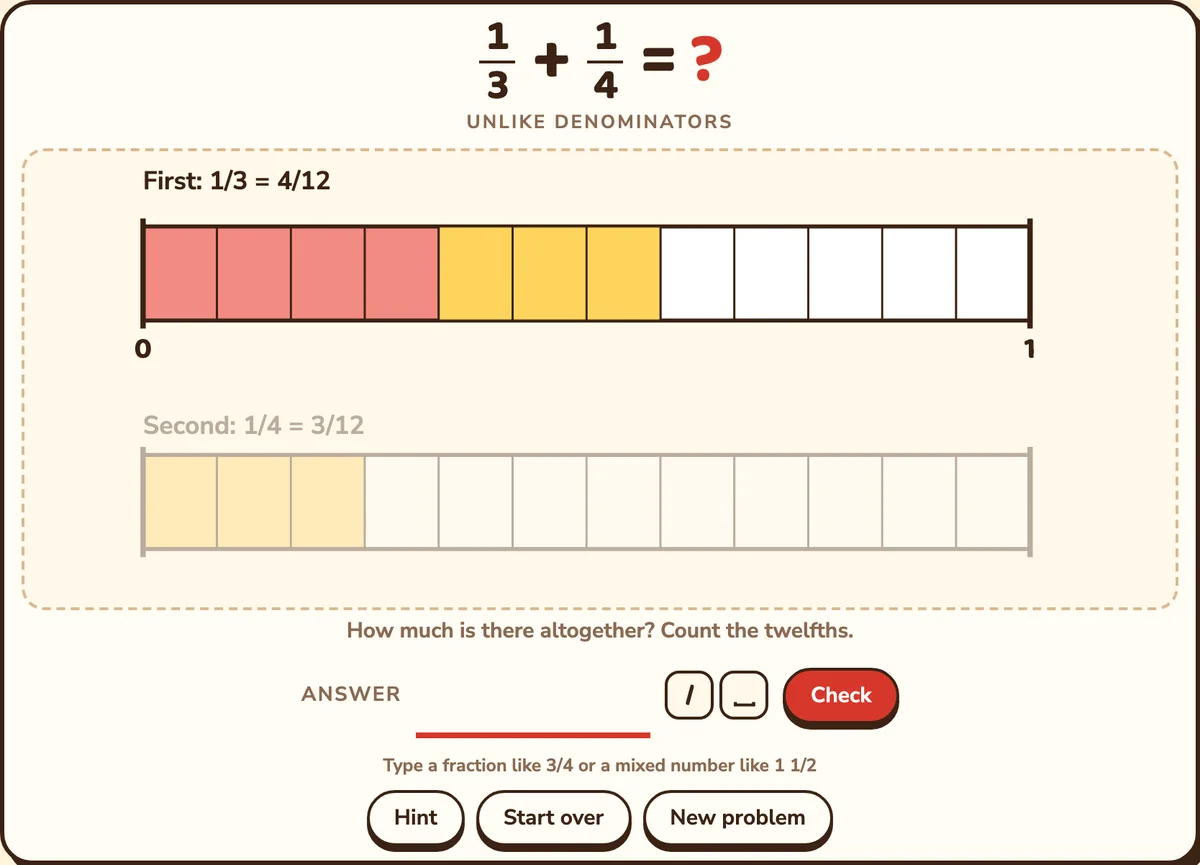
Adding the bottom numbers is caught: an answer of 2/7 gets "Don't add the bottom numbers: the parts stay the same size."
More than one whole
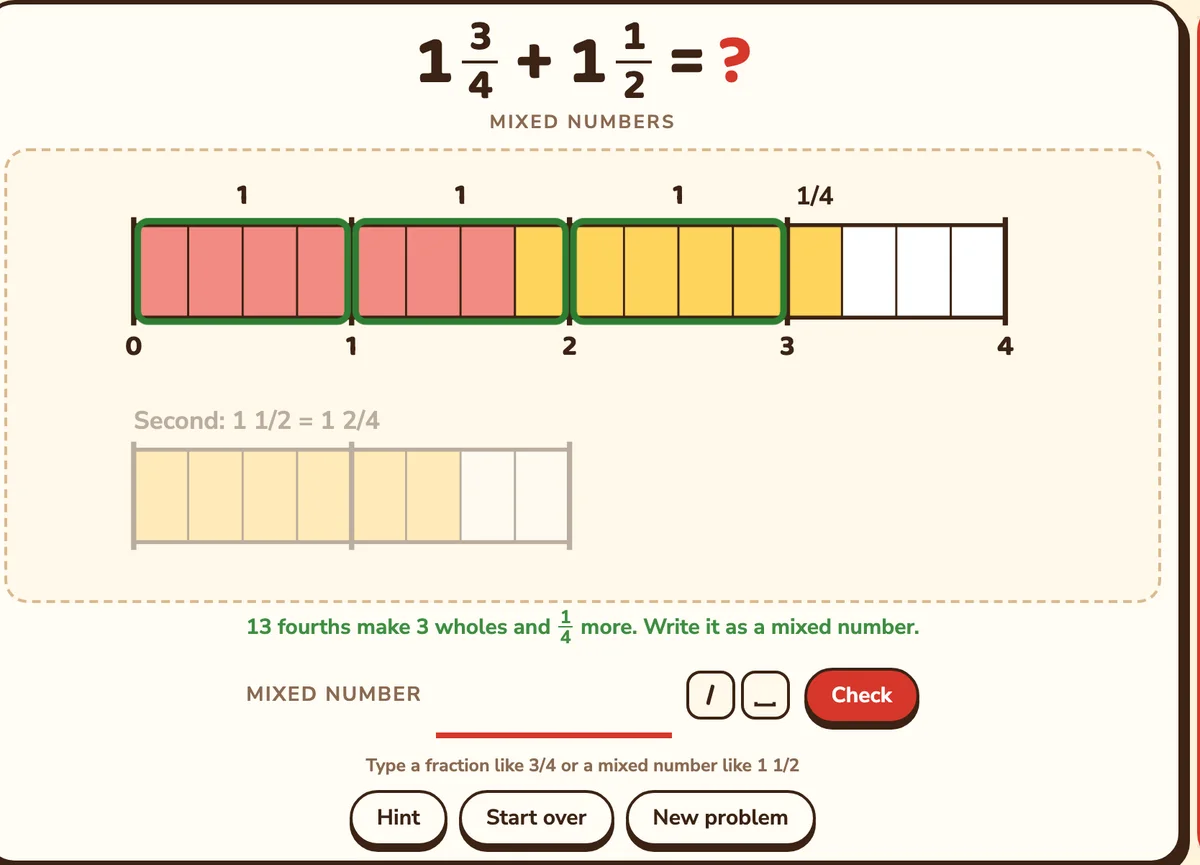
When the answer is 1 or more, students write what they count first: 3/4 + 2/3 is 9 twelfths and 8 twelfths, so 17/12. Then Put the parts together frames every full whole in green:
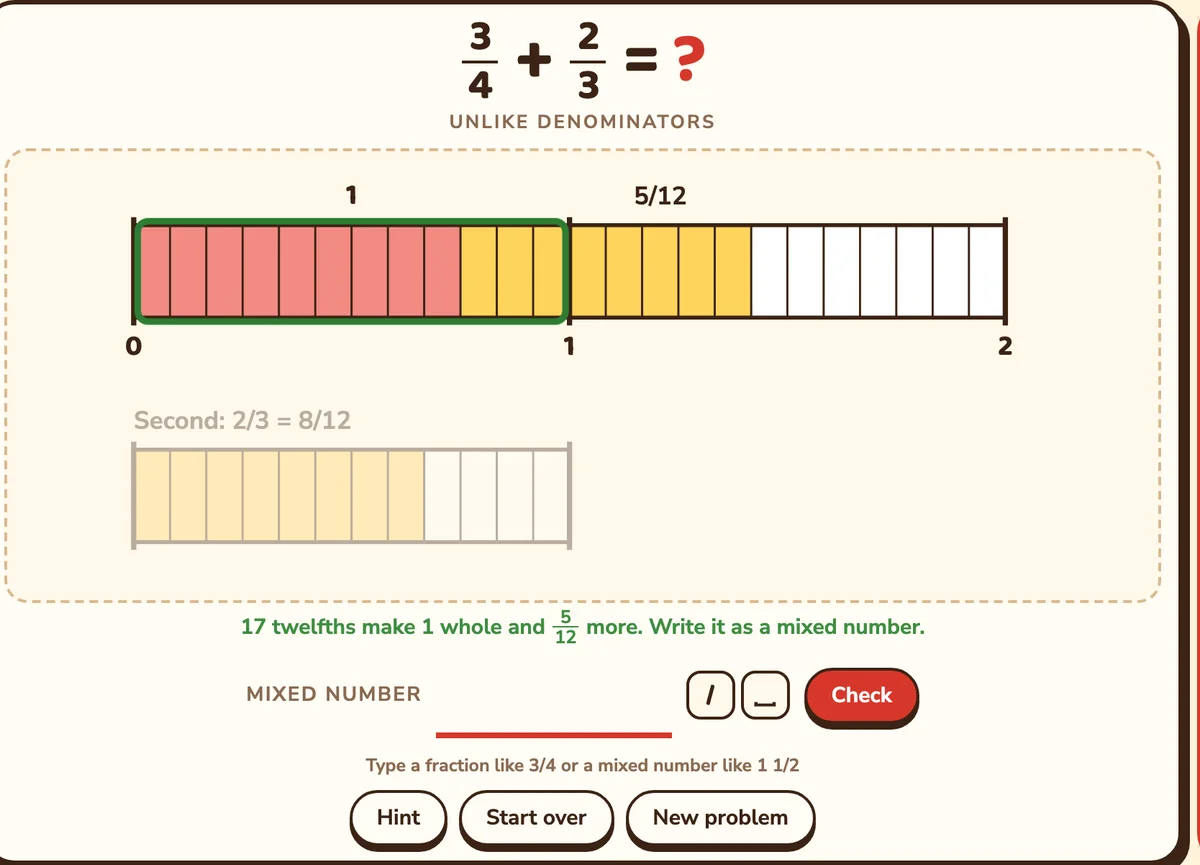
17 twelfths make 1 whole and 5/12 more, so the answer is 1 5/12. Mixed numbers work the same way: 1 3/4 + 1 1/2 fills three wholes and 1/4 of another.
Subtraction: take it away
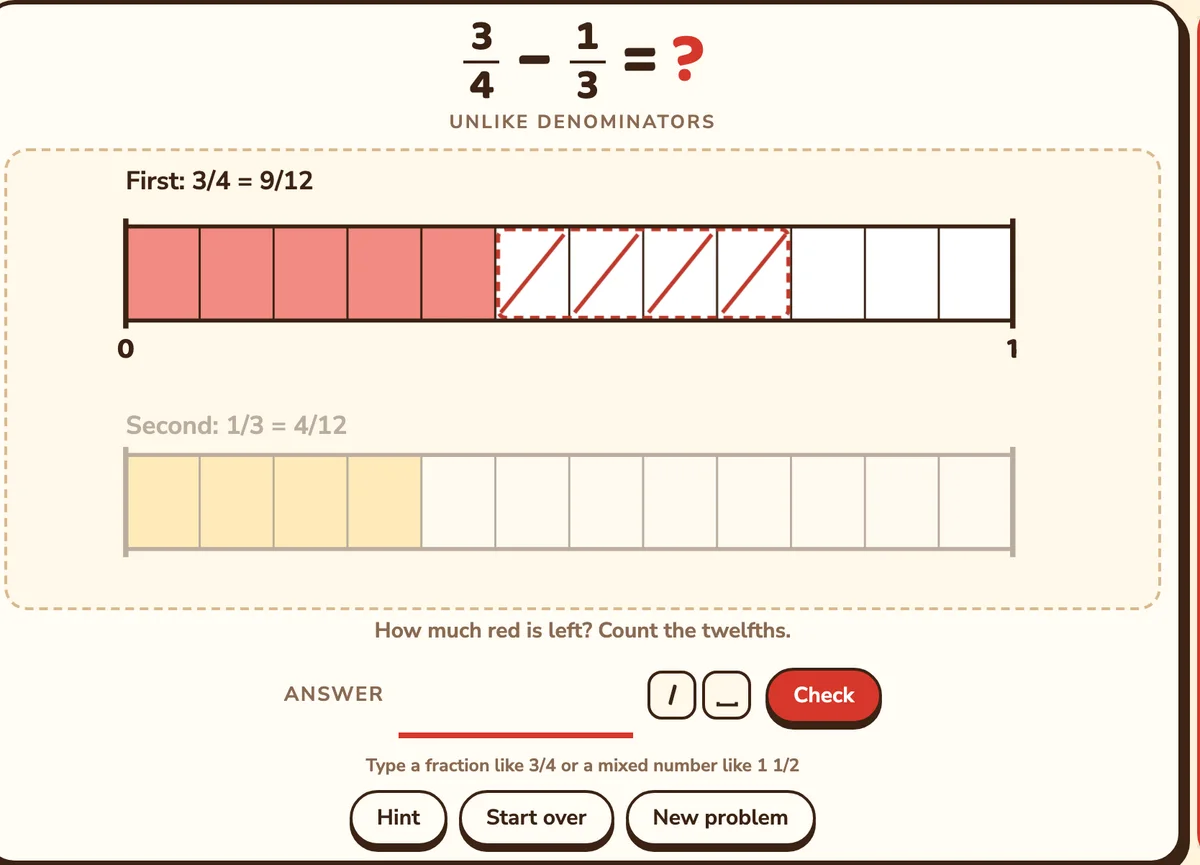
To subtract, the yellow amount slides up over the end of the red bar, and those parts are crossed out. For 3/4 − 1/3, it's 9 twelfths take away 4 twelfths, and 5 twelfths of red are left.
Regrouping you can see
Subtracting mixed numbers is where most students get stuck. In 2 1/4 − 1 2/3, there are only 3 twelfths in the fraction part, and 8 twelfths have to come away. On the bar, the wholes are already cut into twelfths, so the crossed-out parts simply run across a whole:
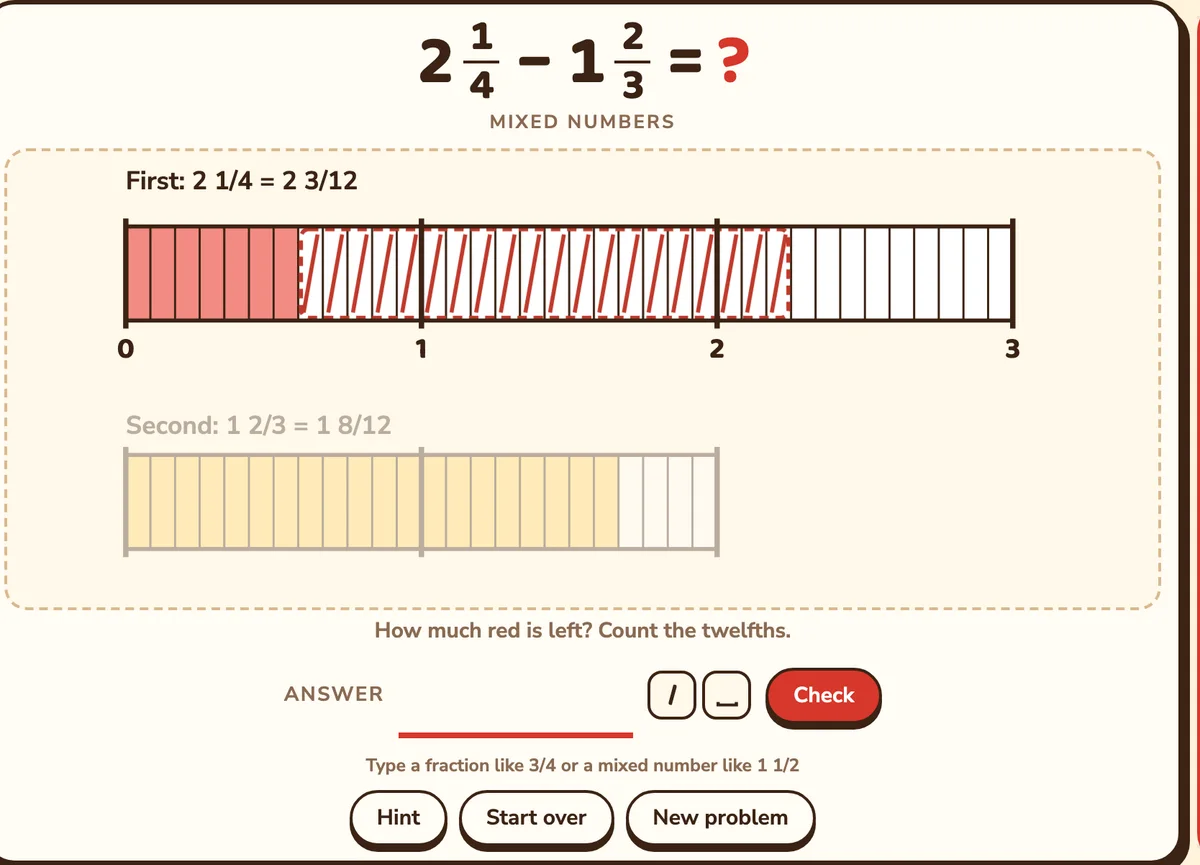
7 twelfths are left. A student who takes the smaller fraction from the bigger and answers 1 5/12 gets "You can't take 8/12 from 3/12. Break a whole into twelfths first: look at the bar."
Simplest form, with both bars
1/3 + 1/6 is 2 sixths and 1 sixth: 3/6. That's right, but it can be simpler. The addition bar stays on screen, and Group the parts draws the same amount underneath in bigger parts:
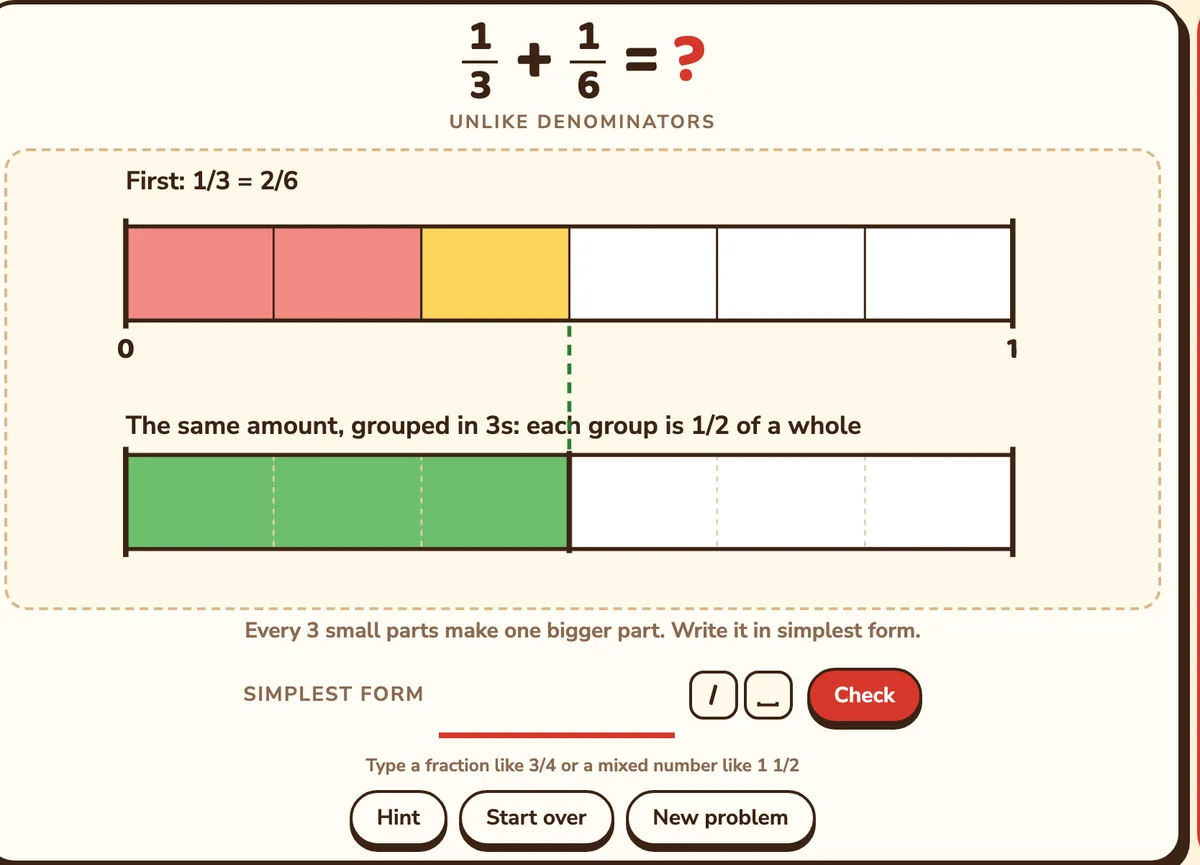
The green ends at the same place on both bars, so students see that 3/6 and 1/2 are the same amount before they write it.
Addition and subtraction, 5 levels each
A switch at the top chooses Addition or Subtraction, and each has the same five levels:
- Same denominators: 2/5 + 1/5, 4/5 − 1/5
- Related denominators: 1/2 + 3/8, 3/4 − 3/8
- Unlike denominators: 1/3 + 1/4, 3/4 − 1/3
- Mixed numbers: 1 1/2 + 1 2/3, and 2 1/4 − 1 2/3 with regrouping
- Word problems: pizza, flour, ribbon, juice
Every level makes new problems each time.
Word problems: add or subtract?
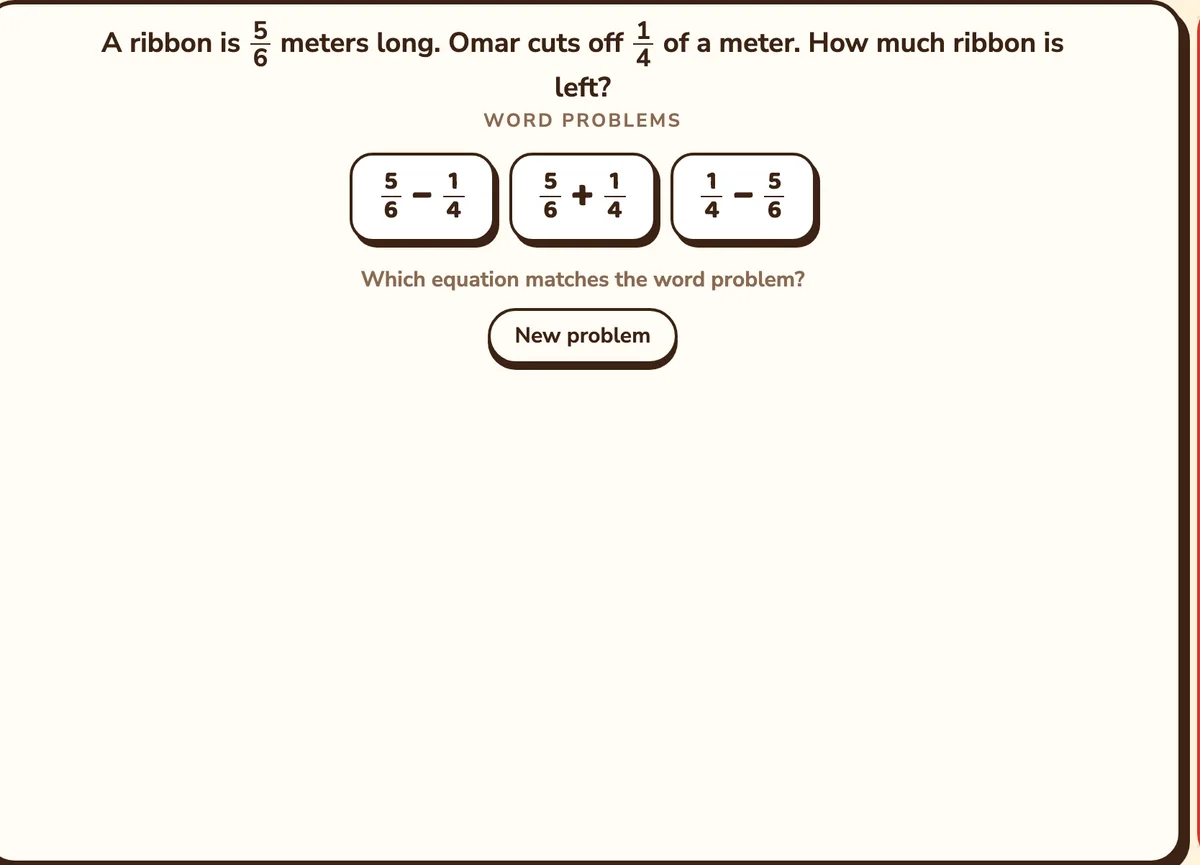
In Word problems, students read the problem and choose the equation first. "A ribbon is 5/6 of a meter long. Omar cuts off 1/4 of a meter. How much ribbon is left?" is 5/6 − 1/4, not 1/4 − 5/6. Then they solve it on the bars.
The builders
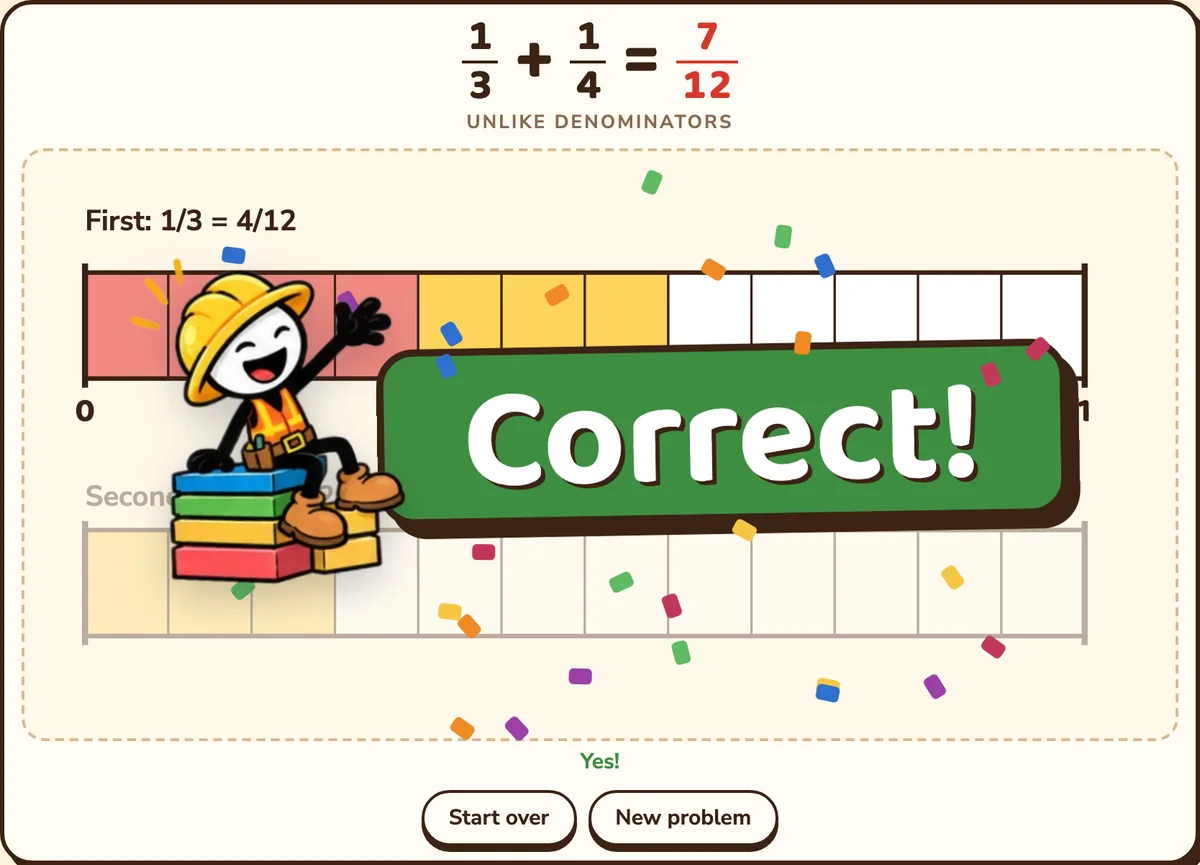
A builder in the steps panel changes with every step: measuring at the start, sawing when the bars are cut, pushing a wheelbarrow of pieces when they go together, hammering when parts are grouped. Every right answer gets a big Correct! with one of the celebrating builders.
What students practise
- Finding common denominators, and seeing why they're needed
- Adding and subtracting fractions with like and unlike denominators
- Adding and subtracting mixed numbers, with regrouping
- Writing improper fractions as mixed numbers
- Simplifying and seeing equivalent fractions
- Choosing the operation for a word problem
Teaching tips
- Ask why first. Before cutting, ask: "Can we add thirds and fourths as they are?"
- Say the new names. "One third is four twelfths."
- Estimate. "Will the answer be more or less than 1?"
- For regrouping, ask "Are there enough twelfths to take away? Where can we get more?"
- Read the steps aloud at the end, so the bars and the written method meet.
Standards
- 4.NF.B.3: add and subtract fractions and mixed numbers with like denominators
- 5.NF.A.1: add and subtract fractions with unlike denominators, including mixed numbers
- 5.NF.A.2: solve word problems involving adding and subtracting fractions
Quick answers
Do students need accounts? No. It's a link, so there's nothing to sign in to.
What devices does it work on? Any device with a web browser, including Chromebooks, tablets and the classroom board.
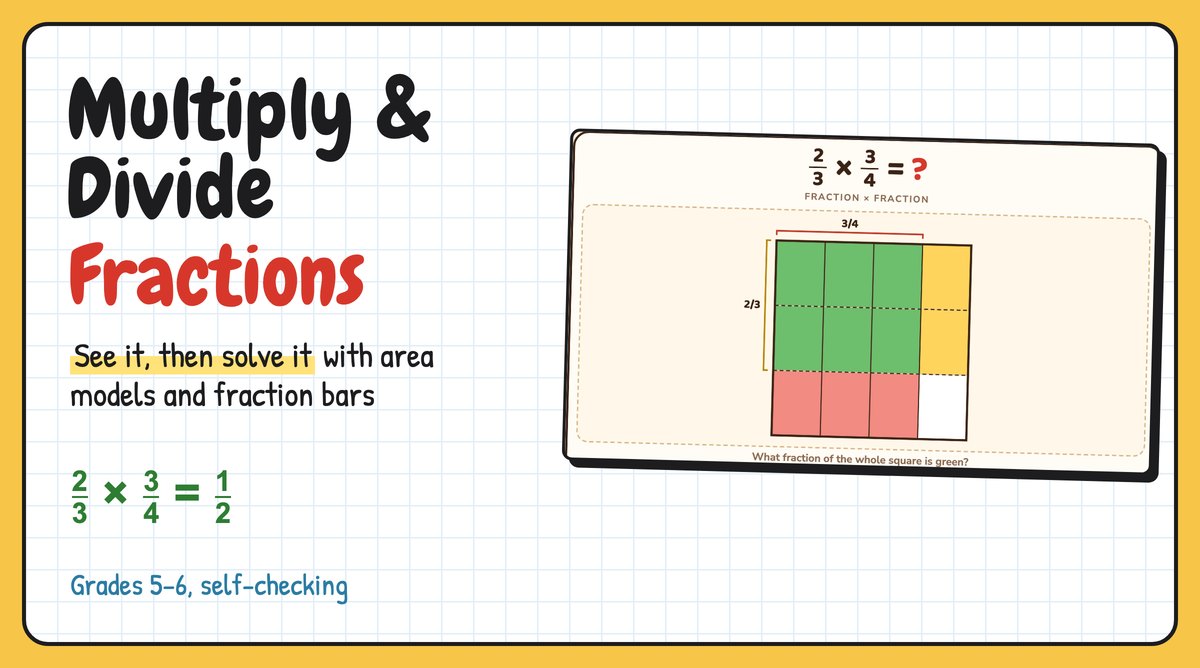
Does it work with Multiply & Divide Fractions? Yes, it's made in the same style. Multiply & Divide Fractions covers area models and dividing with fraction pieces.
Can I turn the sound off? Yes, with the speaker button at the top. The tool remembers it.
Get both tools in the bundle
This tool has a partner: Multiply & Divide Fractions, made in the same style with the same builders. Together they cover all four operations with fractions, from common denominators to dividing with fraction pieces, and they're sold together as a bundle.
Get the Fractions bundle: Add, Subtract, Multiply & Divide
Get Add & Subtract Fractions
Let students see why the parts have to match, and common denominators start to make sense.