Mental Math Strategies for Division: self-checking, instant feedback
Mental math strategies for division turn scary-looking problems into friendly ones. Students halve, double, split numbers into easy parts and lean on what they already know about multiplication. Along the way they build the number sense that makes estimating, checking answers and understanding remainders much easier.
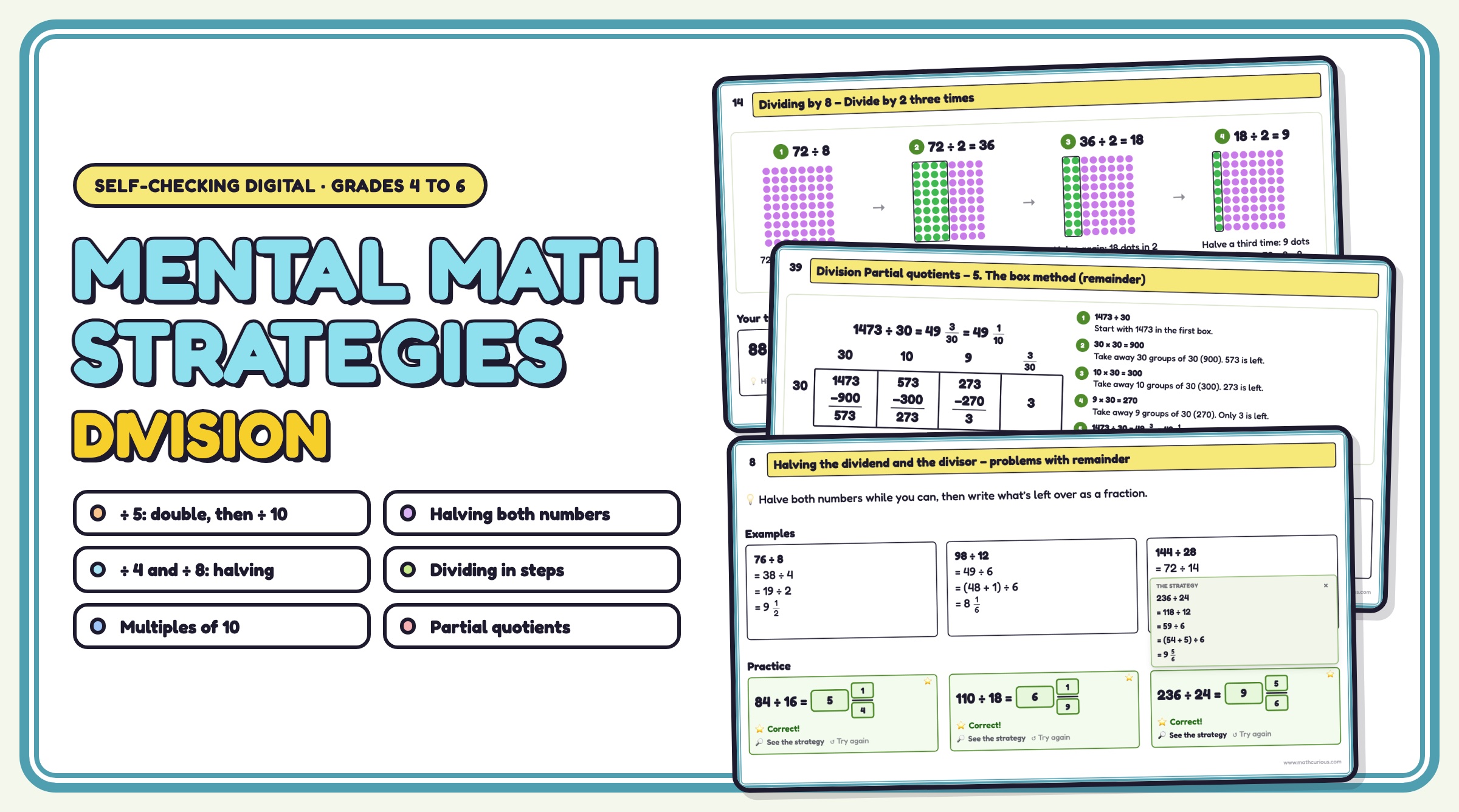
Mental Math Strategies: Division is a self-checking digital version of our classroom slide deck (that comes in print task cards, worksheets, and google slides). It has 52 slides, pictures that show every step of each strategy, and 163 problems that check themselves, including remainders written as fractions.
Watch it in action
It plays in any web browser, one slide at a time, just like the deck. There's nothing to print, cut or laminate, and students don't need logins.
The mental math strategies for division
Start with one big idea
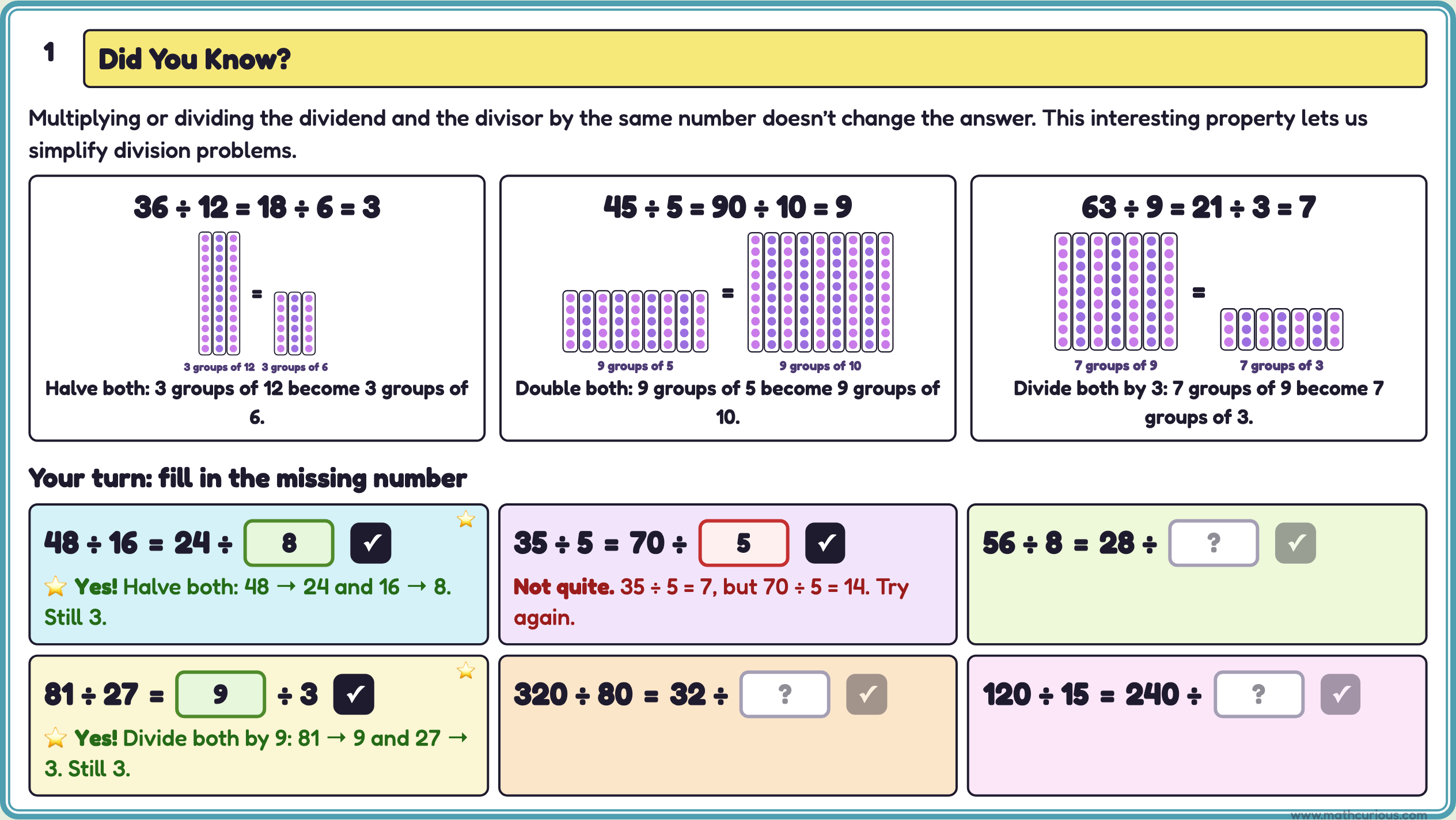
In 12 ÷ 3 = 4, 12 is the dividend, 3 is the divisor and 4 is the quotient. Here's the idea that makes most division strategies work: multiplying or dividing the dividend and the divisor by the same number doesn't change the answer.
- 36 ÷ 12 = 18 ÷ 6 = 3
- 45 ÷ 5 = 90 ÷ 10 = 9
- 63 ÷ 9 = 21 ÷ 3 = 7
Pictures make it click. 36 ÷ 12 is 3 groups of 12. Halve both numbers and you get 3 groups of 6: the groups are smaller, but there are still 3 of them.
1. Dividing by 5: double, then divide by 10
Dividing by 10 is easy, so double both numbers: 65 ÷ 5 = 130 ÷ 10 = 13.
With a remainder, the leftover becomes tenths: 49 ÷ 5 = 98 ÷ 10 = 9 8/10 = 9 4/5.
2. Halving both numbers
When both numbers are even, halve them both, and keep halving while you can.
- 64 ÷ 8 = 32 ÷ 4 = 16 ÷ 2 = 8
- 76 ÷ 8 = 38 ÷ 4 = 19 ÷ 2 = 9 1/2
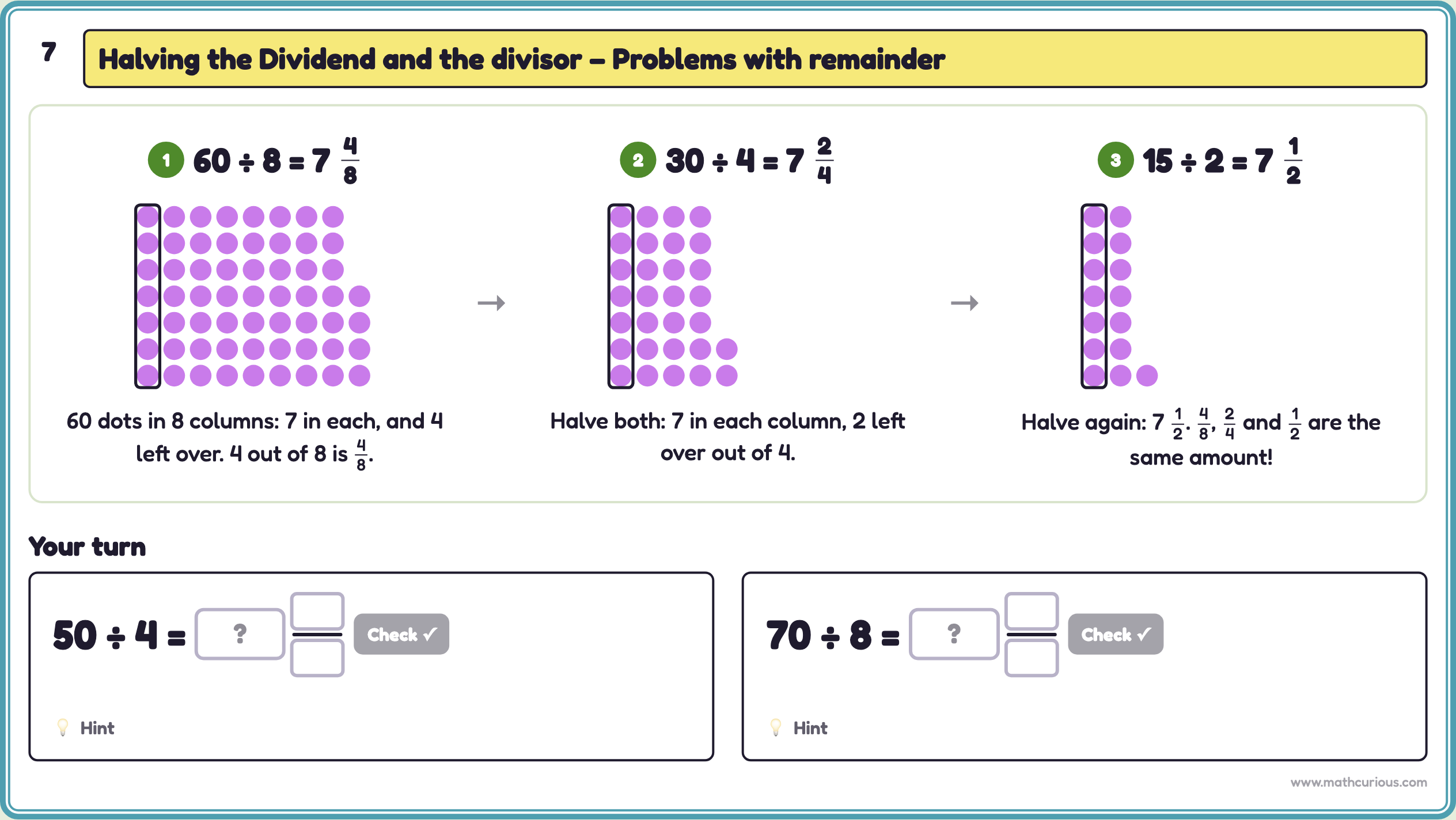
The dot arrays show why the remainders match: 4 out of 8, 2 out of 4 and 1 out of 2 are all the same amount.
3. Dividing by a common factor
If the numbers are odd, look for another number that divides both, like 3, 5 or 7: 63 ÷ 9 = 21 ÷ 3 = 7, and 500 ÷ 25 = 100 ÷ 5 = 20.
4. Dividing by 4 and 8: halving
Dividing by 4 is halving twice. Dividing by 8 is halving three times.
- 268 ÷ 4: half of 268 is 134, half of 134 is 67
- 632 ÷ 8: 316, then 158, then 79
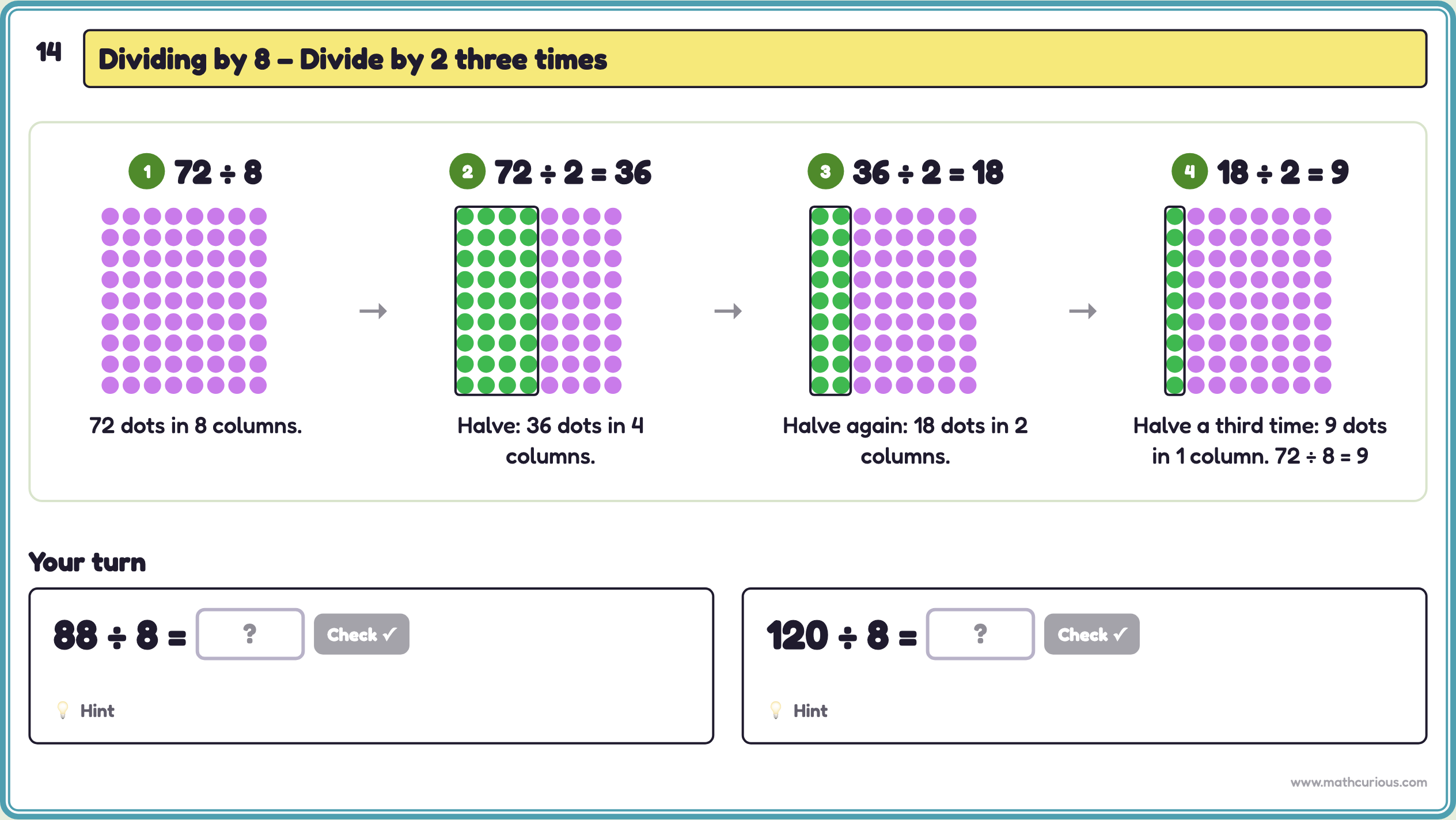
5. Dividing in steps
Split the divisor into factors and divide by one, then the other: 72 ÷ 12 = (72 ÷ 2) ÷ 6 = 36 ÷ 6 = 6, and 390 ÷ 30 = (390 ÷ 3) ÷ 10 = 13.
Or write the dividend as a product: 96 ÷ 8 = 3 × 32 ÷ 8 = 3 × 4 = 12.
6. Rounding and compensating
Round the dividend to a number the divisor goes into, then fix the difference.
- 69 ÷ 7 = (70 − 1) ÷ 7 = 10 − 1/7 = 9 6/7
- 100 ÷ 3 = (99 + 1) ÷ 3 = 33 1/3
7. Dividing multiples of 10
320 ÷ 80 is 32 tens ÷ 8 tens, which works just like 32 ÷ 8 = 4. So take the same zeros off both numbers. When only the dividend ends in zero, write it as a product: 5400 ÷ 6 = 100 × 54 ÷ 6 = 100 × 9 = 900.
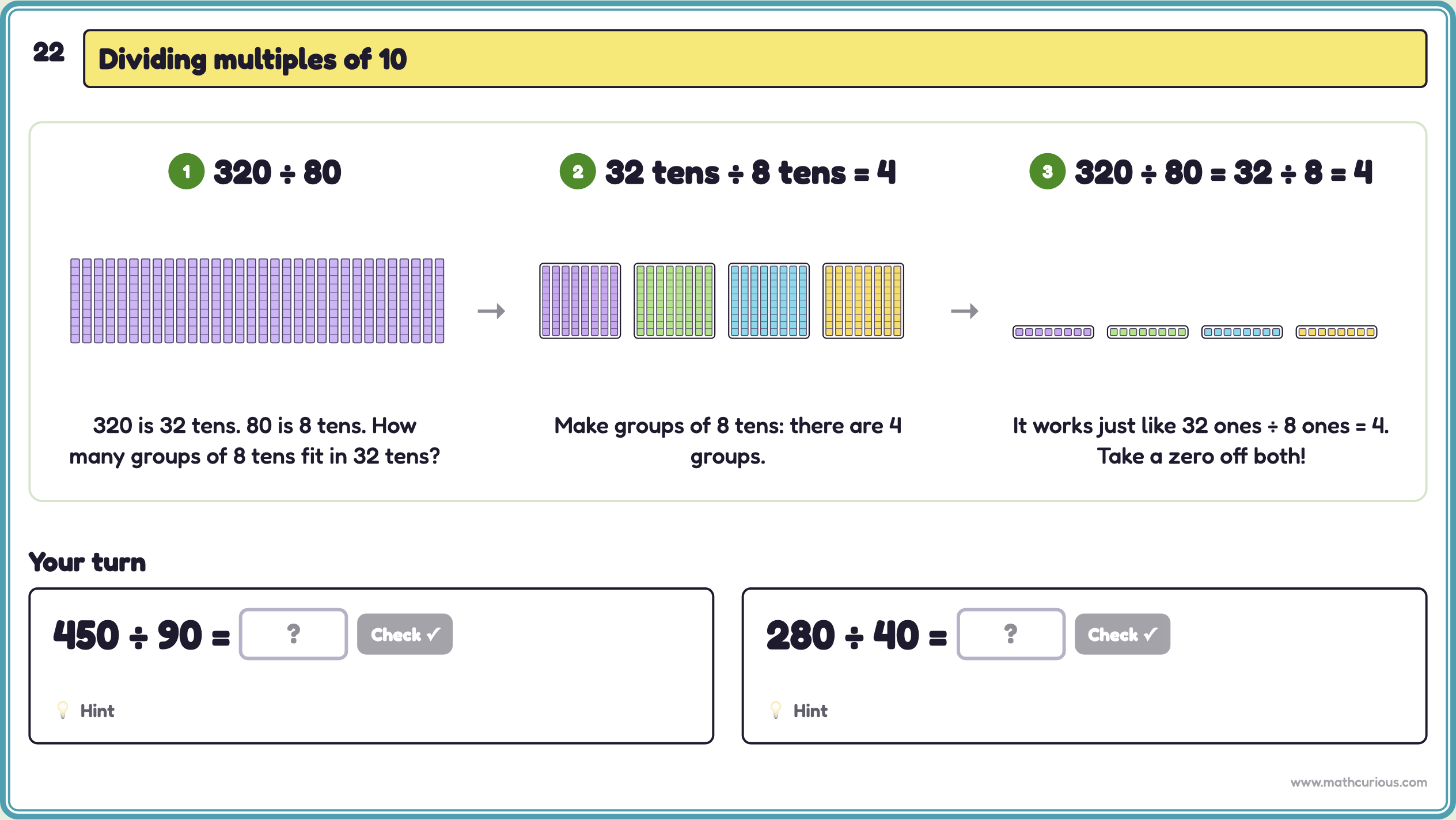
8. Partial quotients
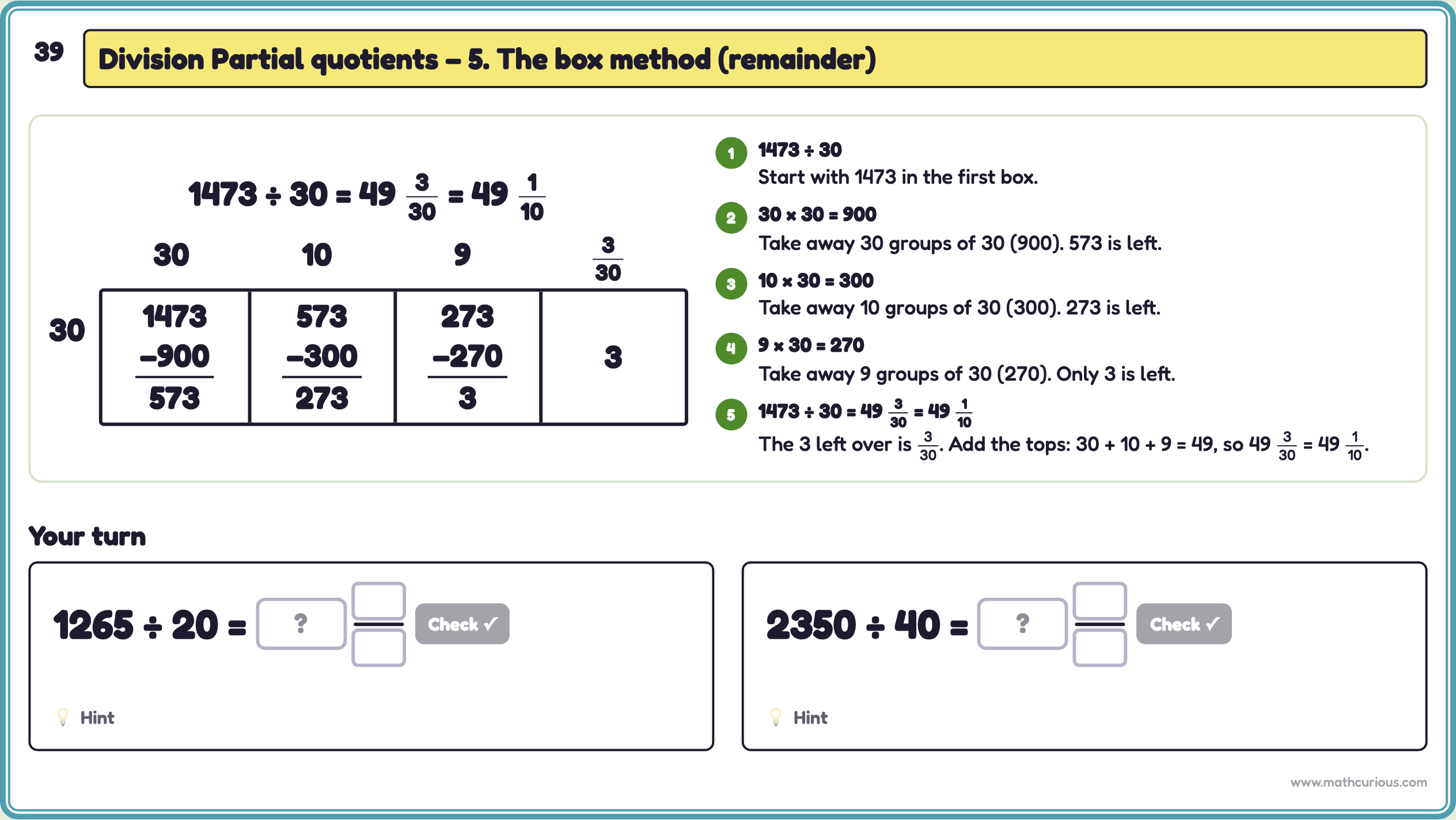
Split the dividend into parts the divisor goes into easily, divide each part, and add: 117 ÷ 9 = (90 + 27) ÷ 9 = 10 + 3 = 13. Whatever is left at the end becomes a fraction: 1879 ÷ 15 = (1500 + 300 + 75 + 4) ÷ 15 = 100 + 20 + 5 + 4/15 = 125 4/15.
The deck shows five ways to record partial quotients: repeated subtraction, splitting the dividend, a sum of fractions, the area model and the box method.
9. Divisibility rules
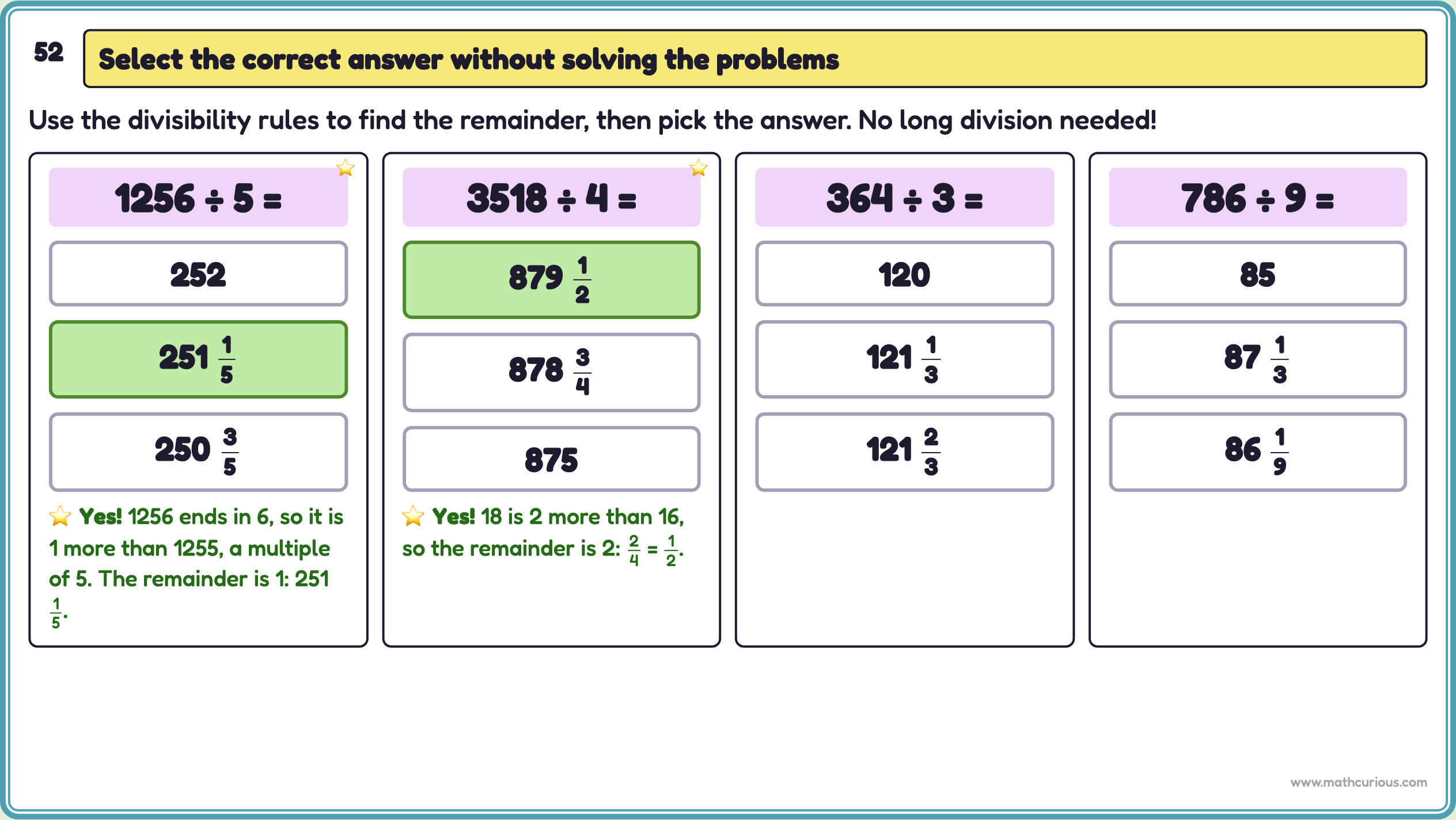
The divisibility rules tell you the remainder without dividing. 1256 ends in 6, so it is 1 more than a multiple of 5: 1256 ÷ 5 = 251 1/5.
How the self-checking works
Every step on the slide
Explanation slides put every step on the slide at once, with dot arrays, base-ten rods or the partial quotient layout, and one sentence for each step. Then students try two problems of their own.
Worked examples, then practice
Practice slides look just like the deck: the worked examples at the top and practice problems underneath. Students type an answer and press Check.
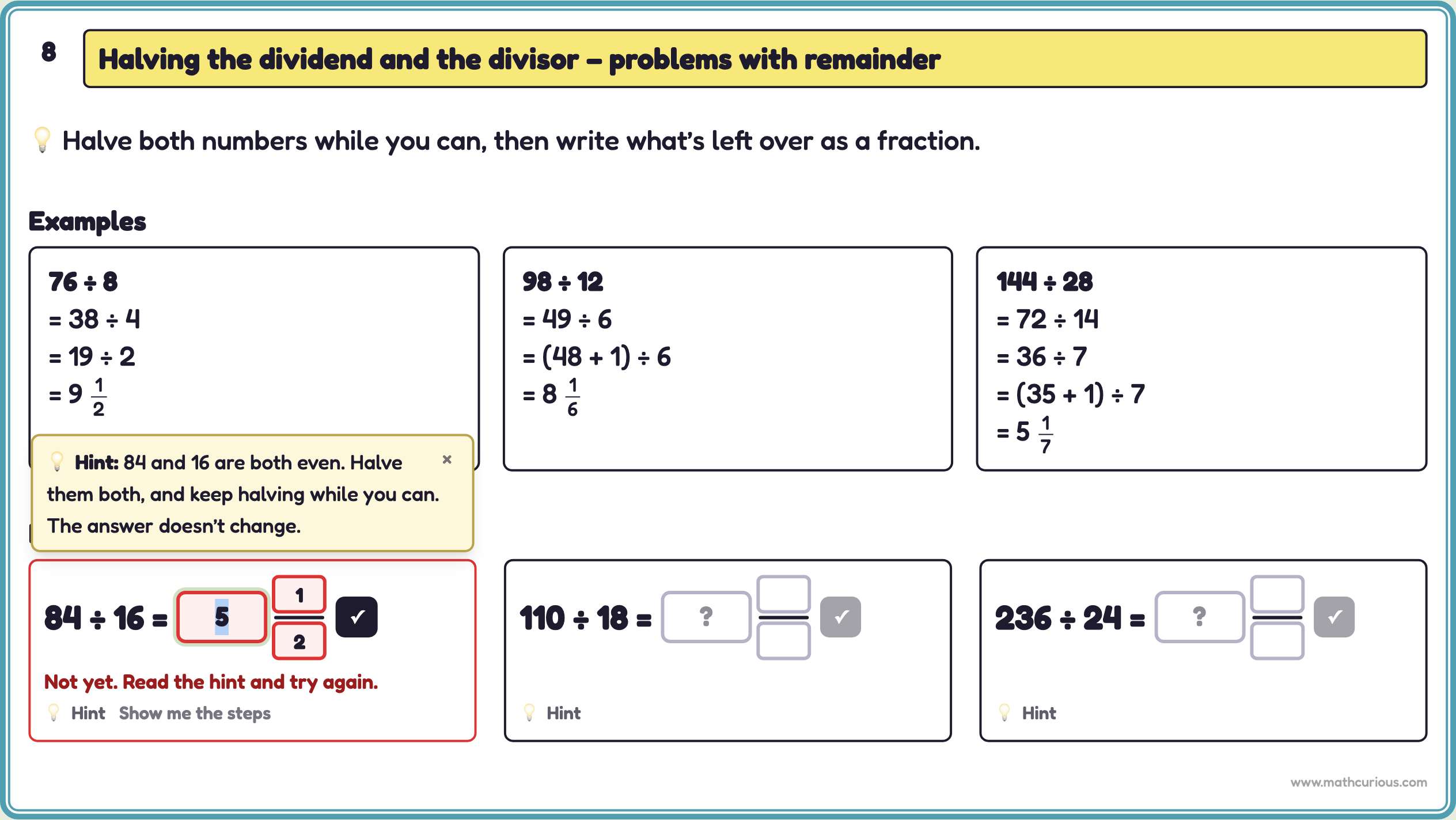
A wrong answer turns the box red and opens a hint for that strategy, like 84 and 16 are both even. Halve them both, and keep halving while you can.
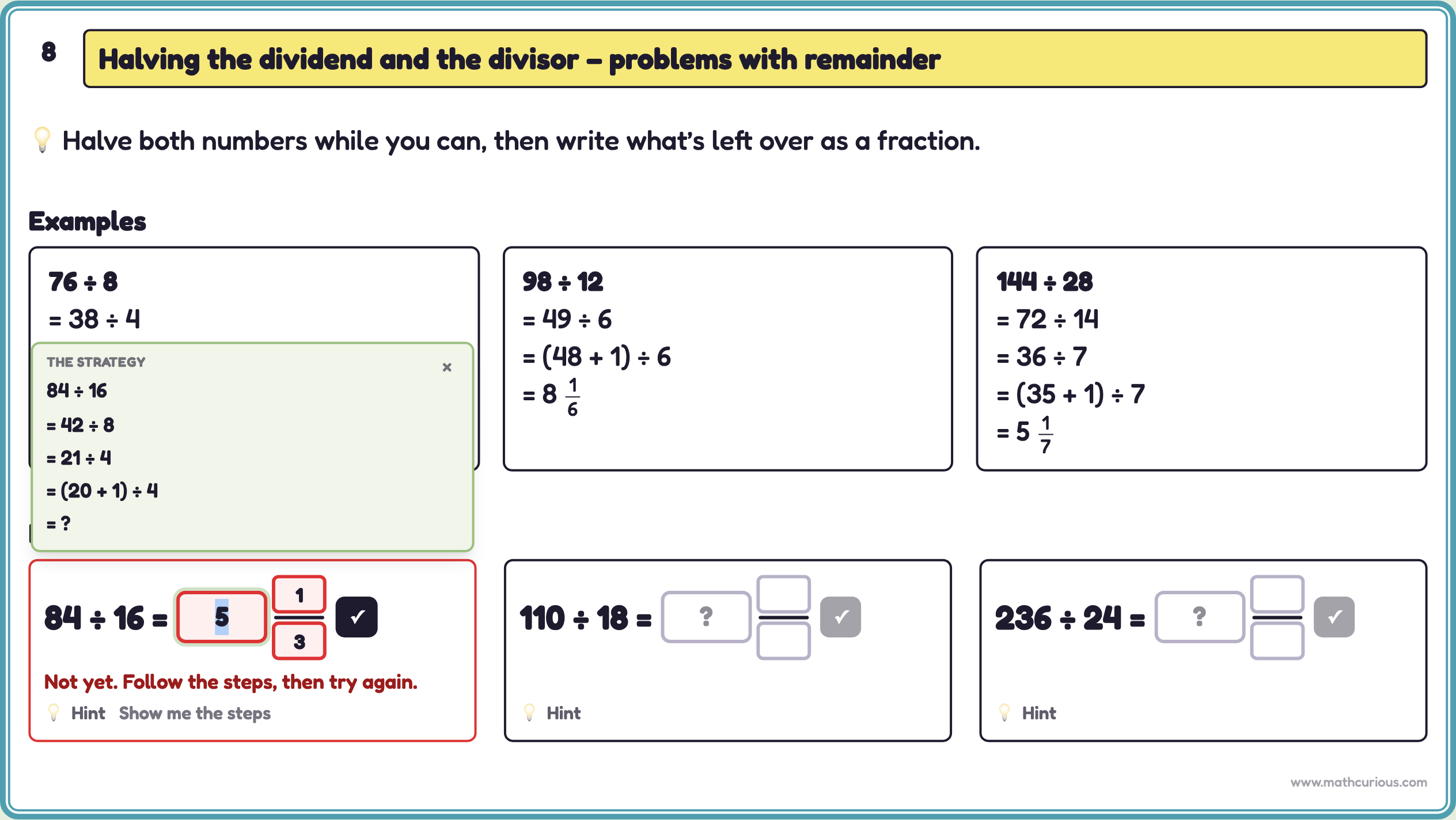
A second wrong answer shows the worked steps with the answer hidden, so students still finish the problem themselves.
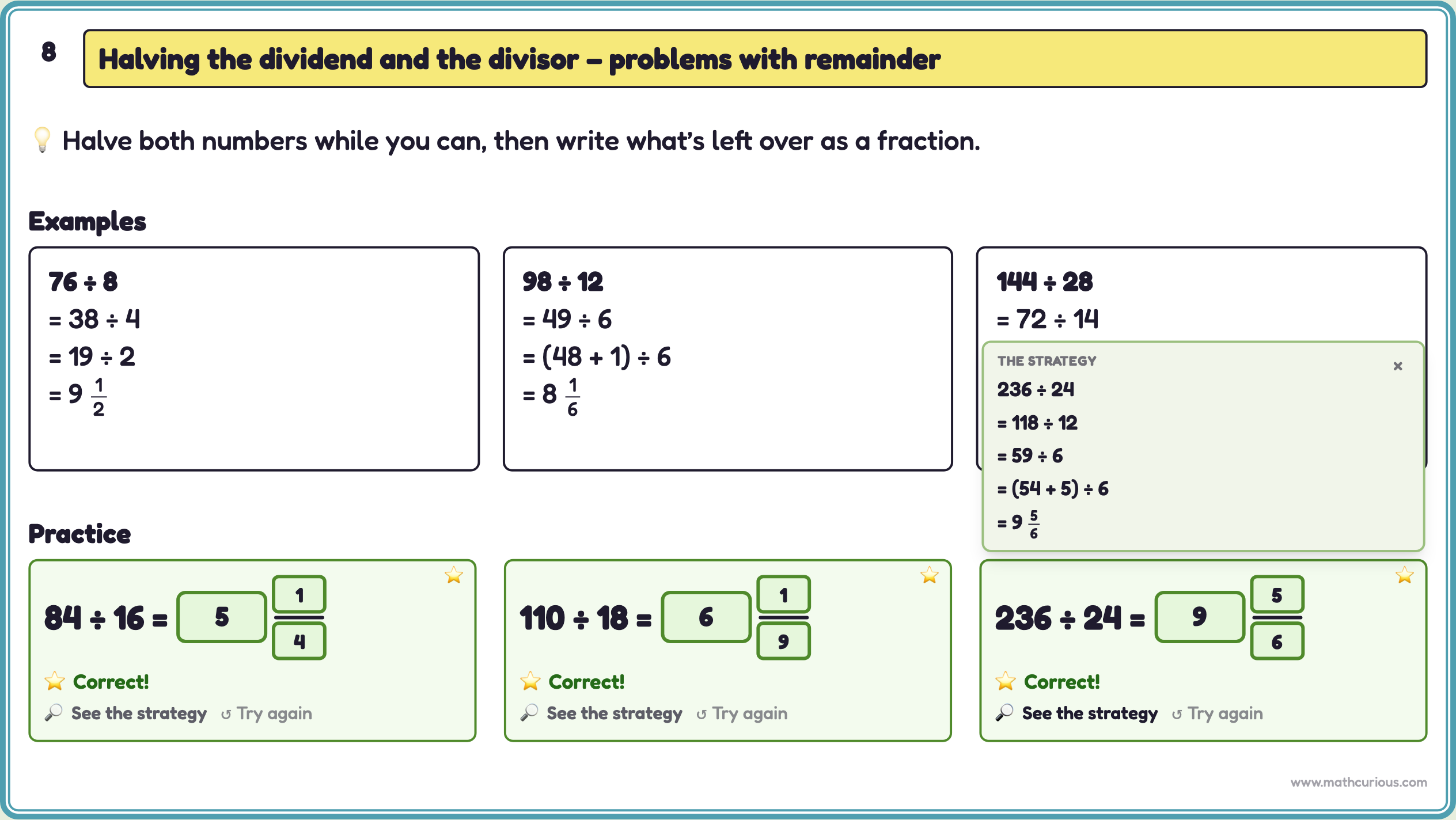
A right answer earns a star, as long as the steps weren't opened first. See the strategy shows one way to solve any problem they've finished.
Remainders as fractions
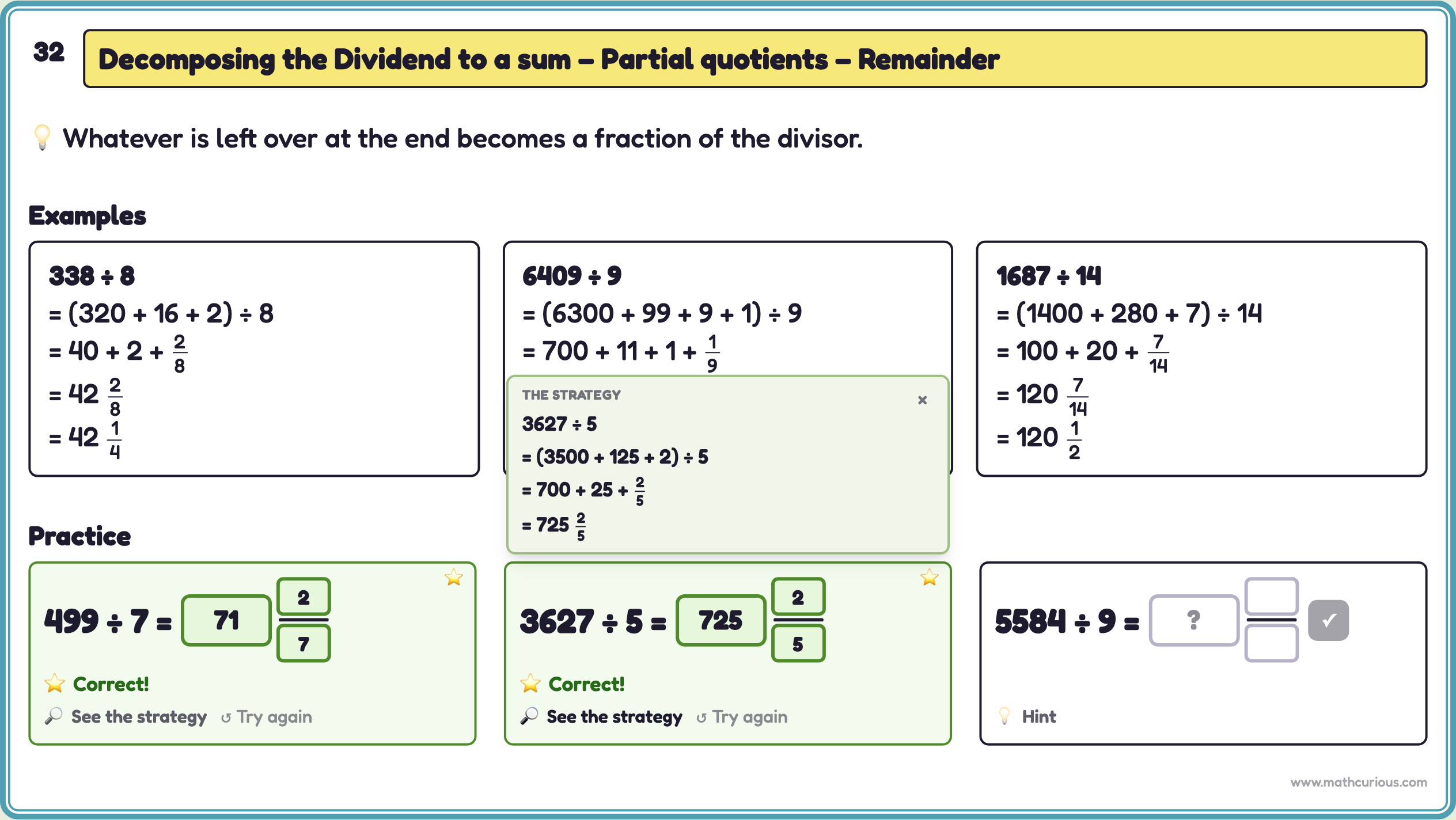
Answers with a remainder are typed as a mixed number: a box for the whole number and boxes for the fraction. The fraction boxes appear only where the answer needs one. If a student types 9 8/10 or 9.8, it's accepted and the simplest form, 9 4/5, is shown. A student who types only the whole number gets a nudge that something is left over.
Mixed practice and reasoning
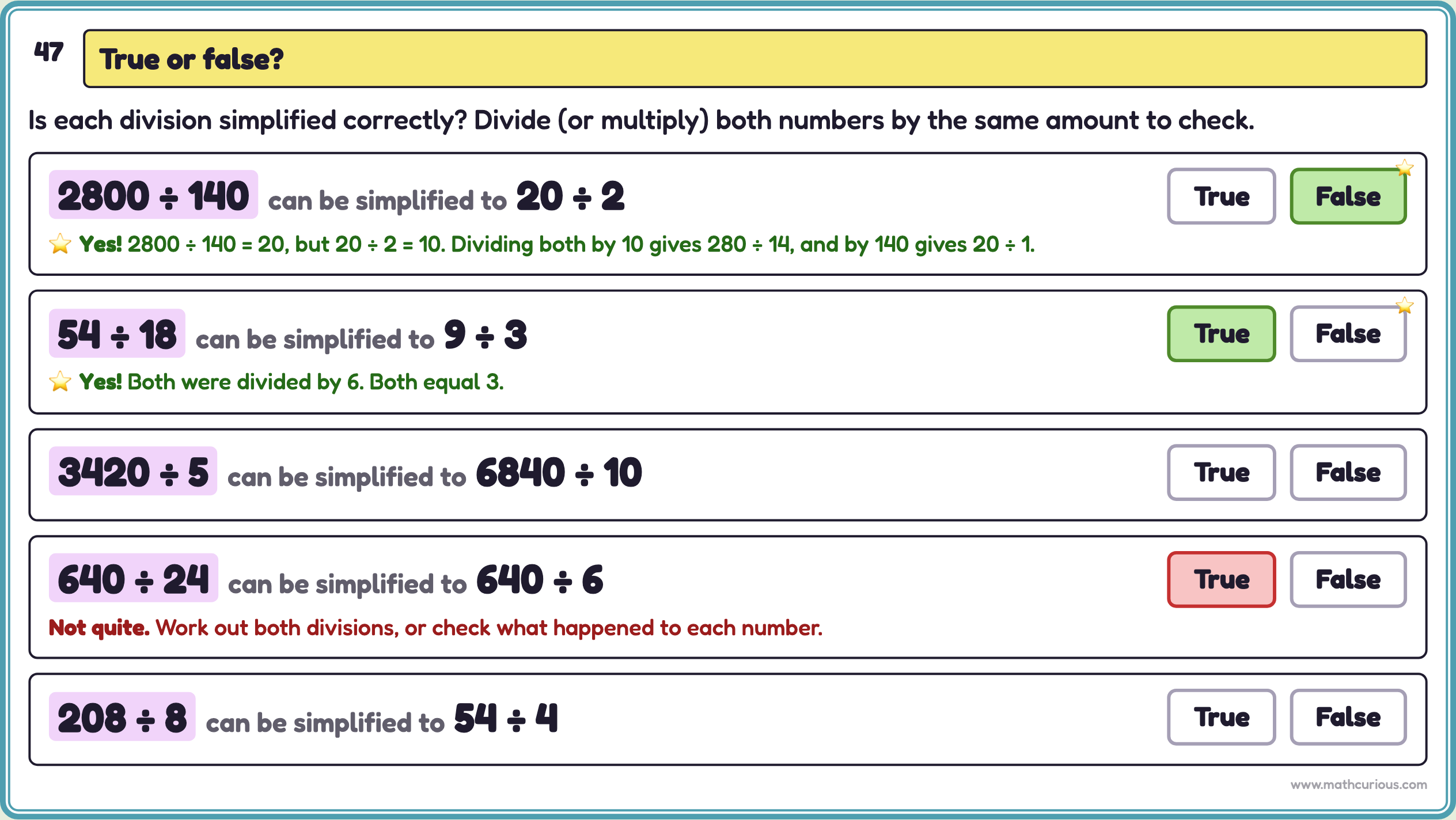
Later slides mix everything up. Students choose their own strategy, decide whether divisions were simplified correctly, estimate quotients and use the divisibility rules to pick answers without dividing.
One slide at a time
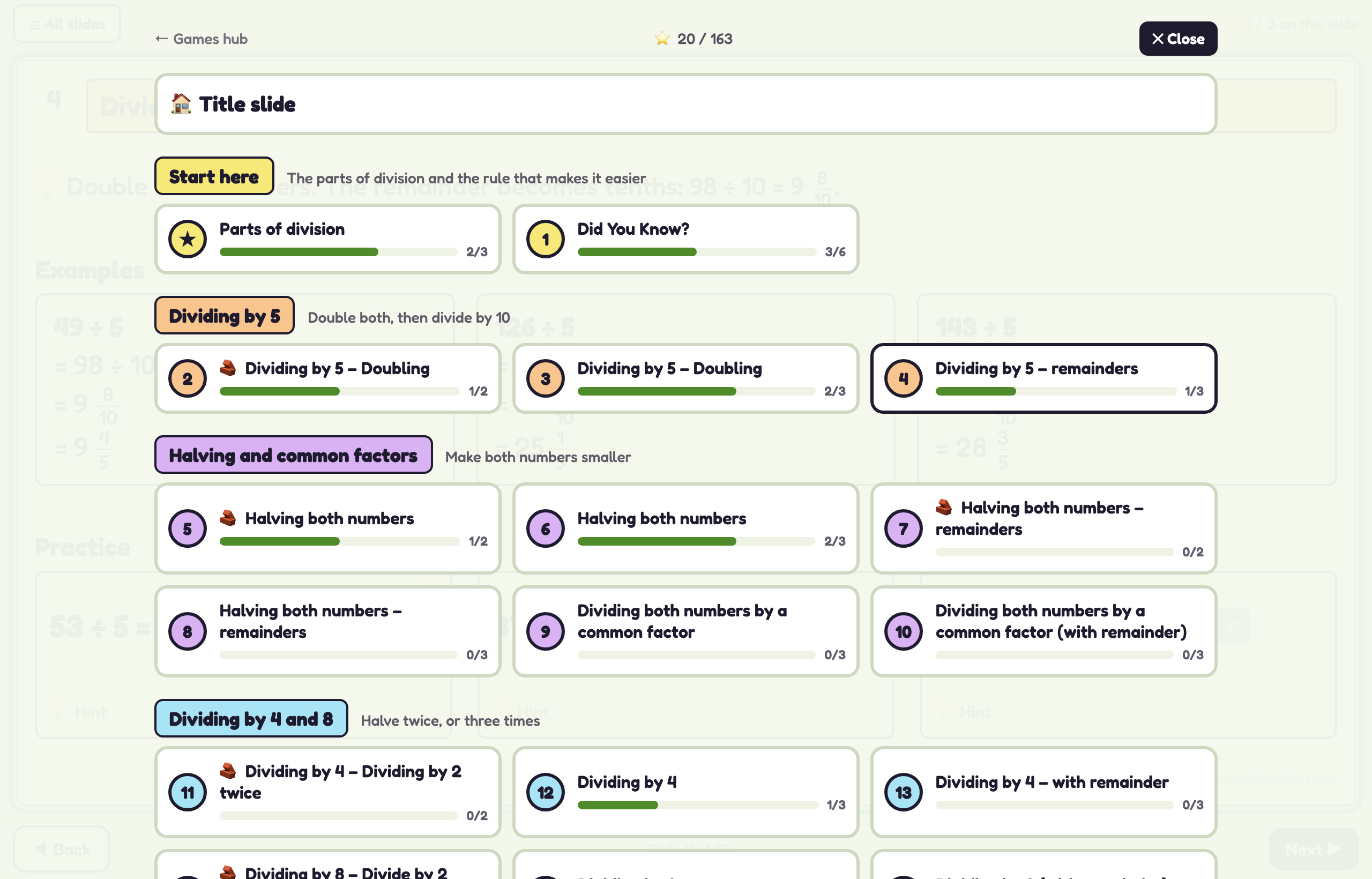
Like the original deck, it opens on a title slide and moves with Next and Back or the arrow keys. All slides jumps straight to any strategy and shows the stars on each one. Slides always open blank, so the next student on the device never sees the answers.
What's inside
- Parts of division, and why multiplying or dividing both numbers keeps the answer
- Dividing by 5: double, then divide by 10
- Halving both numbers and dividing by a common factor
- Dividing by 4 and 8 by halving
- Dividing in steps, rounding and compensating
- Dividing multiples of 10
- Partial quotients, five ways, up to 4-digit by 2-digit division
- Mixed practice, true or false, estimating and divisibility rules
Teaching tips
- Model it first. Project an explanation slide and talk through each picture together before students try "Your turn".
- Say the strategy out loud. "84 and 16 are both even, so I halve them both: 42 ÷ 8, then 21 ÷ 4."
- Connect to multiplication. Every division strategy has a multiplication partner. Ask "What times 8 is close to 100?"
- Talk about remainders. Ask why 4/8, 2/4 and 1/2 are the same leftover.
- Revisit often. One slide makes a five-minute warm up, and stars show which strategies each student has tried.
Standards
- 4.NBT.B.6: Find whole-number quotients and remainders with up to four-digit dividends and one-digit divisors, using strategies based on place value, the properties of operations and the relationship between multiplication and division
- 5.NBT.B.6: Find whole-number quotients with up to four-digit dividends and two-digit divisors
- 4.OA.A.3: Interpret remainders
- 5.NF.B.3: Interpret a fraction as division of the numerator by the denominator
Quick answers
Do students need accounts? No. It's a link, so there's nothing to sign in to.
What devices does it work on? Any device with a web browser, including Chromebooks, iPads, laptops and the classroom board.
What grades is it for? Grades 4 to 6. Fourth graders can start with dividing by 5, 4 and 8 and halving both numbers. Partial quotients with two-digit divisors and remainders as fractions stretch older students.
Do I need to check answers? No. Every problem checks itself, and every one has a hint and worked steps.
Get Mental Math Strategies: Division
Give students a strategy for every division problem, and the practice to make it stick.
Get Mental Math Strategies: Division on Teachers Pay Teachers
Find more cersions below
Mental math strategies-division-17 worksheets and 14 posters
Bundle Mental math Strategies Division – print and google slides versions.
Bundle of all mental Math strategies, Addition, Subtraction, Multiplication, and Division google slides
Bundle of all mental Math strategies, Addition, Subtraction, Multiplication, Division worksheets
More division activities from Math Curious
Understanding division
- Diving into Division: teaching division conceptually, with sharing, grouping and arrays
- Division facts with number bars: tape diagrams that make division visual
- Division Mental Math Strategies: the original slide deck and print task cards
Division facts practice
- Division Facts Mini-Games: quick print and Google Slides games for facts up to 12
- Divide Ride: a division game for partners or small groups
- Block it!: a single-player multiplication and division facts game
- Multiplication and division games: all our facts games in one place
Long division and remainders
- Long Division Partial Quotients Games: print and digital games for partial quotients and the standard algorithm
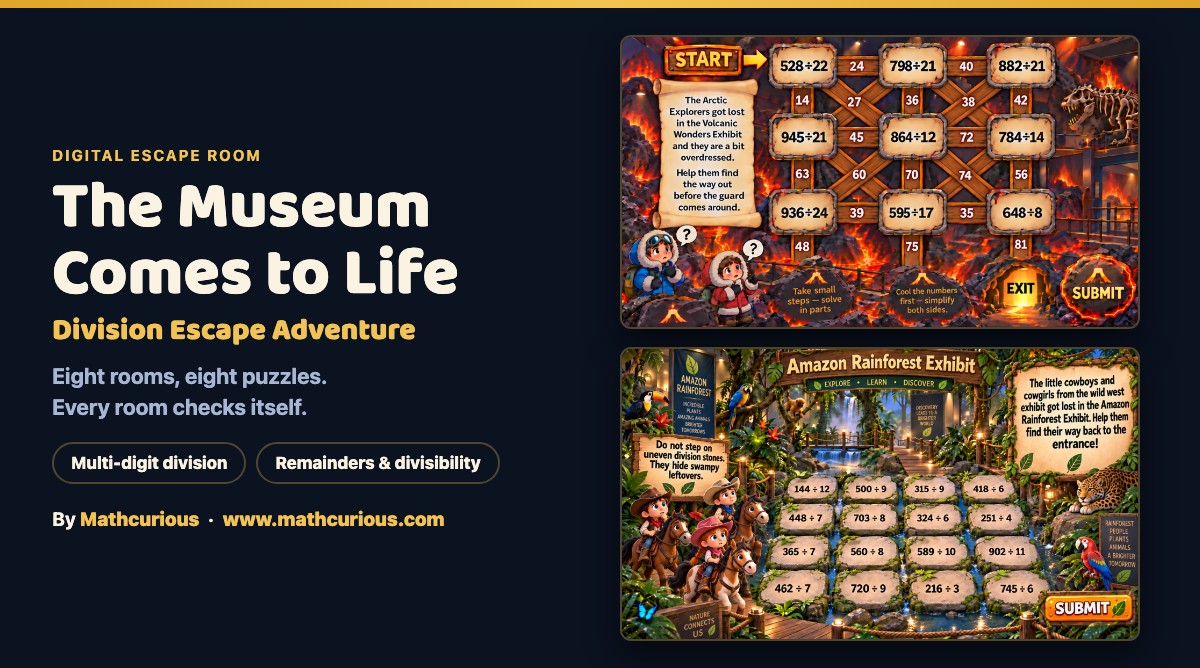
- The Museum Comes to Life: a self-checking division escape room for grades 4 to 6
- Greek Mythology Escape Room Adventures: multi-digit multiplication and division
Divisibility, factors and multiples
- Divisibility Rules activity cards and worksheets: print and digital
- Divisibility Rules games
- Free the Monsters: divide each monster's number down to 1 to set it free
- Station Prime: an arcade-style prime factorization game
More mental math strategies
- Mental Math Strategies for Addition and Subtraction: 117 self-checking problems for grades 2 to 5
- Mental Math Strategies for Multiplication: 107 self-checking problems for grades 3 to 5