The Museum Comes to Life: A Division Escape Room for Grades 4-6
The Museum Comes to Life: a division escape room for grades 4–6
- Eight rooms of multi-digit division, behind one link
- Remainders, divisibility rules and zeros in the quotient, built into the puzzles
- A free room to try with your class, with the solution
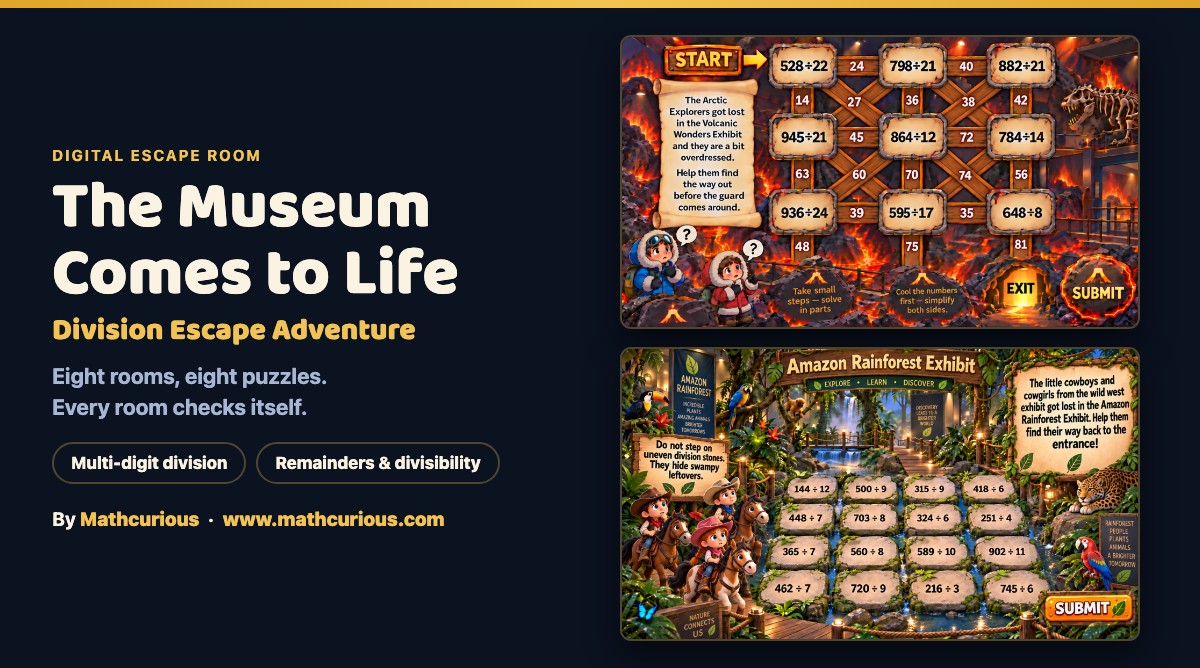
The Museum Comes to Life: Division Escape Adventure is the review day rebuilt as a digital escape room.
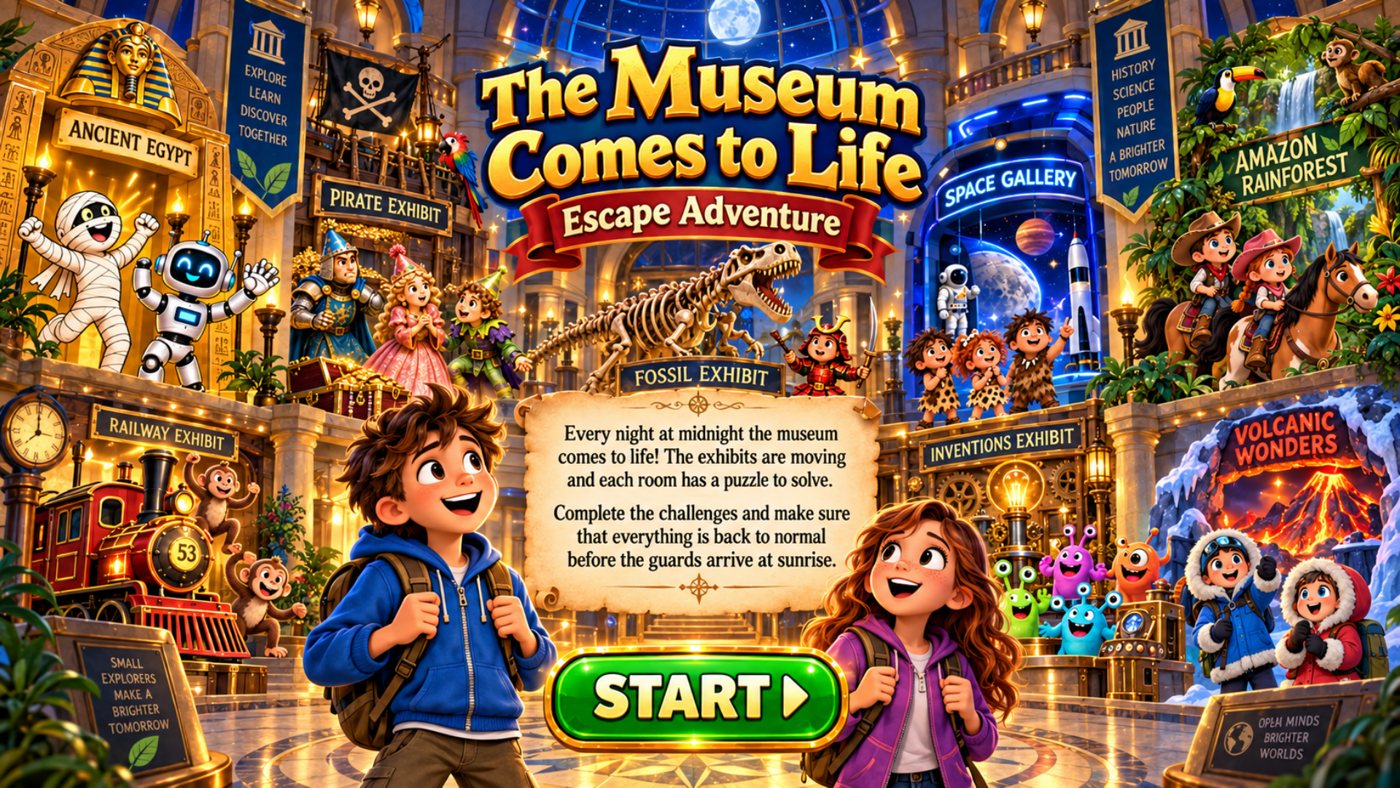
Every night at midnight, the museum wakes up. A robot gets locked in the mummy's sarcophagus. The medieval statues trap themselves in the pirates' treasure room. The cowboys get lost in the rainforest, the monkeys scramble the model trains, and the aliens relabel the big machine in the Inventions Exhibit. There are eight exhibits and eight puzzles, and the guards arrive at sunrise. The only way out is division.
It joins the addition and subtraction museum adventures, with the same story, the same characters and the same no-prep design, but the maths is a few grades on.
The eight rooms
Every room is division, and every room asks for it a different way. That is the point. A student who can grind through 1,716 ÷ 12 still has to think when the question is "which rock belongs on this pedestal?" or "which bridge leads to the exit?"
- Ancient Egypt: The Sarcophagus Code. Three divisions make the code that frees the robot. The code boxes come in groups of 2, 3 and 3, which tells students how many digits each answer should have before they start.
- Pirate Exhibit: Divide the Loot. The sign on the door says What remains is important. The code is the four remainders, not the quotients. That one sign does more for remainders than a week of "r" notation.
- Space Gallery: The Mixed-Up Moon Rocks. Each pedestal shows a division and its answer, but not the starting number (÷18 = 25). Students work backwards to put each moon rock in place.
- Amazon Rainforest: The Division Stones. Sixteen stepping stones and one rule: do not step on uneven division stones; they hide swampy leftovers. Only stones that divide exactly are safe.
- Railway Exhibit: The Model Trains. Each engine carries a number. Students hitch on the two cars whose quotients match it.
- Inventions Exhibit: The Big Machine. 4,860 sits in the middle of the machine. Divide it by every gear (2, 3, 4, 5, 6, 10, 12 and 15) and relabel each one.
- Fossil Exhibit: The Fallen Fossils. Eight cases labelled 3 to 11, eight fossils, and each fossil goes in a case whose number divides it. Several fossils fit more than one case, so this one is divisibility and logic.
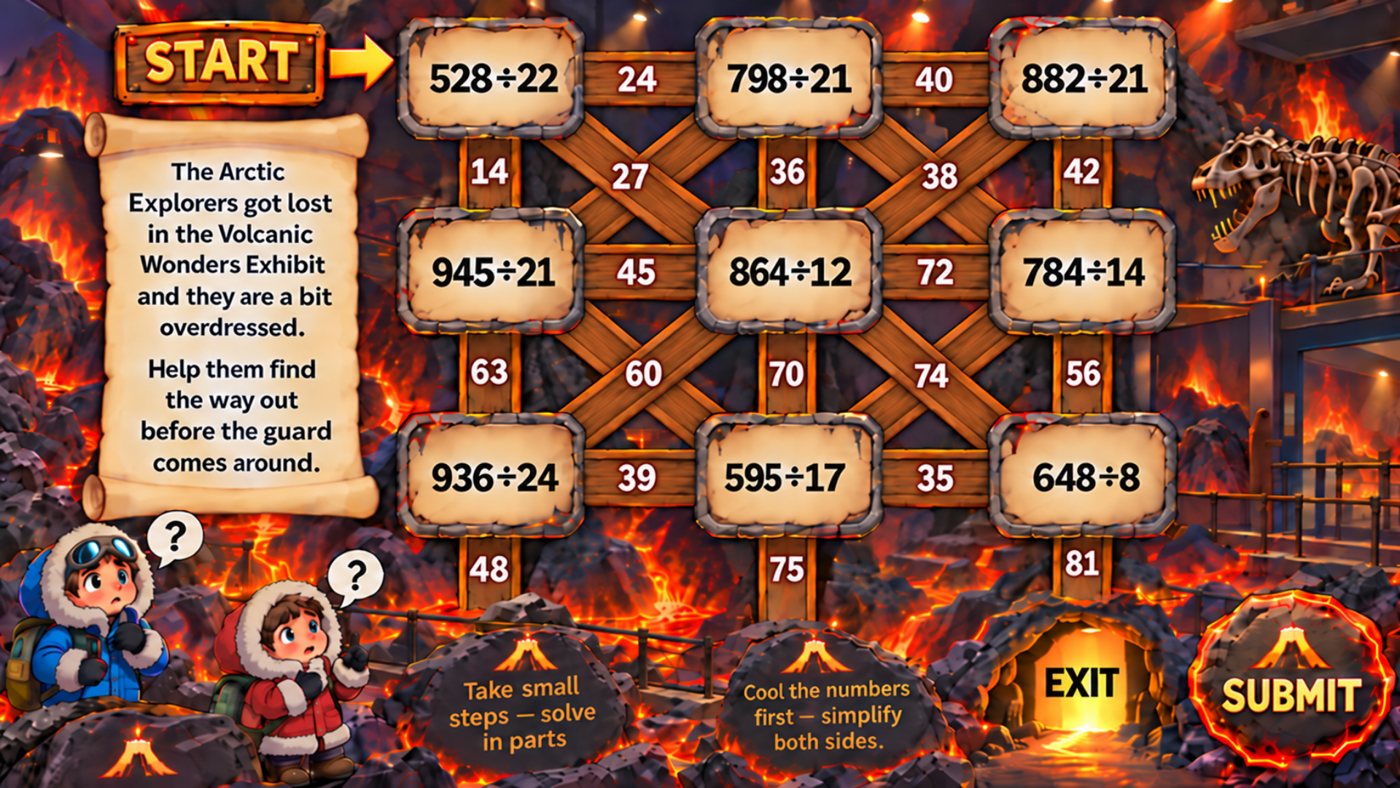
- Volcanic Wonders: The Lava Maze. From START, every division points along a bridge to its quotient. Only the right answers lead to the EXIT.
Finish all eight and the whole museum turns out for a You did it! celebration.
Division in the places it actually goes wrong
The numbers in the rooms are chosen, not random. Here is where they are aimed.
- Zeros in the quotient. 1,456 ÷ 7 = 208 and 5,640 ÷ 8 = 705. When 7 does not go into 5, a student who writes nothing instead of 0 gets 28. That is the single most common long-division slip, and two rooms are built around it.
- Remainders that mean something. In the Pirate Exhibit the remainders are the answer. In the Rainforest, a remainder is the thing you are avoiding. Students stop treating "r3" as a leftover to write down and start treating it as information.
- Scaling both numbers. On the railway, 14,560 ÷ 70 and 1,456 ÷ 7 go behind the same engine. They are the same division with a zero taken off both numbers, and students who notice save themselves a five-digit long division.
- Estimates that trap. In the lava maze, 798 ÷ 21 is "about 40", and there is a bridge labelled 40. The real answer is 38. Estimation gets you close, and checking gets you out.
- Two-digit divisors. Most rooms use divisors like 12, 14, 18, 21 and 22, which is where fourth and fifth graders need the most practice and get the least.
Instant feedback in every room
Every room checks itself immediately. Students solve, press Submit, and the museum guard answers straight away: a full-screen Correct! with the exhibit put right, or Try again! and a nudge to check the clues.
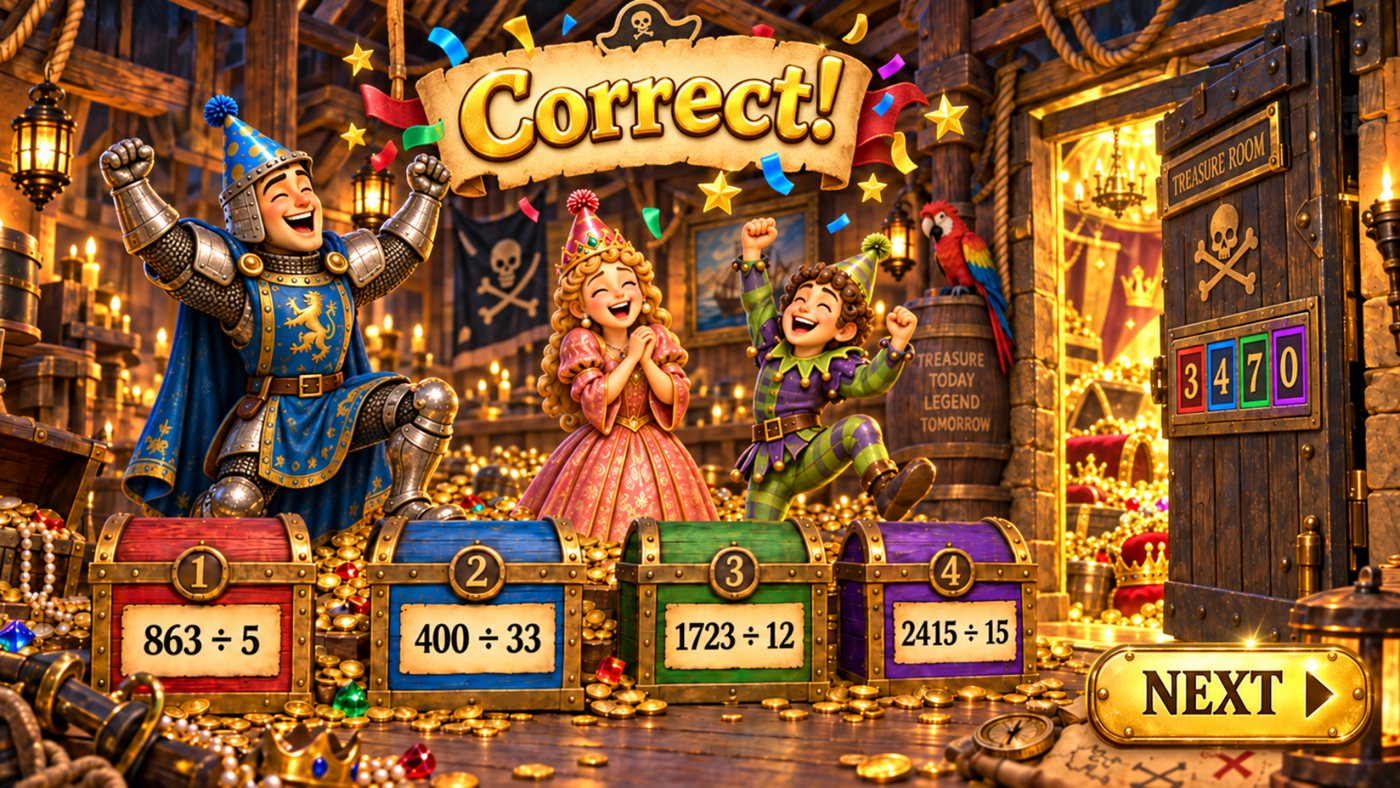
That matters for two reasons. For students, a slip in step three of a long division gets fixed in the next minute, while they still remember what they did. For you, it means a whole class getting feedback at once, none of it from you, so you can sit with the group that needs you and stay there.
The guard never says which part was wrong. Students have to go back to their own working to find it, and that is the habit long division needs most.
Free: try the Fossil Exhibit with your class
Here is one room you can use today, on the board or on paper, no link needed. It is the best divisibility puzzle in the adventure.
The cases: 3, 4, 5, 6, 7, 8, 9, 11
The fossils: 573, 628, 470, 1,092, 679, 5,640, 288, 616
The rule: each fossil goes in a case whose number divides it exactly. Every case gets one fossil.
Give students the divisibility rules first:
- 3: the digit sum is a multiple of 3.
- 4: the last two digits make a multiple of 4.
- 5: it ends in 0 or 5.
- 6: it passes the tests for 2 and 3.
- 7: there is no friendly rule, so divide.
- 8: the last three digits make a multiple of 8.
- 9: the digit sum is a multiple of 9.
- 11: the alternating digit sum is 0 or 11 (for 616: 6 − 1 + 6 = 11).
The catch is that 288 divides by 3, 4, 6, 8 and 9, and 616 by 4, 7, 8 and 11. Students who place fossils from left to right get stuck. The ones who look for forced moves get out.
Answer: 3 ← 573, 4 ← 628, 5 ← 470, 6 ← 1,092, 7 ← 679, 8 ← 5,640, 9 ← 288, 11 ← 616. Check each one with a full division. 5,640 ÷ 8 = 705 has a zero in the quotient, too.Show the solution
How to use it
Whole class, on the board. Project the Egypt room and solve it together. Read the scroll aloud, ask for predictions of how many digits each answer will have, and argue about the answer before anyone presses Submit. Then send the link.
Math centers and rotations. One link, no instructions past the first room, and it works as a station.
Partners, with roles. One student does the long division on paper and the other checks by multiplying back. Swap every room. They have to agree before Submit.
Early finishers. Eight rooms of multi-digit division is real work, not a two-minute filler.
Intervention and small groups. Watch which room a student stalls in. Stalling in Egypt or on the railway is a long-division problem. Stalling in the Fossil Exhibit or the lava maze is a reasoning problem. The rooms diagnose for you.
Test prep, sub days and the week before a break. No login, no accounts, nothing to print, and it marks itself. Leave the link and a note.
Six teaching moves
1. Predict the number of digits first. 371 ÷ 7: since 7 × 10 = 70 and 7 × 100 = 700, the answer is between 10 and 100. The Egypt code boxes confirm it. Students who predict first catch their own place-value slips.
2. Multiply back, every time. Quotient × divisor + remainder = the starting number. The Space Gallery is built on this: the missing numbers are 160 × 6, 25 × 18, 54 × 21 and 72 × 11.
3. Two methods, one room. The Space Gallery also falls to divisibility. Only one rock passes ÷11 (792) and only one passes ÷21 (1,134), and the rest follows. Split the class between the two methods and compare.
4. Simplify both numbers. The lava maze's own hint sign says cool the numbers first. Halving both numbers turns 784 ÷ 14 into 392 ÷ 7, and 528 ÷ 22 into 264 ÷ 11. Show it once and students start looking for it everywhere.
5. Reuse your answers. In the Inventions Exhibit, ÷6 is half of ÷3, and ÷12 is half again. Challenge students to find all eight labels with as few long divisions as they can.
6. Use the wrong answer. When the guard says try again, do not give the answer. Ask which division they would re-check first, and why. Choosing where to look is a skill a worksheet never asks for.
What it does for you
- No prep. Open the link and teach. Nothing to print, cut, laminate or mark.
- No login, no accounts, no app. Nothing for students to sign up to.
- It marks itself. Instant feedback in every room.
- It holds the room. The story carries students who have already decided how they feel about long division.
- One link for the whole class. The same activity on every device, at every desk.
- It ends properly. The celebration screen gives the work a finish line.
Devices and practicalities
- It runs in a browser on a Chromebook, laptop, iPad or interactive whiteboard. The art is full-screen and reads from the back of the room.
- Have paper out. The rooms deliberately do not do the division for students. Working on paper next to the screen is the point.
- Students type answers in some rooms and drag pieces into place in others, so a mouse or a touchscreen both work well.
- It is designed to be done in one sitting, so plan for a full lesson.
Standards: 4.NBT.B.6, 5.NBT.B.6, 4.OA.B.4 and MP.1.
Get the Division Escape Adventure
Find it on Teachers Pay Teachers: The Museum Comes to Life: Division Escape Adventure
More museum adventures:
- The Museum Comes to Life: Addition
- The Museum Comes to Life: Subtraction
- The Museum Comes to Life: Addition and Subtraction bundle
Multiplication and Division Escape Room Adventures: Greek Mythology