Solving Equations with Integers on a Balance Scale: Algebra Balance with Integers
Algebra Balance with Integers is a digital tool for solving equations when negative numbers are involved, which is exactly where many students start losing track of signs.
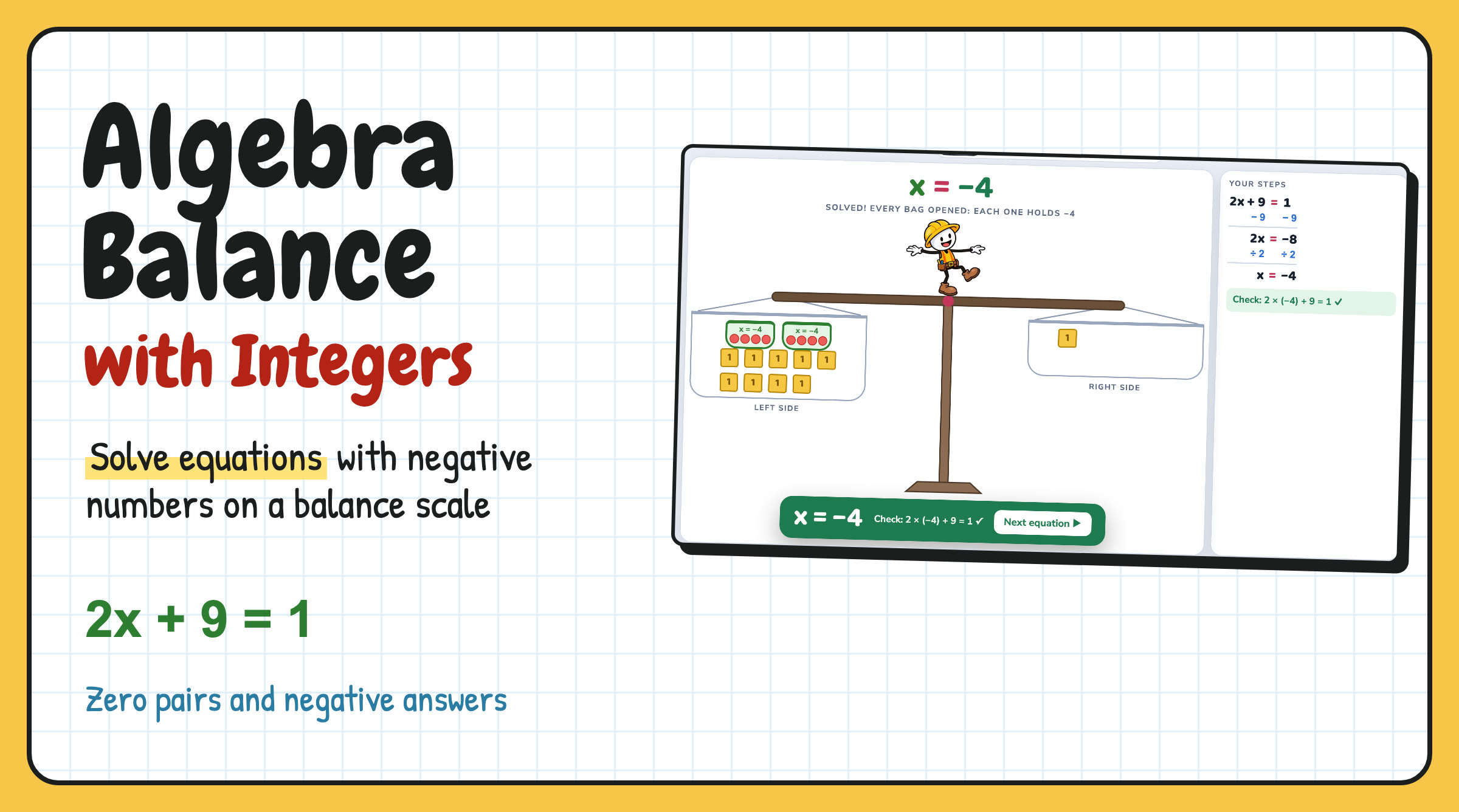
Every equation sits on a balance scale. Green mystery bags are x, yellow tiles are 1, and red balloons are −1: a balloon lifts its side of the scale instead of weighing it down. A 1 and a −1 together make zero, so students can watch integer addition and subtraction happen on both sides of the equation. And the answer can be negative: when x = −4, the bag opens to show four red balloons.
Watch it in action
The tool runs in any web browser. There's nothing to print, cut or laminate, and students don't need logins.
Bags, tiles and red balloons
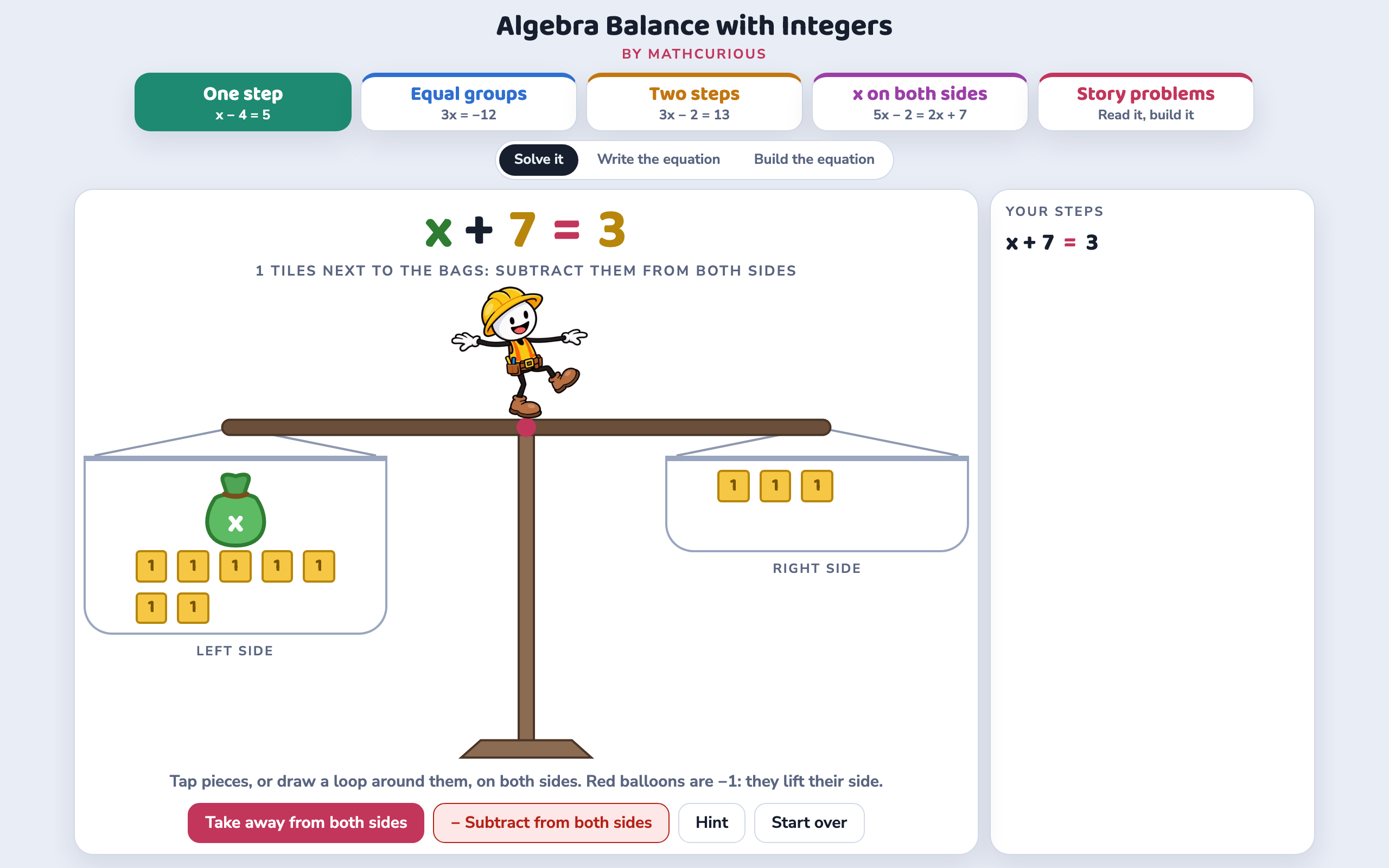
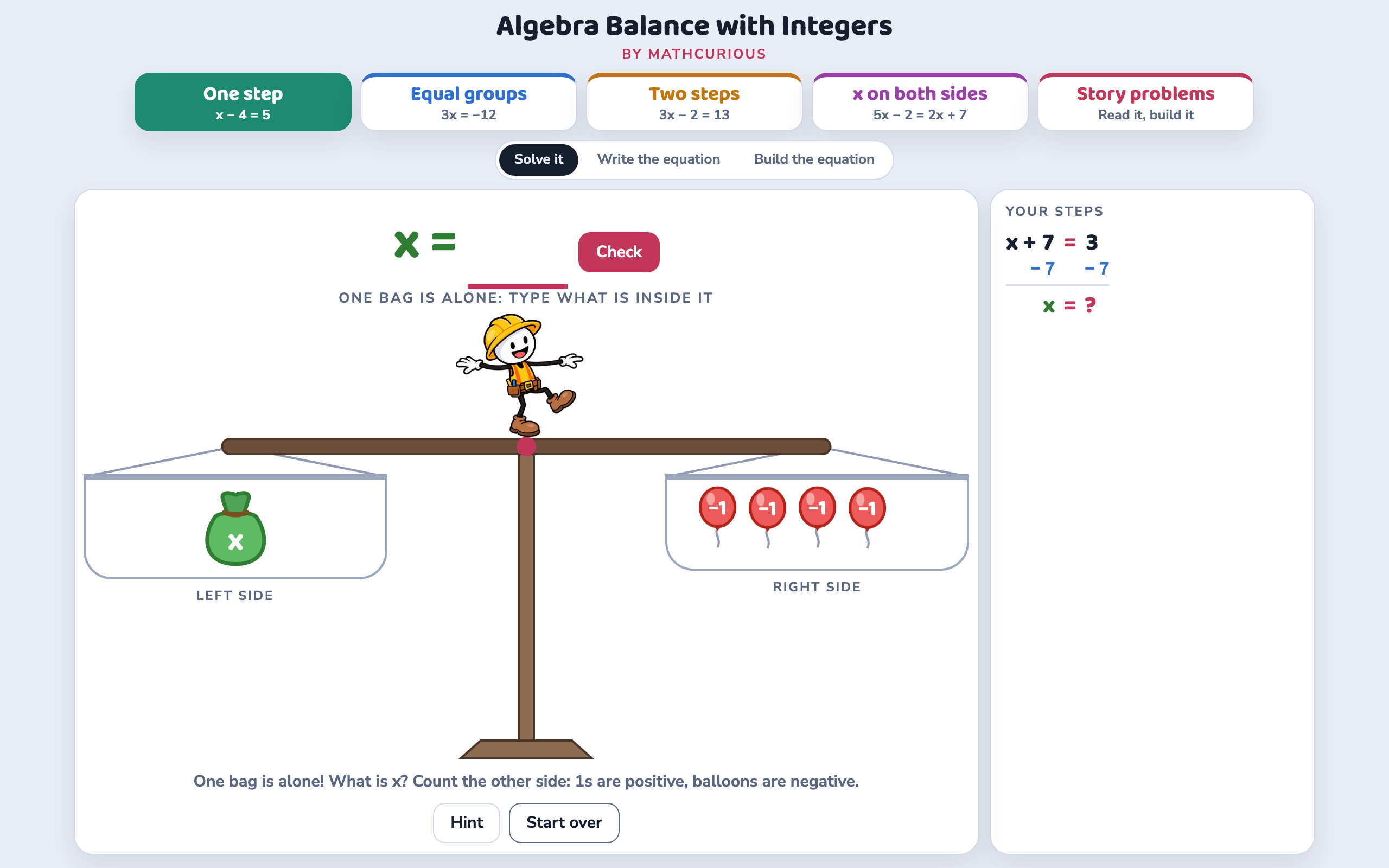
x + 7 = 3 is a bag and 7 tiles on the left, balancing 3 tiles on the right. Before solving, it's worth asking: is x more or less than 0? The left side has 7 tiles and still only weighs as much as 3, so whatever is in the bag must pull it down below zero.
- Pick pieces by tapping them or drawing a loop around them, balloons too.
- The scale shows what would happen before a move is made.
- Every move is written as an equation in the steps panel, the way students would write it on paper.
The scale tips when the sides don't match
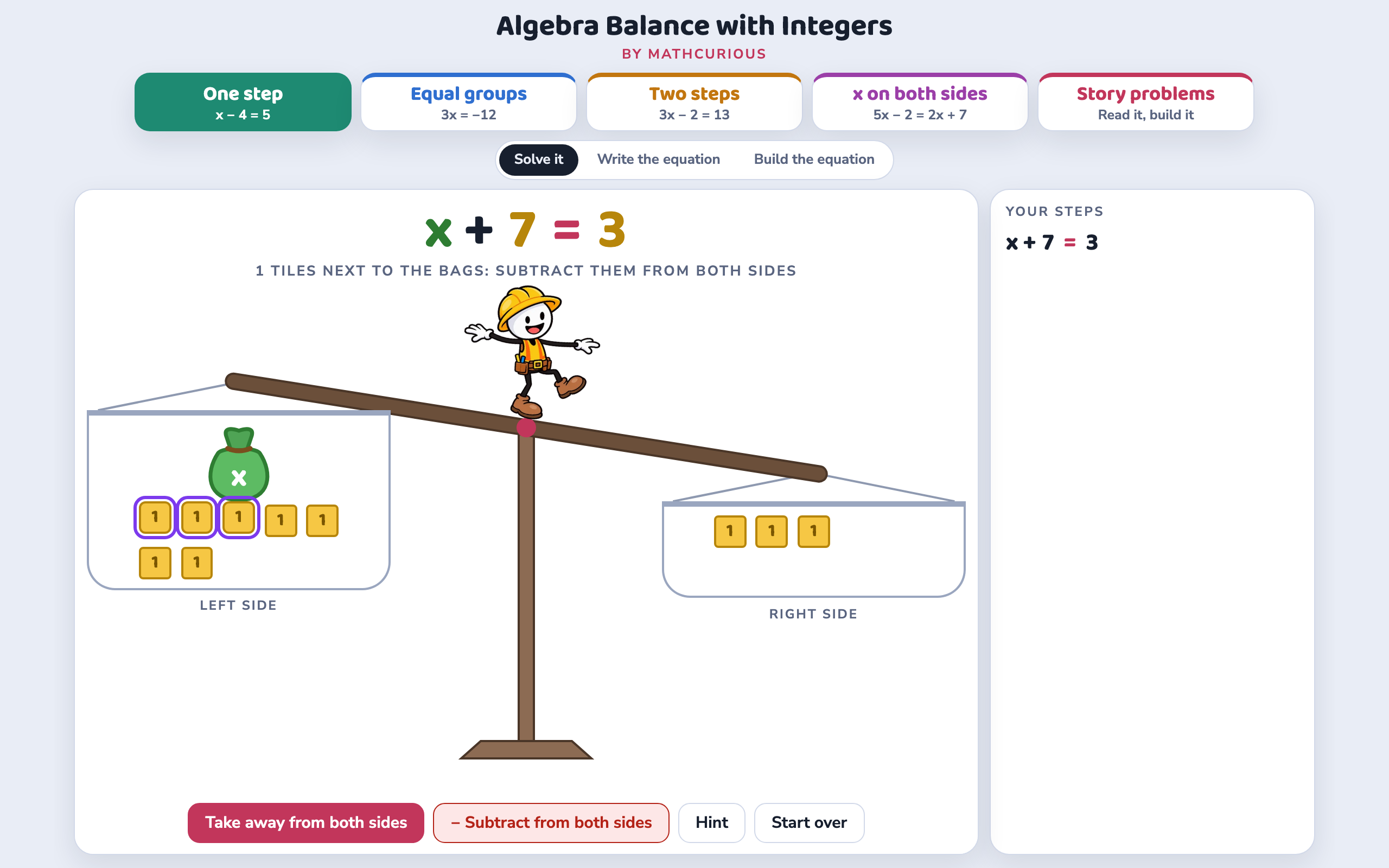
Pick tiles on one side only and the scale tips. The rule "do the same to both sides" stops being something to memorise; students see what breaks it.
Zero pairs: x + 7 = 3
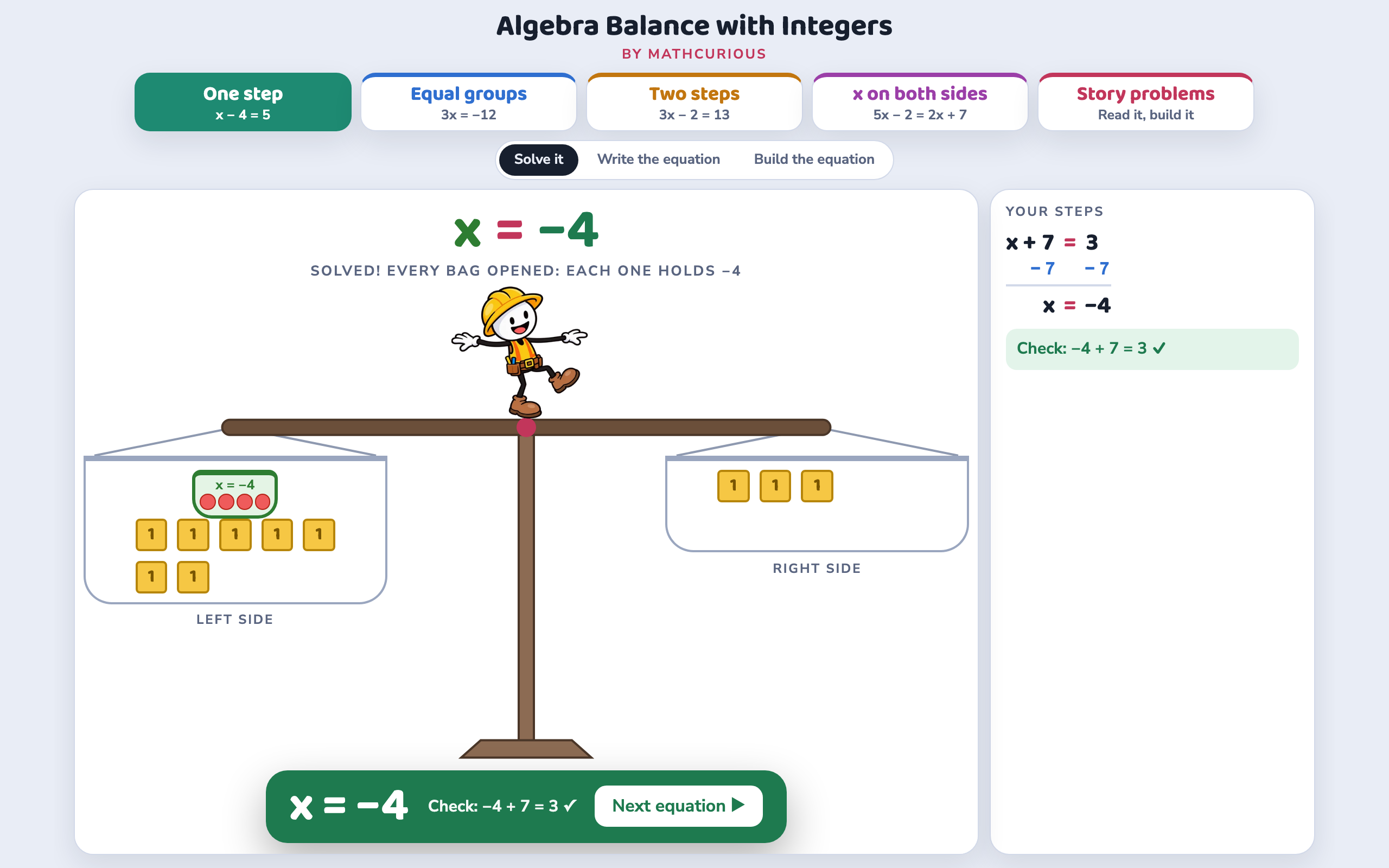
To get the bag alone, students subtract 7 from both sides. Subtracting puts 7 red −1 balloons on each side. On the left, each balloon pairs up with a tile and both disappear. On the right there are only 3 tiles, so 3 balloons pair up with them and 4 balloons are left over:
One bag balances four −1 balloons, so x = −4. When students type it (with a minus sign), the bag opens to show four balloons inside, and the check is written out: −4 + 7 = 3.
If a student types 4 instead of −4, they're told to check the sign: are the pieces on the other side tiles or balloons?
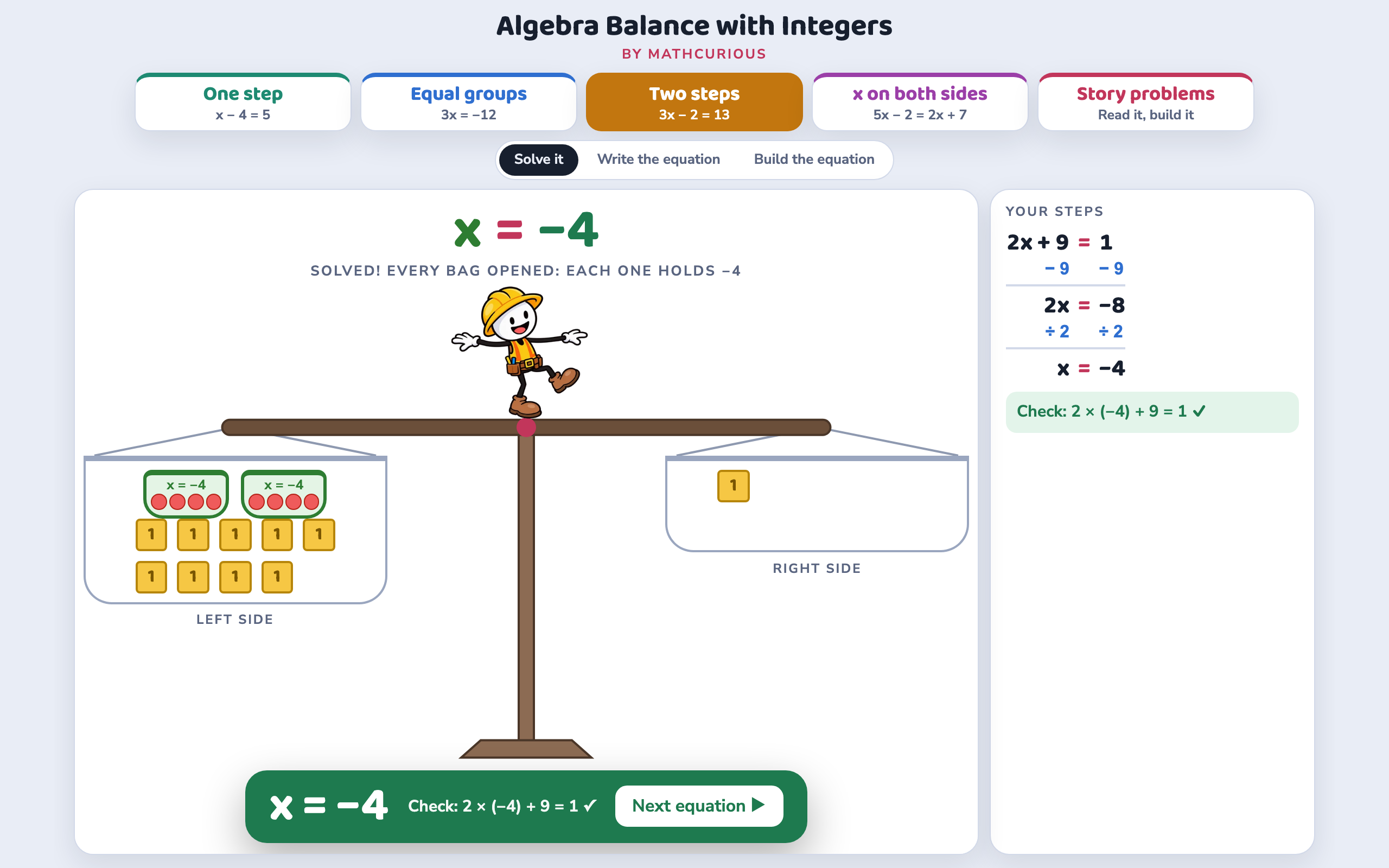
Two steps: 2x + 9 = 1
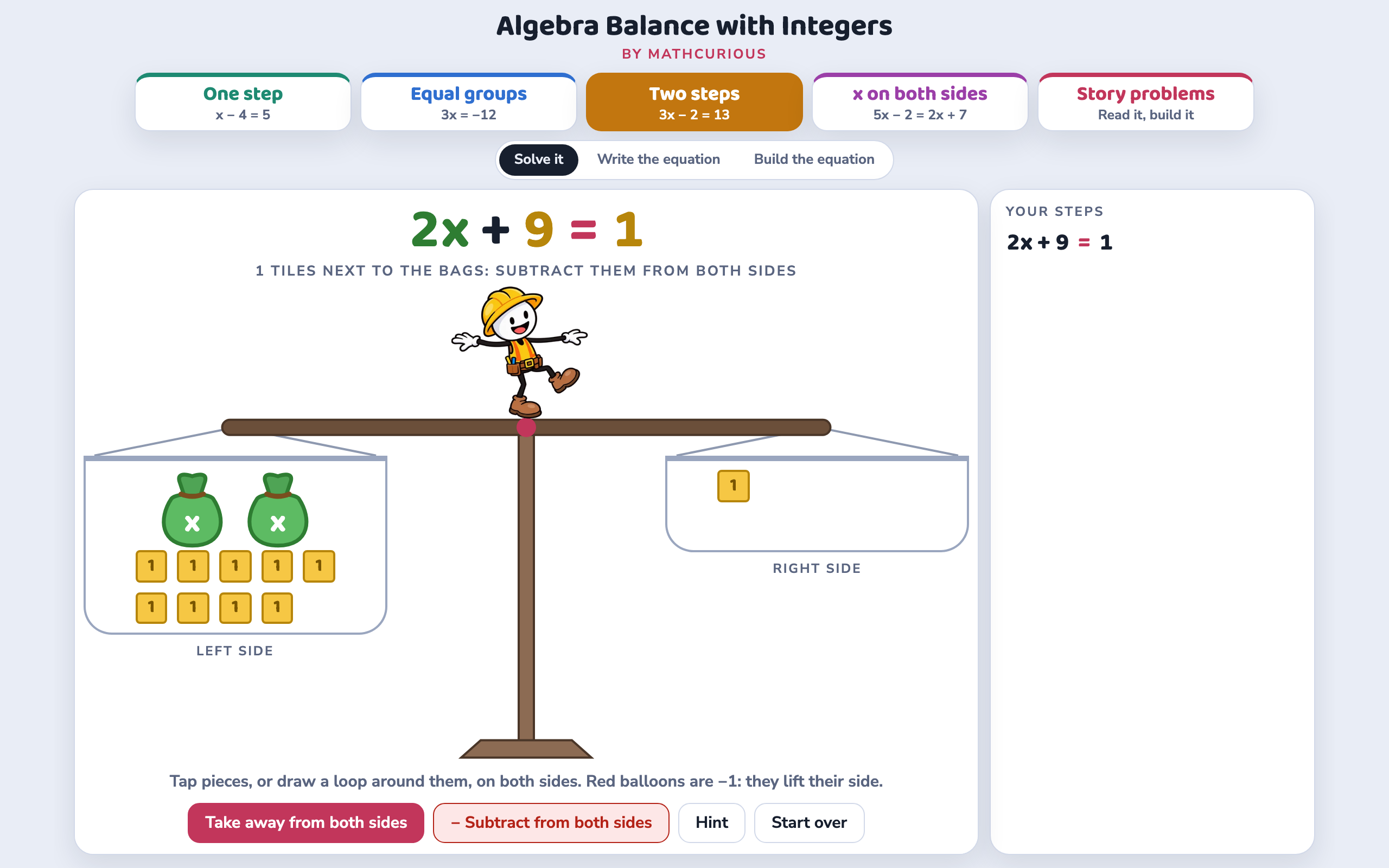
Students subtract 9 from both sides. The 9 tiles next to the bags all pop, and on the right, 1 tile pairs with 1 balloon, leaving 8 balloons: 2x = −8.
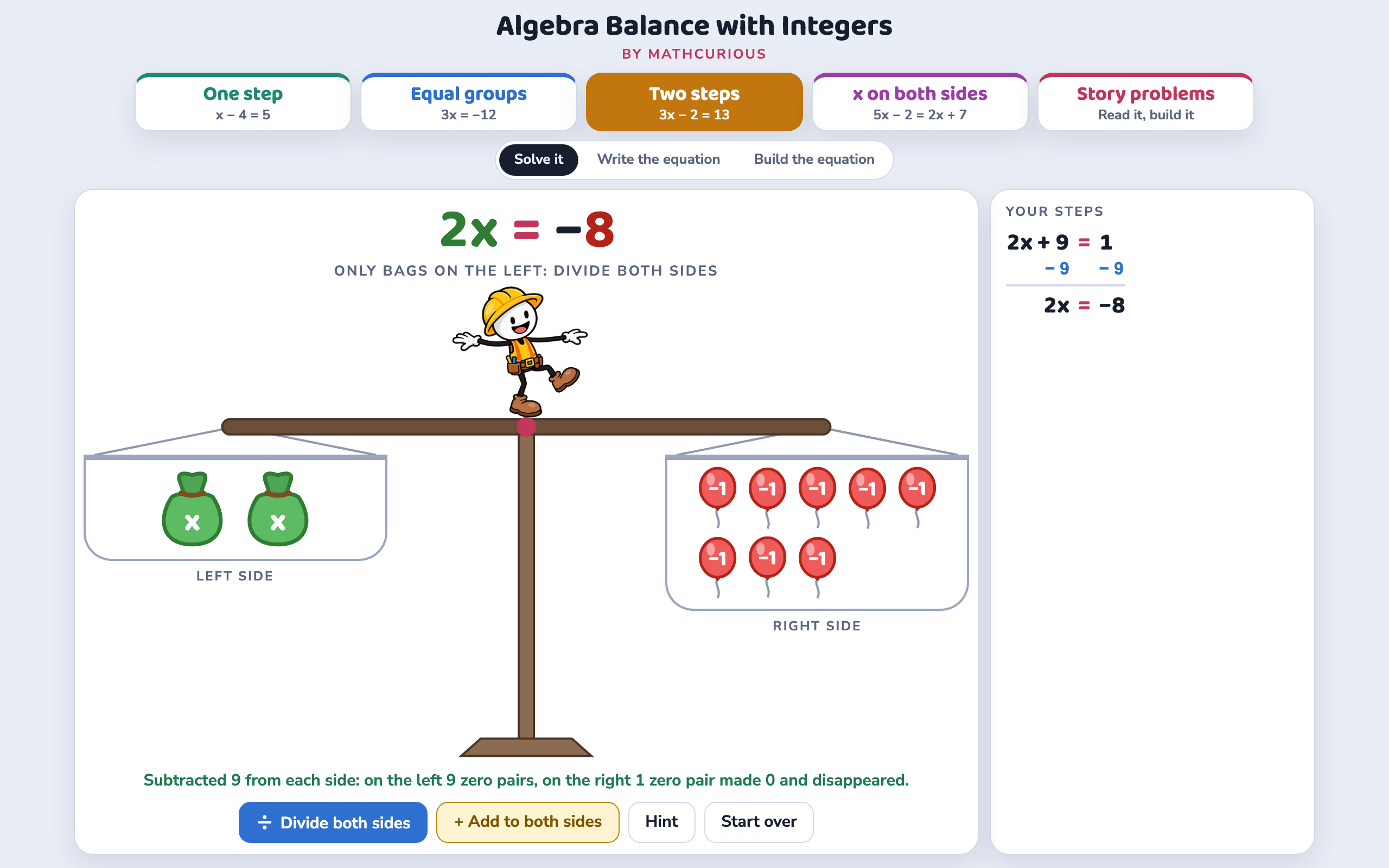
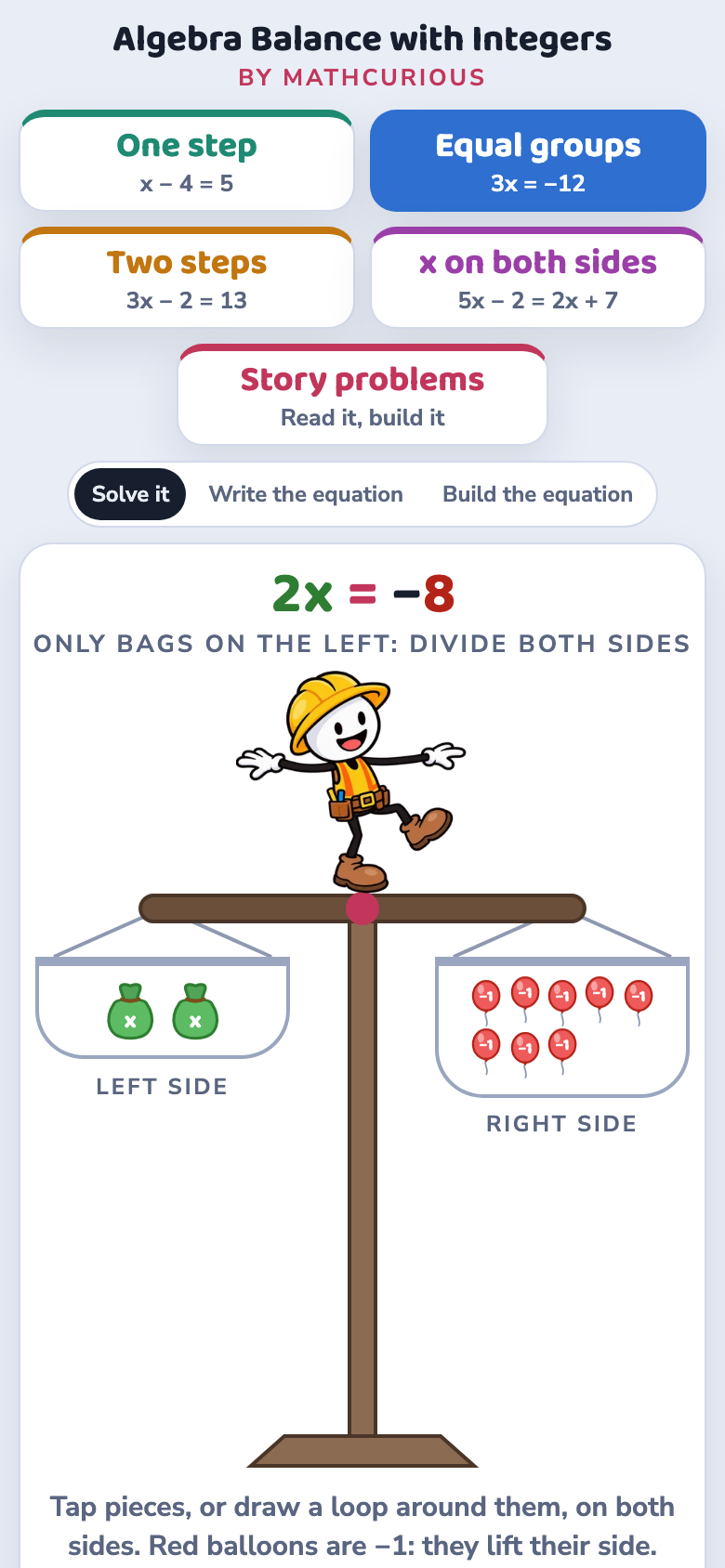
Then they divide both sides by 2. Each side splits into equal groups: one bag in each group on the left, four balloons in each group on the right.
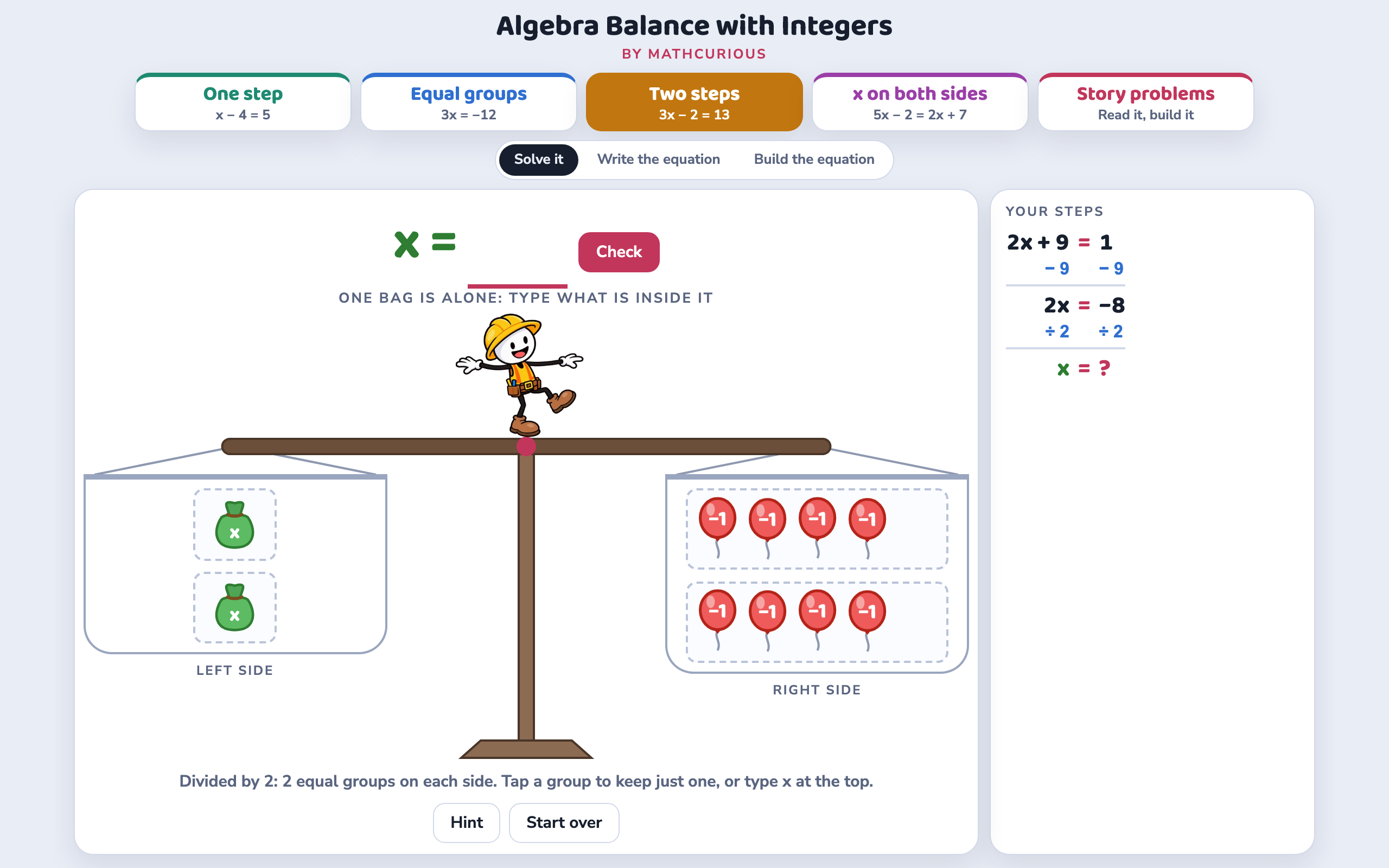
One bag balances four balloons, so x = −4. Every bag opens to show its balloons, and the check reads 2 × (−4) + 9 = 1.
Every move, in both directions
- Add to both sides: adds 1 tiles, which pop balloons.
- Subtract from both sides: adds −1 balloons, which pop tiles.
- Take away the same bags, tiles or balloons from both sides.
- Divide both sides into equal groups. A number that doesn't share equally gets a reason, like "3 bags can't share into 2 equal groups".
A move only shows up when it can be used on the equation on the scale, and students choose every number themselves.
x on both sides
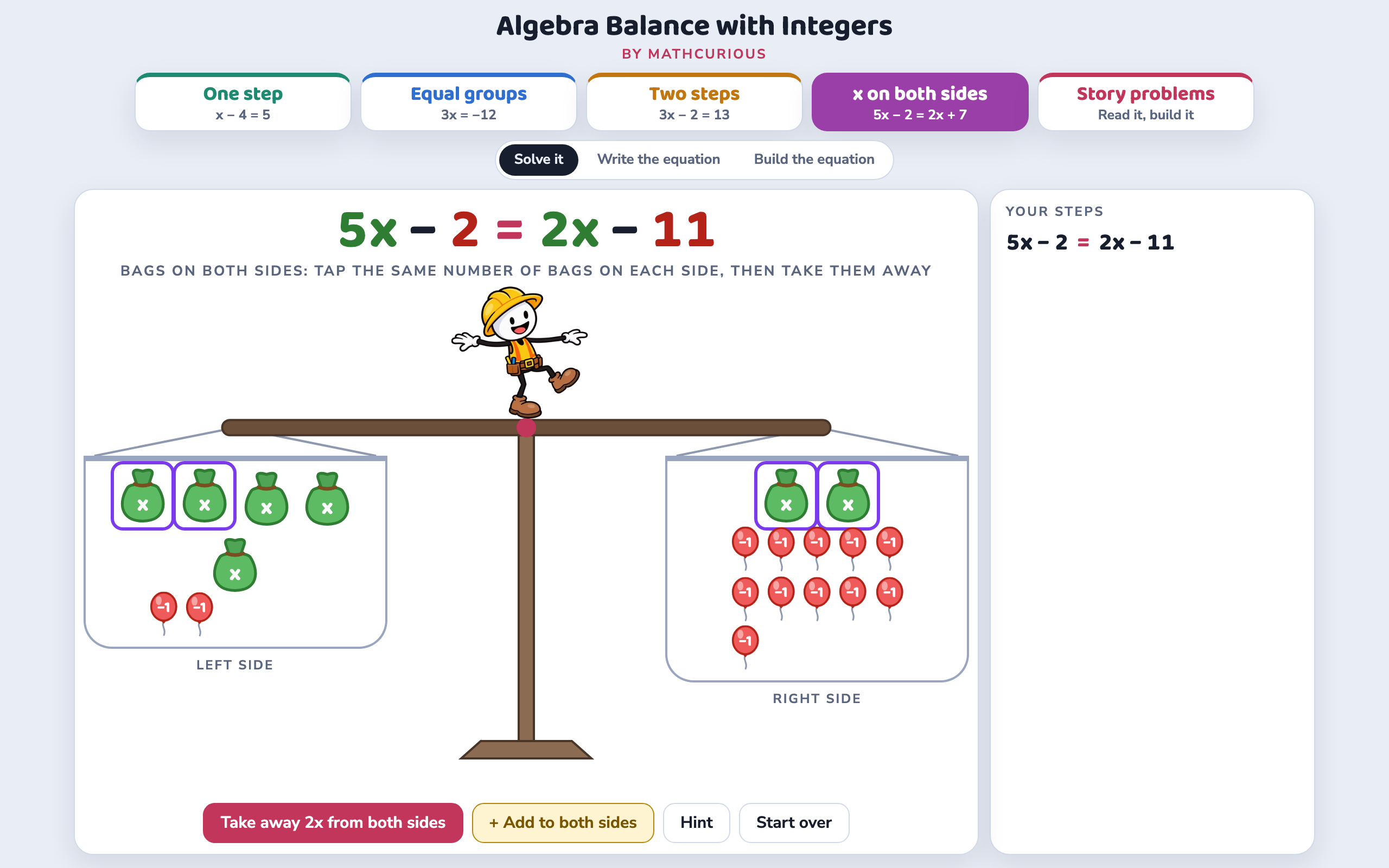
5x − 2 = 2x − 11 has bags and balloons on both sides. Students take away 2 bags from each side, add 2 to pop the balloons next to the bags, then divide by 3: x = −3.
Five levels
- One step: x + 7 = 3, x − 4 = −9
- Equal groups: 3x = −12
- Two steps: 2x + 9 = 1, 3x − 2 = 13
- x on both sides: 5x − 2 = 2x − 11
- Story problems: temperatures below zero, money owed, giving things away
Most rounds have a negative somewhere, in the answer, in the equation, or both, and every level makes new equations each time.
Story problems
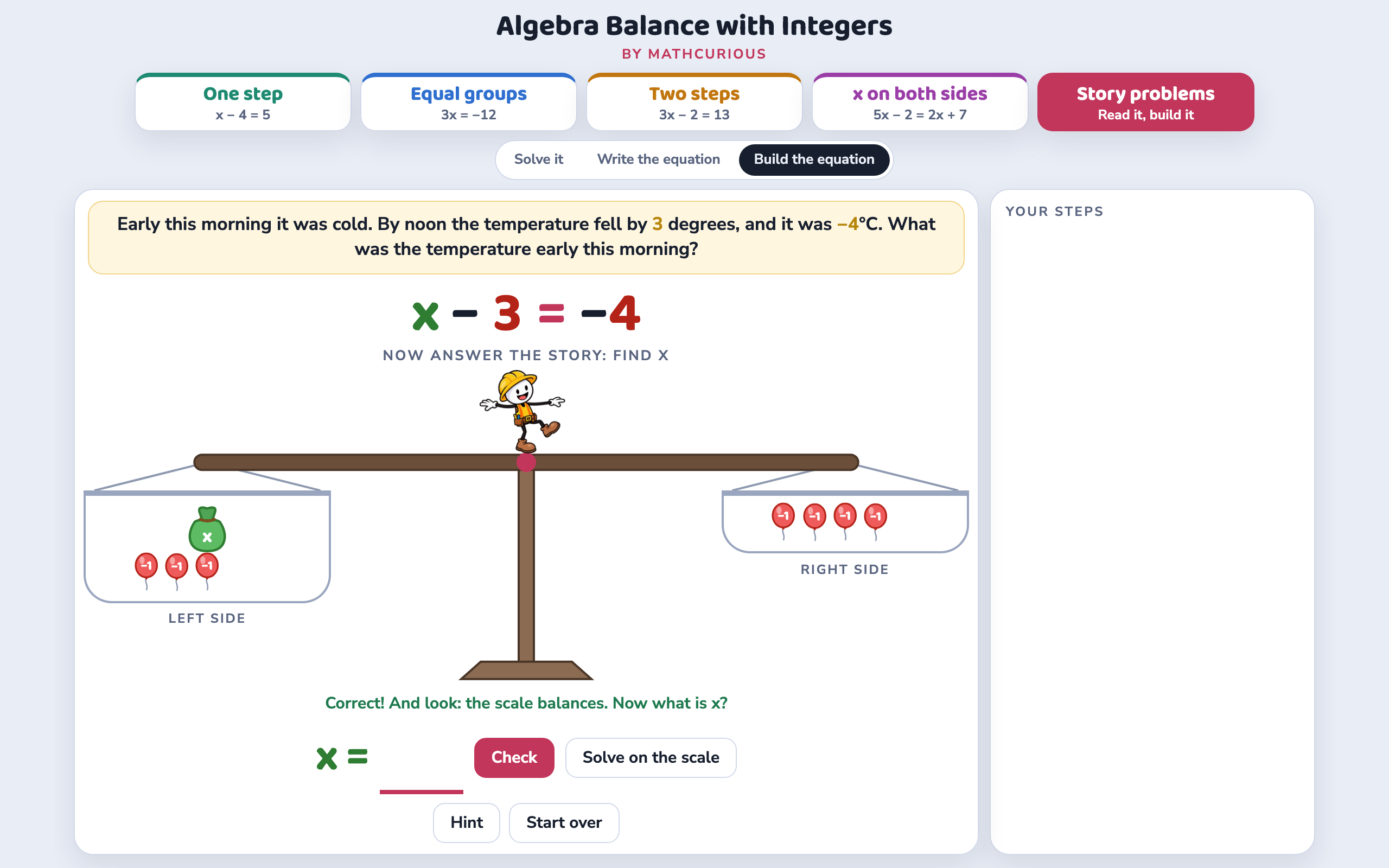
In Story problems, students read a short story, like a morning temperature that drops below zero or money spent with some of it borrowed, build it on the scale, and solve it. The answer is given back in the story's words: "It was −7°C early this morning."
Three ways to play
- Solve it: the equation is on the scale; get one bag alone.
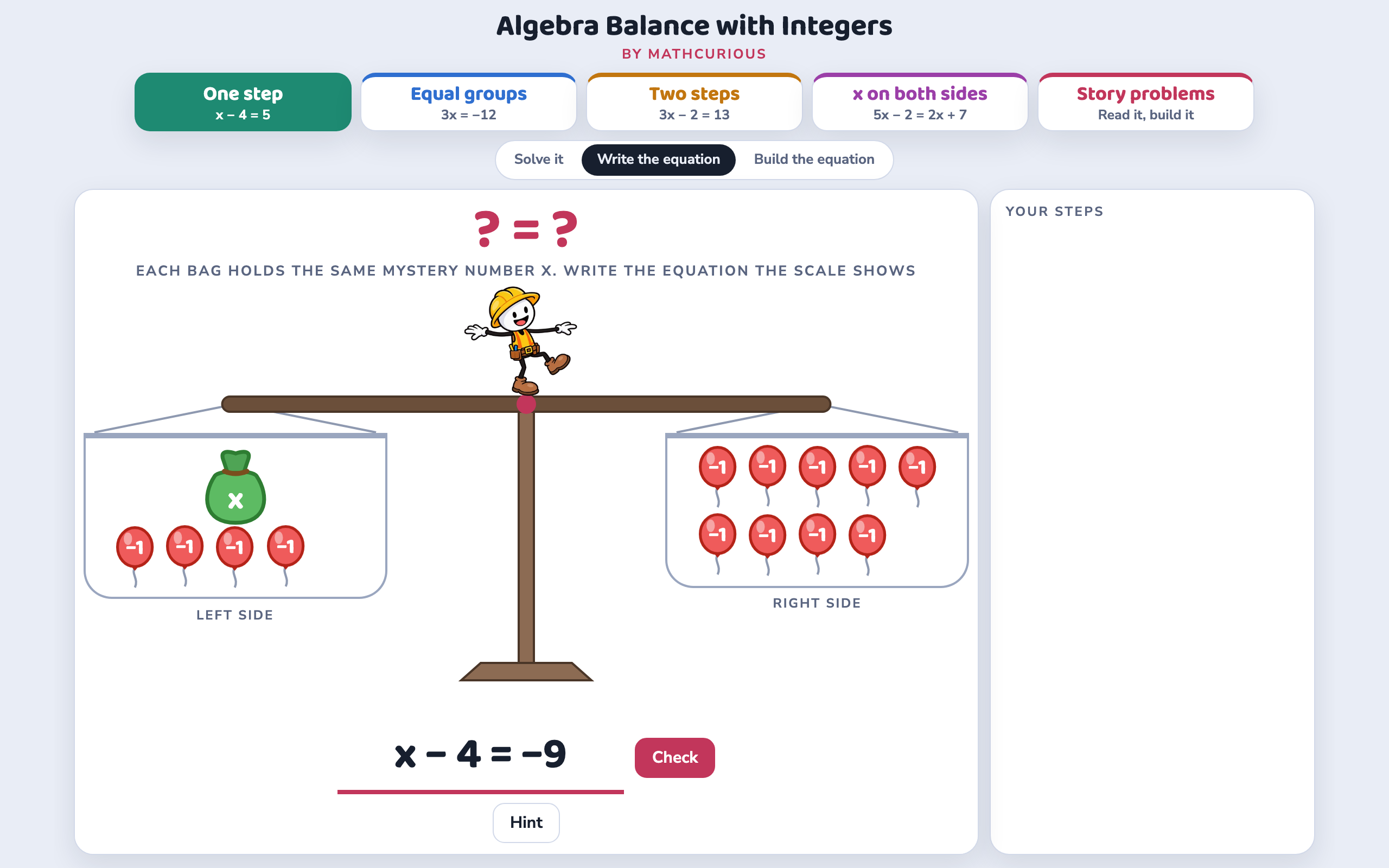
- Write the equation: the scale shows the pieces, and students type the equation, minus signs included, then find x.
- Build the equation: students put bags, tiles and balloons on the scale to match an equation or a story, then solve it.
Which balance tool is right for my class?
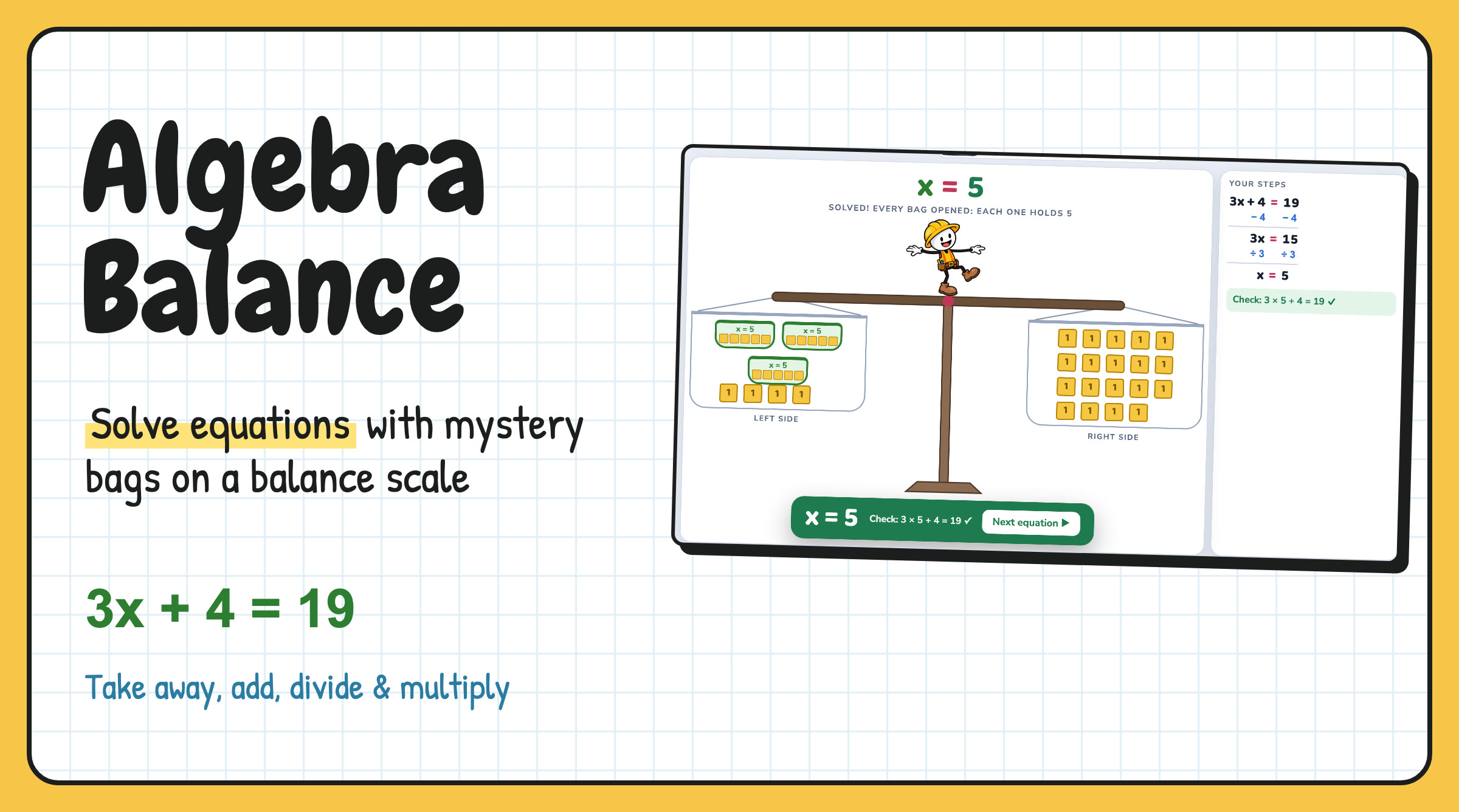
- Algebra Balance is the place to start: one-step and two-step equations with whole-number answers, including subtraction with x − 4 = 5.
- Algebra Balance with Integers is the next step: negative numbers anywhere and negative answers, with the same Solve, Write and Build modes, story problems and steps panel.
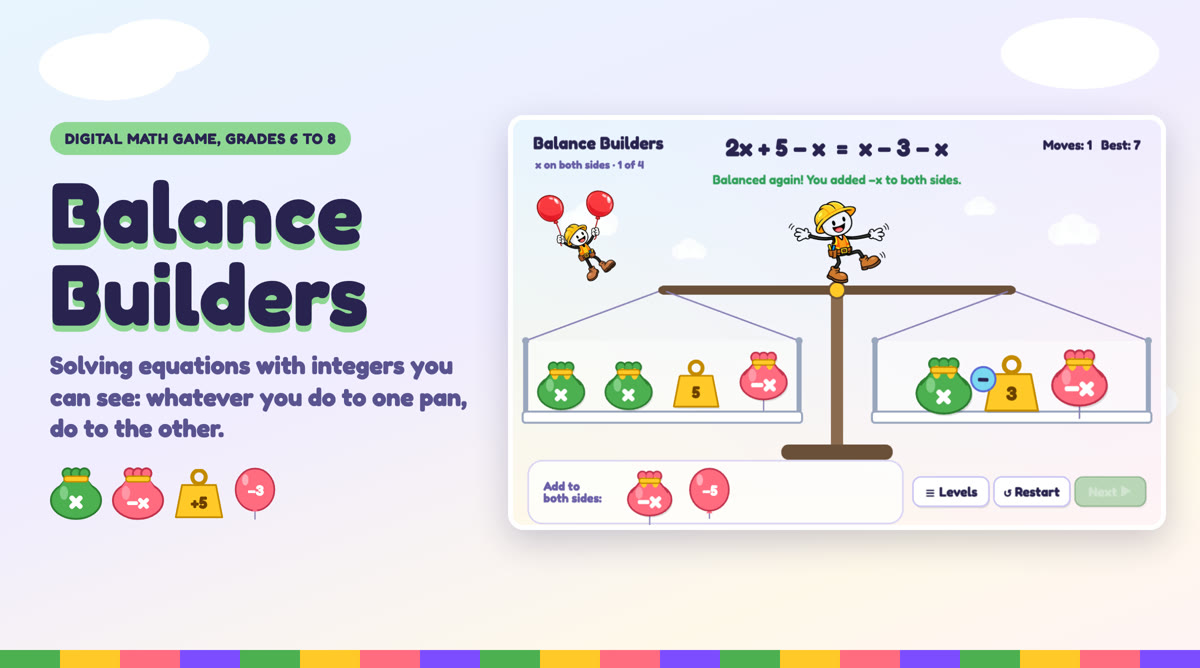
- Balance Builders is the game version: worlds and levels to play through, with −x bags and flips.
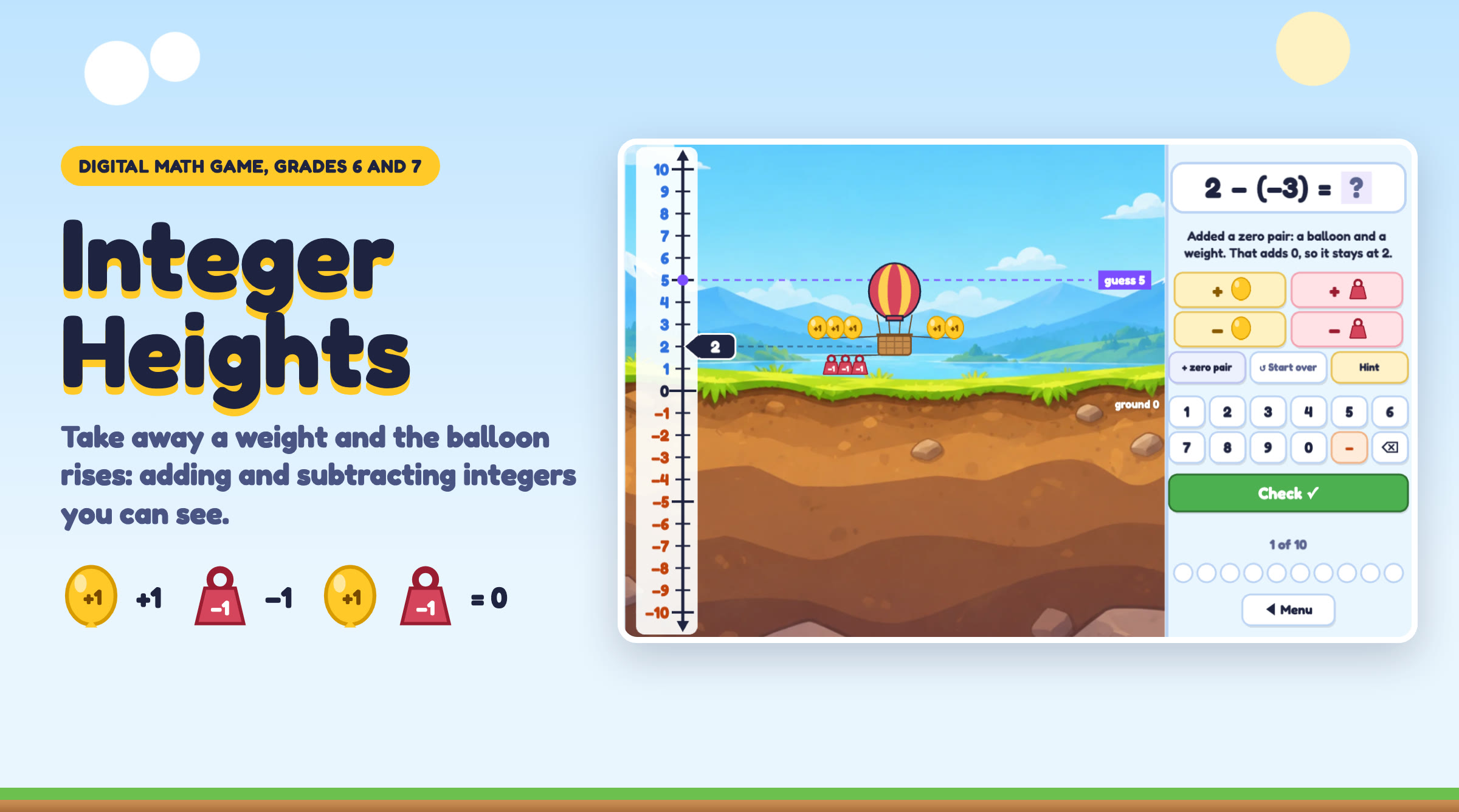
For integer addition and subtraction on its own, before equations, Integer Heights uses the same zero-pair idea.
What students practise
- One-step and two-step equations with integers
- Equations with x on both sides
- Negative solutions, and checking them by putting them back into the equation
- Adding and subtracting integers with zero pairs
- Writing equations from a model and from a word problem
Teaching tips
- Predict the sign. Before solving, ask "Is x more or less than 0?", then check against the answer.
- Name the zero pairs. Point at a tile and a balloon together and ask what they're worth.
- Tip it on purpose. Pick pieces on one side only and ask why the scale tipped.
- Read x from a group. After dividing, ask students what one group of balloons shows before they tap to keep it.
- Read the steps aloud as equations at the end, so the scale and the written method meet.
Standards
- 7.NS.A.1: add and subtract integers, including with zero pairs
- 7.EE.B.4a: solve equations of the form px + q = r
- 8.EE.C.7: solve linear equations, including those with the variable on both sides
Quick answers
Do students need accounts? No. It's a link, so there's nothing to sign in to.
What devices does it work on? Any device with a web browser, including Chromebooks, tablets and the classroom board.
How do students type a negative answer? With a minus sign, like −4. A missing or wrong sign gets a hint to check the sign.
Get Algebra Balance with Integers
Give students a scale they can see, and negative numbers stop being a source of sign mistakes.