Order of Operations, One Step at a Time: Order Up!
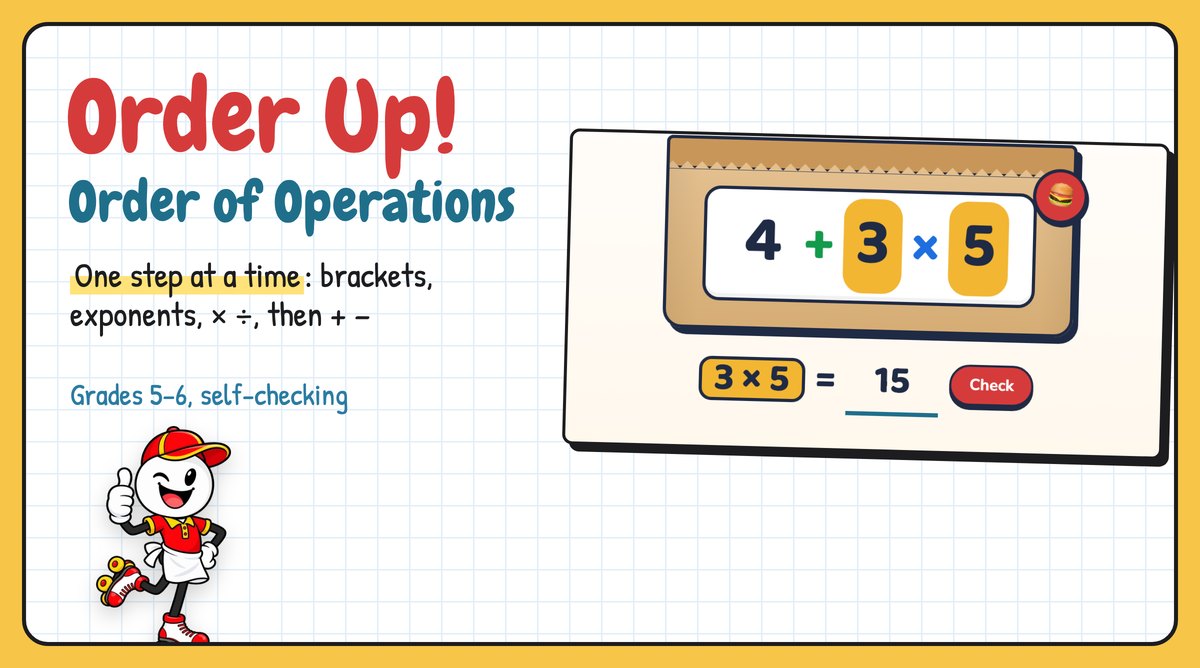
Order Up! is a digital tool for the order of operations. Students know the rule, but they still add before they multiply, work straight through brackets left to right, and turn 3² into 6. Usually, the whole expression goes on the page at once, and the mistake is buried somewhere in the middle.
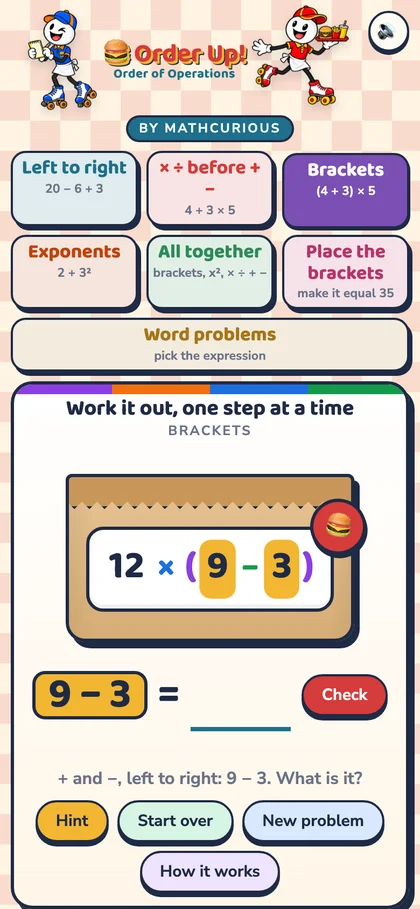
In Order Up!, students do one step at a time. They tap the two numbers to work on first, type the answer, and that part of the expression becomes one number. A wrong step is caught the moment it's picked, with a hint that says which rule comes first. And a diner crew of roller-skating servers cheers every right answer.
Watch it in action
The tool runs in any web browser. There's nothing to print or set up, and students don't need logins.
Pick the step
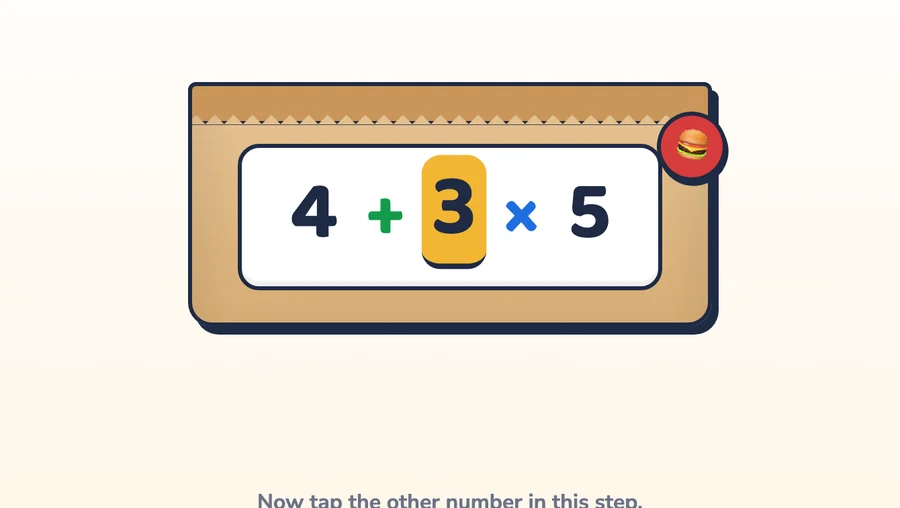
Each expression comes on a take-away bag. For 4 + 3 × 5, students tap the two numbers that go together first: 3 and 5. The first one they tap lights up, then the second.
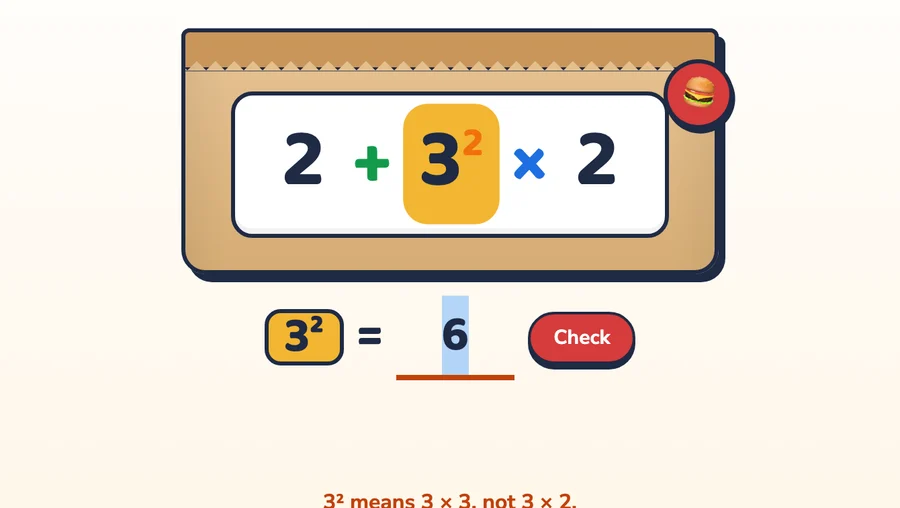
A number with an exponent is a step on its own: tapping 3² picks it straight away.
Solve it, and it collapses
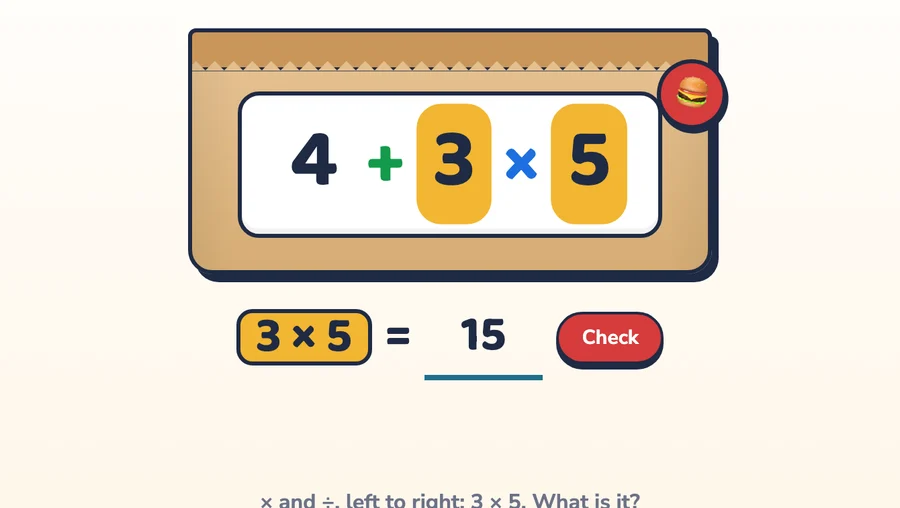
Once both numbers are picked, students type the answer: 3 × 5 = 15.
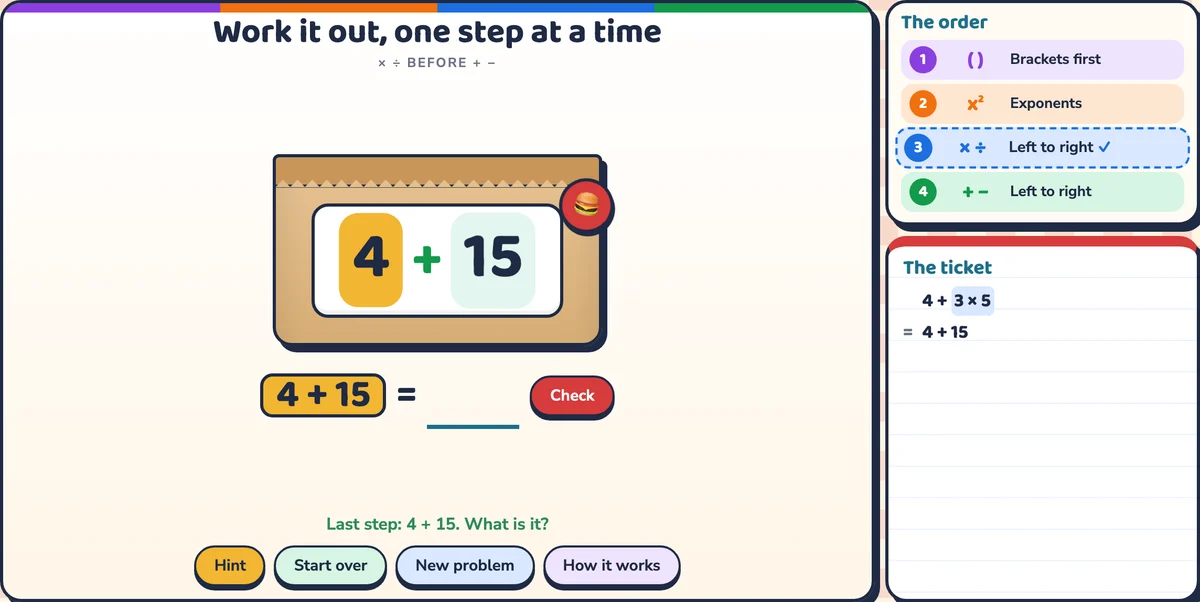
Then 3 × 5 becomes 15 on the bag, and the expression is 4 + 15. When only one step is left, it's picked for them, so they go straight to the answer: 19.
Hints for the mistakes students make
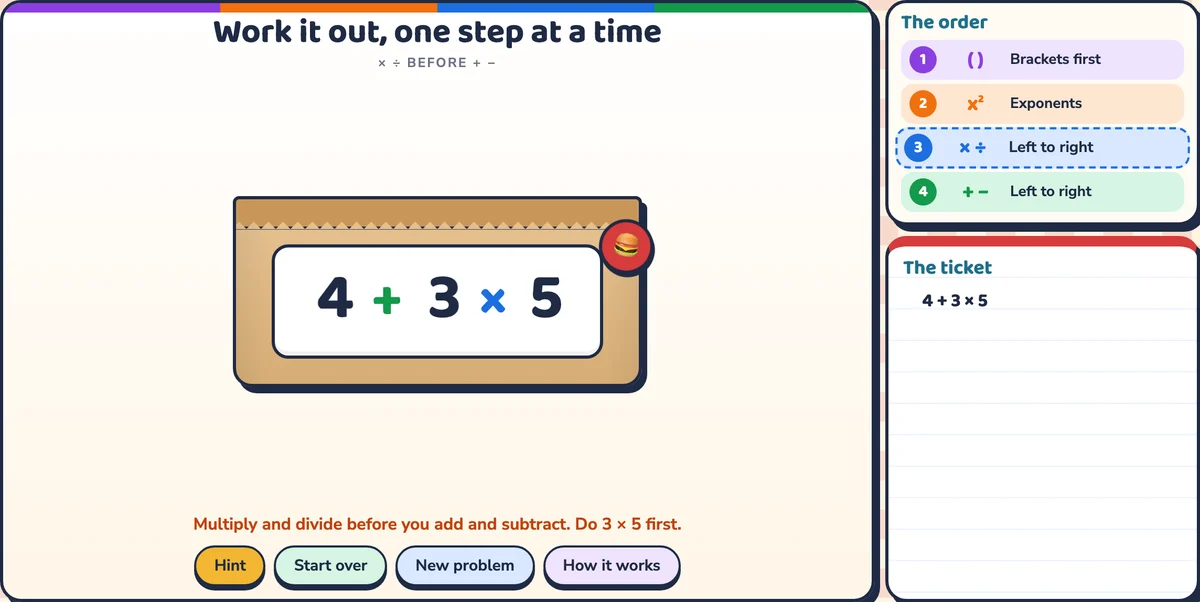
A student who taps 4 and 3 first gets "Multiply and divide before you add and subtract. Do 3 × 5 first." The rule the hint points to lights up on the order card.
Other hints catch multiplying before a division that comes first, starting outside the brackets, and picking two numbers that aren't in the same step. Typing 6 for 3² gets "3² means 3 × 3, not 3 × 2."
The order card
The four rules sit beside the expression, each in its own color: brackets in purple, exponents in orange, × ÷ in blue, and + − in green. The same colors run through the expression, so students can see which kind of step each sign is.
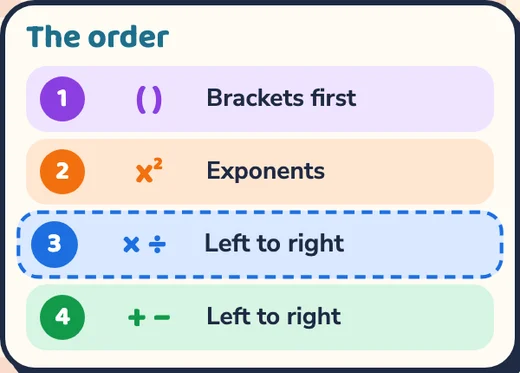
After each step, the card lights up the rule it used.
The ticket
Every step is written on the ticket, line by line, with the step taken highlighted in its rule's color. For 18 − (2 + 1)² ÷ 3, it's brackets, then the exponent, then ÷, then −:
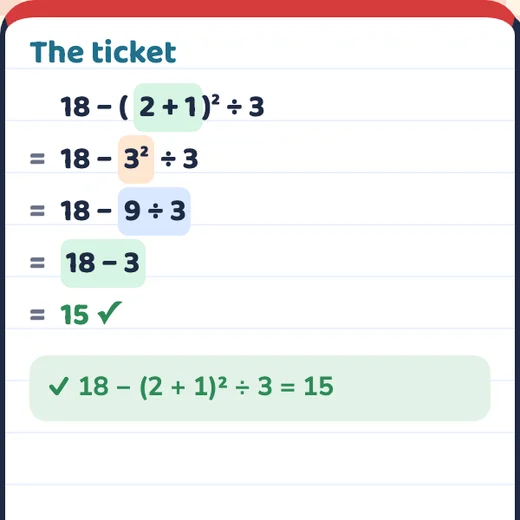
By the end, students have the written working, the same lines they'd write in a notebook.
How it works, for every level
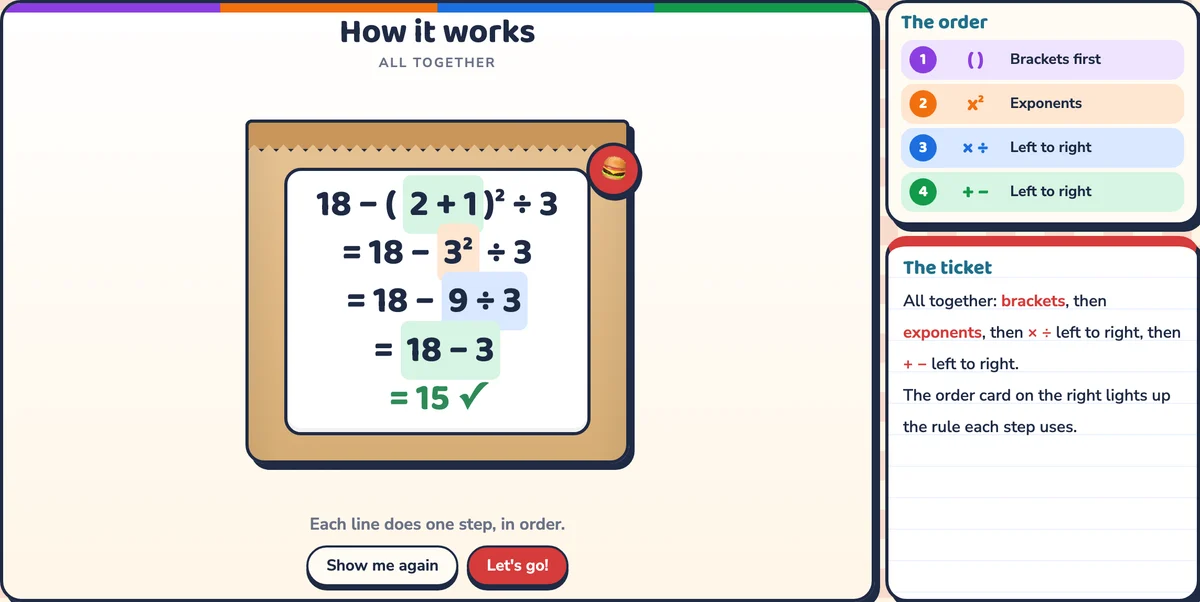
The first time a level is opened, it starts with a worked example: each line does one step, with the step marked, and a short explanation of the rule.
Seven levels
- Left to right: only + and −, or only × and ÷, like 20 − 6 + 3
- × ÷ before + −: like 4 + 3 × 5
- Brackets: like (4 + 3) × 5, including two sets of brackets
- Exponents: squares and cubes, on numbers and on brackets
- All together: all four rules, with brackets inside brackets
- Place the brackets: put in brackets to reach a target
- Word problems: pick the expression that matches, then work it out
Every level makes new problems each time.
Place the brackets
Here the expression is already written, and students put in the brackets. 2 + 5 × 5 is 27, but the target is 35. They tap the first and the last number to go inside the brackets, then check: (2 + 5) × 5 = 35.
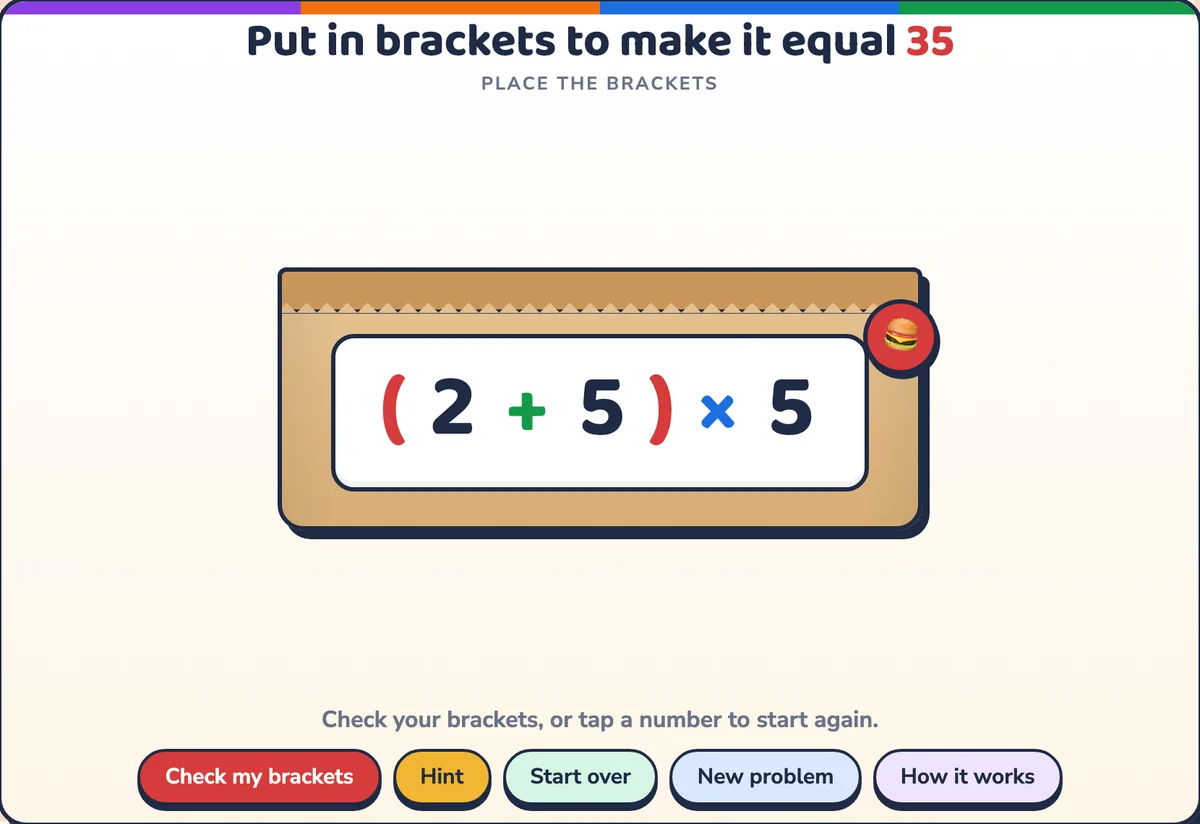
It turns the rule around: instead of following the order, students decide what has to happen first.
Word problems at the diner
"A burger costs $5 and fries cost $2. Maya buys 3 burgers and 3 fries. What's the total?" Students pick the matching expression first.
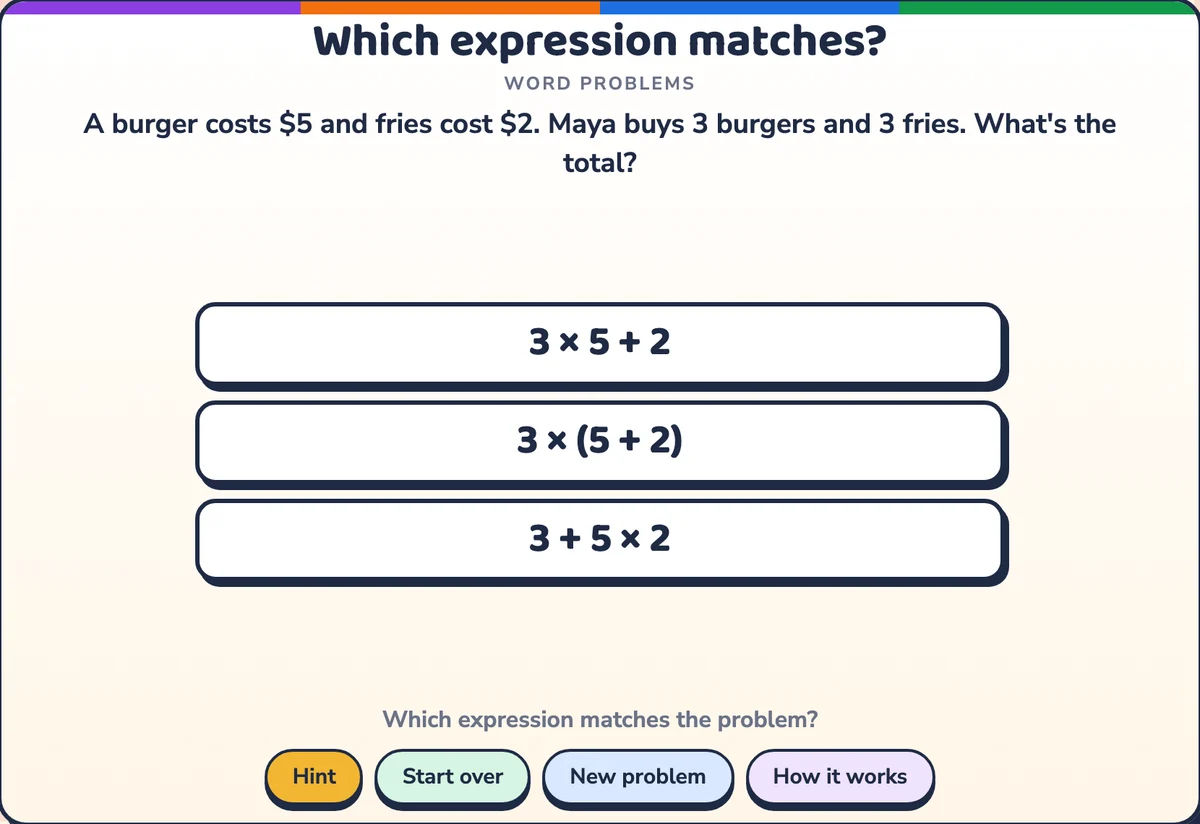
3 × 5 + 2 only adds the fries once, and gets "Each meal is a burger and fries, $5 + $2, and there are 3 meals." The right one, 3 × (5 + 2), is then worked out step by step.
The diner crew
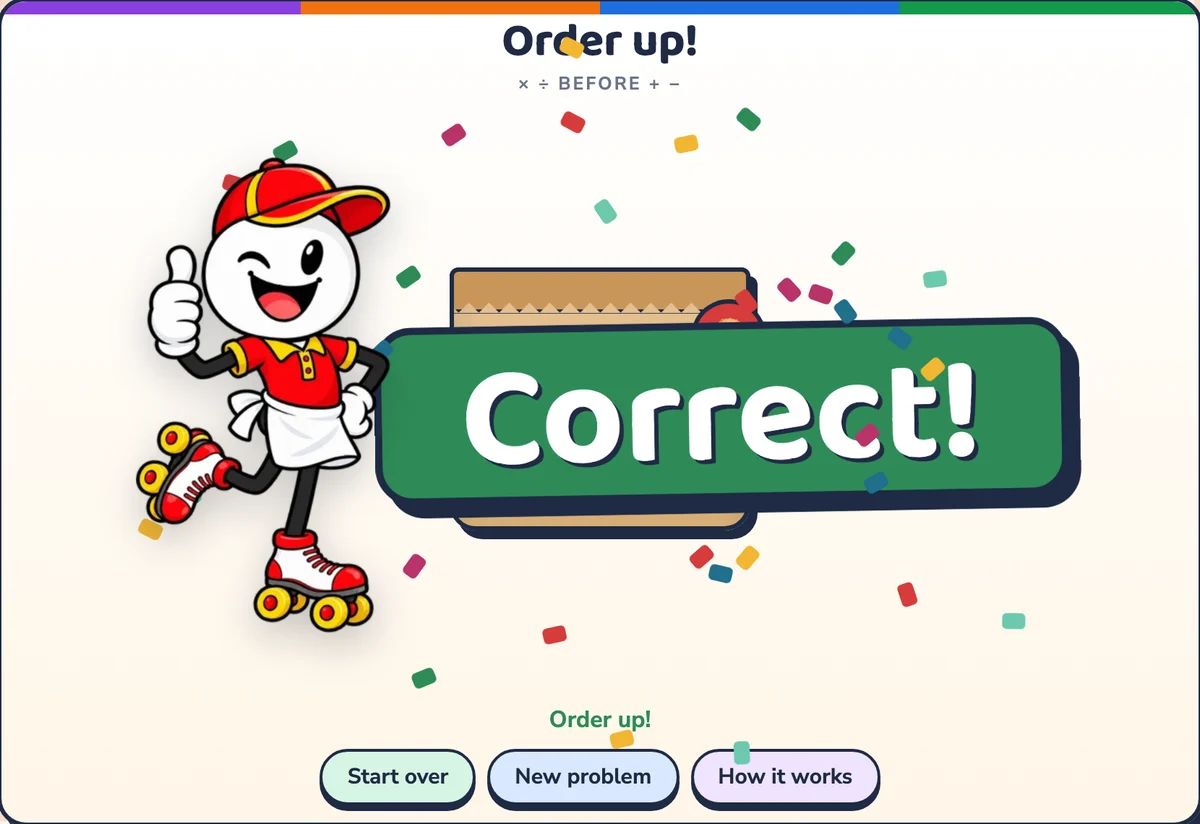
Two servers wave from beside the title, two more skate in the corners on bigger screens, and every right answer gets a big Correct! from the crew.
What students practise
- Evaluating expressions with the order of operations
- Working left to right through + − and through × ÷
- Brackets, including brackets inside brackets
- Whole-number exponents
- Seeing how brackets change the value of an expression
- Writing an expression that matches a word problem
Teaching tips
- Model How it works on the class board before students try a level.
- Before each step, ask "Which rule comes next? Look at the order card."
- Do it the wrong way on purpose. Work 4 + 3 × 5 left to right on the board, then compare with the tool.
- In Place the brackets, ask "What has to happen first to make the target?"
- Read the ticket aloud at the end, so the steps and the written method meet.
Standards
- 5.OA.A.1: use parentheses and brackets in numerical expressions, and evaluate them
- 5.OA.A.2: write simple expressions and interpret them
- 6.EE.A.1: write and evaluate expressions with whole-number exponents
- 6.EE.A.2c: evaluate expressions using the order of operations
Quick answers
What grades is it for? Grades 5–6, and it's good review in grade 7.
Do students need accounts? No. It's a link, so there's nothing to sign in to.
What devices does it work on? Any device with a web browser, including Chromebooks, tablets, phones and the classroom board.
Can I turn the sound off? Yes, with the speaker button at the top. The tool remembers it.
Get Order Up!
One step at a time, in the right order, and the rule starts to stick.